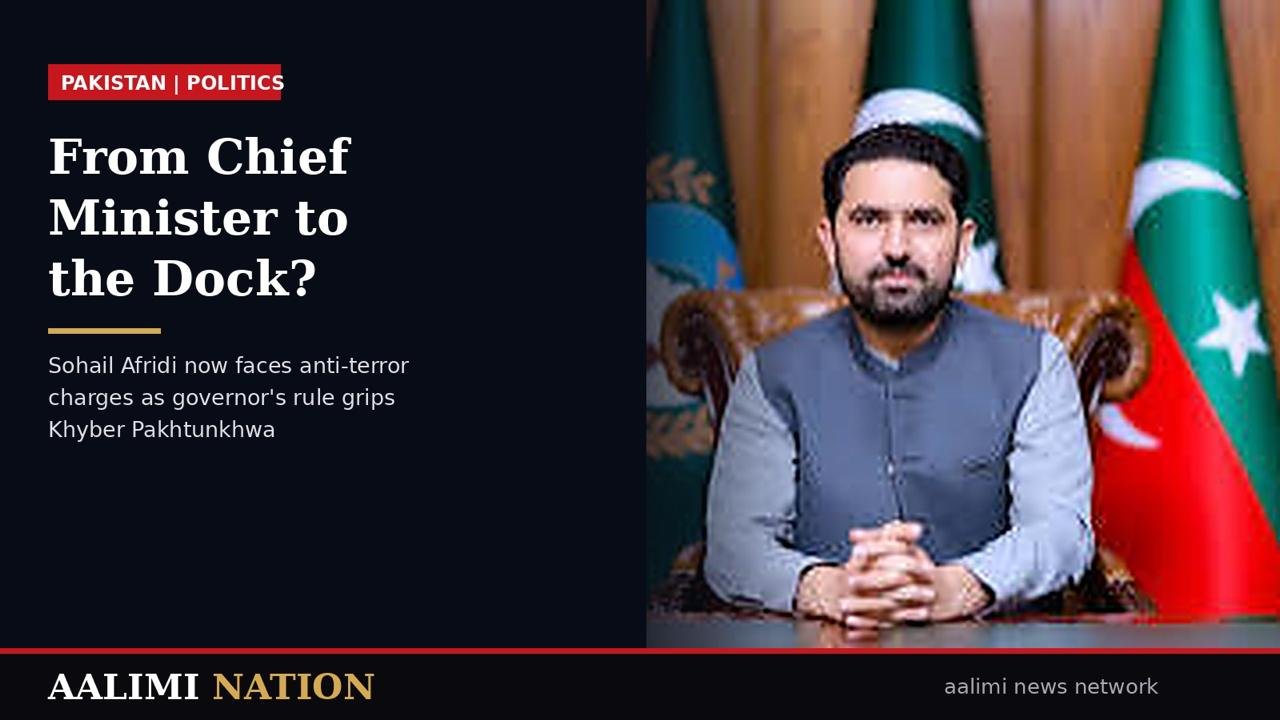
PESHAWAR / NEW DELHI — Barely a year ago, Sohail Afridi was sworn in as the youngest chief minister in the history of Khyber Pakhtunkhwa, a 36-year-old from the tribal hills of Bara who had climbed from student activism to the head of Pakistan's most restive province. Today, he sits in an undisclosed location under what the government calls "preventive custody," his administration dissolved, his family petitioning a court simply to learn where he is — and, according to one Pakistani political analyst, he may be staring at the prospect of spending the rest of his life in prison.
On October 11, President Asif Ali Zardari, acting on the advice of Prime Minister Shehbaz Sharif, invoked Articles 232 and 234 of the Constitution to declare a state of emergency in Khyber Pakhtunkhwa and impose governor's rule. The Pakistan Tehreek-e-Insaf (PTI) government — which held a commanding two-thirds majority in the 145-seat provincial assembly — ceased to exist with the stroke of a pen. Its powers passed to Governor Faisal Karim Kundi, a Pakistan Peoples Party politician and an ally of the ruling coalition.
Islamabad justified the move on security grounds. Federal Law Minister Azam Nazeer Tarar told reporters the emergency was about law and order and the fight against terrorism, while Information Minister Attaullah Tarar went further, accusing the PTI provincial government of colluding with militant groups — an allegation for which no evidence has yet been made public. Violence in the province has indeed surged: an Islamabad-based think tank recorded more than 1,200 militant attacks nationwide in the first nine months of 2026, the bulk of them in Khyber Pakhtunkhwa and Balochistan.
But the timing was impossible to ignore. Afridi had spent the previous week leading a PTI "long march" from Lakki Marwat toward Islamabad to demand the release of the party's jailed founder, former prime minister Imran Khan. Talks between the government and PTI had collapsed days earlier.
"Preventive custody" — or arrest?
Within hours of the proclamation, PTI leaders claimed Afridi had been seized. The federal government stayed silent for nearly 30 hours before Minister of State for Interior Talal Chaudhry confirmed that the chief minister and several cabinet members had been "taken into preventive custody." Those with cases against them, he added, would be charged and tried; the rest would be released. Police officials put the number of detained senior PTI figures at eight, including provincial party president Junaid Akbar and Assembly Speaker Babar Saleem Swati.
Afridi's family tells a darker story. In a habeas corpus petition filed before the Peshawar High Court on Tuesday, his brother, Muhammad Aamir, alleged that the chief minister had been taken from the Chief Minister's House around 2pm on October 11 by armed, masked men in the presence of Peshawar's top police officer. The petition described the family as gravely worried about "his safety, physical integrity and continued liberty," and asked the court to locate him, produce him, and order an independent judicial inquiry.
The case that changes everything
The crucial development came on Tuesday, in a Peshawar anti-terrorism court. Prosecutors submitted a supplementary charge sheet formally adding Afridi as an accused in the May 2023 ransacking and burning of the Radio Pakistan building — one of the most notorious episodes of the nationwide unrest that followed Imran Khan's arrest on May 9, 2023.
The case was registered under multiple provisions of the Pakistan Penal Code and the Anti-Terrorism Act. Afridi has been named alongside former provincial ministers Taimur Saleem Jhagra and Kamran Bangash and two other PTI figures, on the strength of forensic reports by the Punjab Forensic Science Agency and the National Database and Registration Authority that matched their faces to video footage of the riot. PTI disputes the authenticity of those clips. Seventy-five others are already on trial in the case; the hearing has been adjourned to October 28.
It is this charge that underpins the analyst's grim forecast. Pakistan's anti-terrorism courts have shown little hesitation in handing down maximum sentences in May 9-related cases. In January this year, an Islamabad anti-terrorism court sentenced several journalists and social media personalities to life imprisonment for inciting violence during the 2023 protests. History offers its own precedent: a former prime minister, Nawaz Sharif, was himself handed a life term by an anti-terrorism court in 2000.
Afridi's legal exposure does not end there. He was already the subject of non-bailable arrest warrants issued by Islamabad courts in cases linked to PTI's October 2024 and November 2024 protests — warrants he had long avoided while shielded by office.
For the government, the arrests are a matter of state security, not politics. Federal sources have told Pakistani media that Afridi's return to the chief minister's office is now all but ruled out, even if governor's rule eventually lapses.
For PTI, the sequence — dissolution, detention, and a fresh terrorism charge within 72 hours — reads as a carefully choreographed decapitation of the party's last bastion of power. PTI spokesperson Sheikh Waqas Akram demanded the "immediate and unconditional release" of Afridi and all detained party leaders. Junaid Akbar, before his own detention, described the arrests as evidence of creeping "fascism." Party chairman Gohar Ali Khan has challenged the emergency in the Peshawar High Court and asked why, if militancy is concentrated in a dozen districts, an entire province had to lose its elected government.
Constitutional experts remain divided. Lahore lawyer Hassan Abdullah Niazi has argued that the assembly and its chief minister are not permanently removed but rendered "dysfunctional until the emergency is lifted," at which point they must be restored. Yet both houses of Parliament, where the ruling coalition holds a majority, have already passed resolutions endorsing the emergency — and once ratified by a joint sitting, the Constitution sets no fixed end date for it.
Several dates now loom large: the Peshawar High Court's response to the habeas petition, Gohar's constitutional challenge, and the October 28 hearing in the Radio Pakistan case. Each will test whether Pakistan's courts are willing to scrutinise the state's sweeping new powers — or simply to process the cases placed before them.
Even voices from outside the current PTI leadership have cautioned the government. Former finance minister Asad Umar asked this week why every leader Islamabad arrests seems to emerge a hero in the public eye, noting that whatever one thinks of Afridi's performance, many Pashtuns now see him as one.