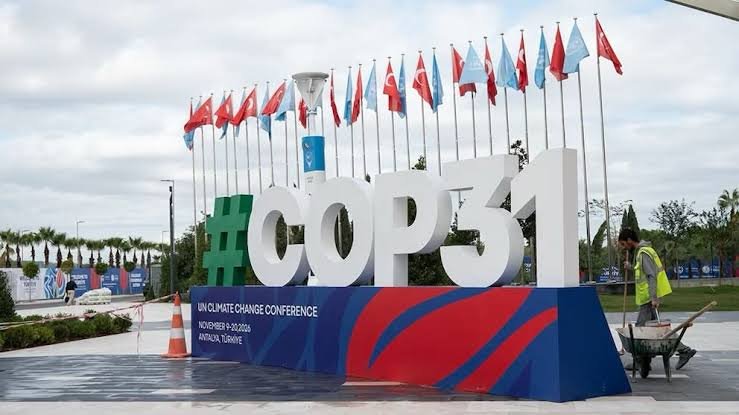
ANTALYA, November 22 (Aalimi Nation) – The COP31 United Nations climate summit in Antalya, Türkiye, ran into a second day of overtime on Sunday as delegates remained divided over whether the final agreement should address fossil fuels.
The two-week talks were originally due to end on Friday, November 20. COP31 President Murat Kurum, who is also Türkiye's environment minister, told a late-night plenary session on Saturday that he believed a text had been put forward "which all the parties can agree upon," and said the conference would reconvene on Sunday morning to approve it.
The latest wording had not been made public, and it was unclear whether negotiators received it overnight, which would leave only a few hours to raise objections. Delegations had until 03:00 GMT on Sunday to submit objections, with a session scheduled for 06:00 GMT to begin approving the deal.
An earlier draft drew strong condemnation for not mentioning fossil fuels. An opening draft from Australia on November 17 had called for a faster phase-out of fossil fuels. A slimmer version circulated on Thursday removed every mention of them after Saudi Arabia and other major oil and gas producers objected. Kurum said he believed concerns about fossil fuels and about financing climate adaptation for developing countries had been addressed. A business coalition said the word "fossil" does not appear anywhere in the revised text.
Negotiators have disagreed on how much effort countries should make to move away from coal, oil and gas, and on whether to encourage industrial carbon capture and storage. They have also differed on whether the expansion of electricity supply should rely only on renewables such as wind and solar or also include natural gas and coal. A coalition led by France and Panama is reported to be pushing to restore the fossil fuel language, while opposition is led by producers including Saudi Arabia and Russia.
Vulnerable nations and small island states argue that wealthy countries, which caused the climate crisis, should contribute more to funds for disaster recovery and adaptation. Tuvalu's Environment Minister Maina Talia pointed to growing "mistrust and frustration" among civil society, Indigenous peoples and climate-vulnerable countries.
In a letter to co-hosts Türkiye and Australia on Saturday, 100 civil society groups warned the summit was on course to be one of the most disappointing in UN history, with only hours left to keep it from becoming a low point in three decades of negotiations. Teresa Anderson of ActionAid International said: "No one knows what is happening behind closed doors, or what the outcome of COP31 will be." Harjeet Singh, a strategic adviser to the Fossil Fuel Treaty Initiative, said "nobody knows how long this will go on."
The UN said before the talks that the world would likely exceed the 2015 Paris Agreement goal of limiting warming to 1.5°C above pre-industrial temperatures. Experts say emissions from coal, oil and gas must be cut sharply and urgently to avoid the worst effects of warming. The United States did not participate directly in the talks, and the next summit is due in Addis Ababa, Ethiopia, in November 2027. Whether any agreement was approved on Sunday was not confirmed at the time of writing.