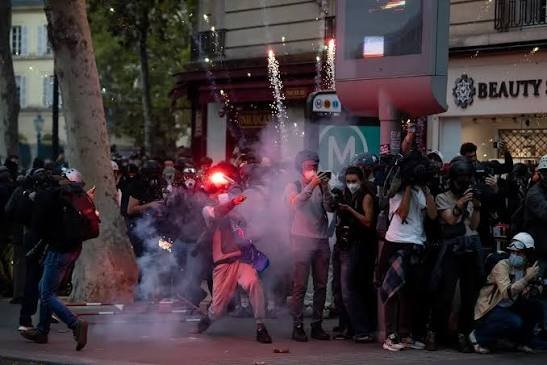
PARIS, October 24 (Aalimi Nation) – France saw a second consecutive weekend of nationwide protests on Saturday, with the government deploying up to 70,000 police officers and gendarmes, about 20 per cent more than a week earlier, after the worst unrest in years.
Interior Minister Laurent Nuñez said the force would be backed by helicopters, armoured vehicles and water cannon. A coalition of Yellow Vest groups, trade unions and students planned marches over the cost of living and purchasing power, and the Yellow Vests announced more than 700 actions across the country.
France protests: bans and incidents
Authorities restricted demonstrations in several cities. Protests in the city centres of Montpellier, Rouen, Nice and Lyon were banned, and marches planned in Marseille and Lyon were prohibited or put under strict conditions, with local curfews imposed in some places. In Lyon, police used tear gas to disperse about 150 people gathered in an area where demonstrations were barred.
In Paris, the police prefecture changed the approved march route at short notice, moving it to run from Porte d'Italie to Porte de Vincennes between 1 pm and 7 pm. Organisers said they would keep to the original route towards Bastille, and left-wing leaders argued the change was intended to disrupt the marches.
Disruption was widespread in the capital. At least 24 metro stations were closed, the Louvre and the Musée d'Orsay shut for the day, and Art Basel Paris cancelled its weekend programme. Shops in the centre were boarded up.
In Orléans, where the far-right National Rally held a party congress marking the start of its presidential campaign, the local prefecture put the crowd of counter-demonstrators at 11,000.
How the protests began
The movement began in mid-September, when high school students blockaded schools over dilapidated buildings, teacher shortages and what they see as an unfair university admissions system. It has since widened into broader anger over living costs, inequality and the presidency of Emmanuel Macron.
On October 17, largely peaceful marches turned violent in places, with looting and clashes. Official figures put the number of people taken into custody at more than 2,000, and thousands of businesses were reported damaged or ransacked. Authorities estimated that 550,000 people marched that day.
Government response and criticism
On Friday, Macron met representatives of secondary school pupils for the first time since the protests began and chaired a defence council meeting. He promised more teachers and a deep overhaul of Parcoursup, the university admissions platform. The student representatives left the talks saying they were not enough, and urged protesters to continue until the government puts forward concrete proposals. Macron postponed a planned trip to Nigeria and Senegal.
Amnesty International France criticised the bans and the heavy security posture, saying the escalation "comes at the expense of our freedoms."
The political stakes are rising. France holds a presidential election in about six months, and Macron, who is barred from seeking a third consecutive term, leaves office in 2027. Recent opinion polls show National Rally leader Marine Le Pen ahead by a wide margin.