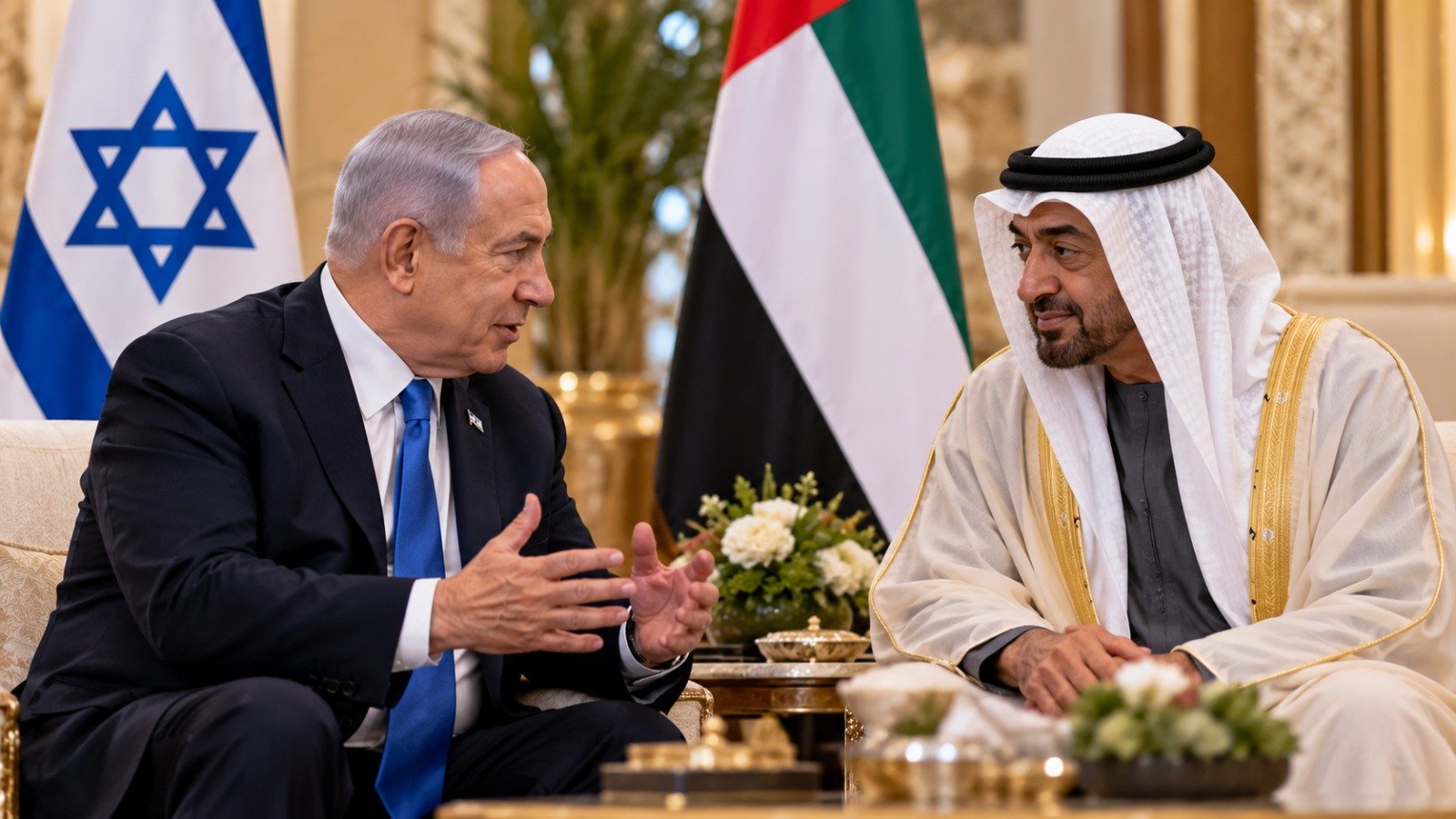
Israeli Prime Minister Benjamin Netanyahu made an unannounced trip to Abu Dhabi on Sunday, travelling by private aircraft for a meeting with UAE President Sheikh Mohamed bin Zayed Al Nahyan.
The visit was initially kept out of the public domain and was only officially acknowledged by the UAE on Monday through the state-run Emirates News Agency, WAM. Netanyahu’s office subsequently confirmed that the visit had taken place at the invitation of Sheikh Mohamed.
The official explanation was relatively broad. Netanyahu’s office said the discussions focused on strengthening relations between Israel and the UAE and addressing regional challenges. WAM similarly reported that the two leaders discussed bilateral relations and ways to strengthen and develop them.
But the circumstances surrounding the meeting point to several overlapping issues.
Iran appears to have been a major issue
Three senior Israeli officials told Reuters that the meeting lasted about six hours and that Iran was a major focus of the discussions.
That is significant because the UAE and Israel have been dealing with a rapidly changing regional security environment following the recent conflict involving Iran. The UAE has sought to strengthen its security relationships with both Israel and the United States, while maintaining its own diplomatic channels across the region.
The presence of senior Israeli security officials also underlined the security dimension of the visit.
Netanyahu was accompanied by the head of Israel’s National Security Council, Mossad chief Roman Gofman, his military secretary and his foreign-policy adviser, according to the Israeli prime minister’s office.
The composition of the delegation suggests that the meeting was not simply a ceremonial diplomatic encounter, although neither government has published a detailed account of the discussions.
The October 7 warning controversy
The visit also took place against the backdrop of an increasingly contentious dispute inside Israel over what Netanyahu allegedly knew before the Hamas-led attack of October 7, 2023.
A recent investigation by Haaretz, based partly on reporting for a forthcoming book, alleged that Sheikh Mohamed contacted Netanyahu roughly 10 days before the attack and warned him that Hamas leader Yahya Sinwar was preparing a major operation that could cause significant bloodshed and destabilise the region.
An Emirati source familiar with the alleged conversation subsequently confirmed to The Times of Israel that a phone call between the two leaders had taken place.
Netanyahu’s office has strongly rejected the allegation.
His office said that the reports were false and that Netanyahu had not received a warning from the UAE before October 7. It further maintained that any relevant intelligence would have been transmitted through official intelligence channels.
The UAE has also stopped short of confirming the alleged conversation.
In a statement issued earlier this month, its Foreign Ministry said it did not comment on media reports or speculation concerning conversations between government leaders. It nevertheless said that UAE and Israeli government agencies had maintained open and direct communication channels and that relevant intelligence had been communicated between the appropriate authorities when necessary.
A UAE official source later told The National that security matters are discussed with other countries through the relevant agencies rather than at the level of national leaders.
That leaves an important distinction: there are published allegations and sources supporting the existence of a warning, but there is no public official confirmation from Abu Dhabi that Sheikh Mohamed personally delivered such a warning to Netanyahu.
Did Netanyahu ask for a denial?
This is one of the most sensitive aspects of the visit.
Haaretz reported that Netanyahu asked Sheikh Mohamed during the Abu Dhabi meeting to deny reports concerning the alleged pre-October 7 phone conversation and the warning attributed to the Emirati president. AP also reported that Netanyahu travelled to Abu Dhabi to urge Sheikh Mohamed to publicly deny the report.
However, Netanyahu’s office has disputed that account, saying the visit was focused on strengthening relations and regional challenges.
Because neither side has released a detailed transcript or account of the private discussions, the reported request remains an attributed claim rather than an independently established fact.
Why the timing matters
The timing of the visit is politically significant.
Israel is scheduled to hold elections for the 26th Knesset on October 27, 2026, meaning the Abu Dhabi meeting took place roughly one month before Israelis are due to vote. The Knesset was dissolved on July 17, triggering the election timetable.
The October 7 warning controversy has therefore become intertwined with Israel’s domestic political debate over responsibility for the security failures preceding the Hamas attack.
That does not establish that the election was the reason for Netanyahu’s trip. The official explanation points instead to bilateral relations and regional security. But the proximity of the election means the political implications of the meeting are difficult to separate from its diplomatic significance.
A relationship that has become strategically important
Israel and the UAE established formal diplomatic relations under the Abraham Accords in 2020.
Since then, the relationship has developed beyond formal diplomatic recognition, encompassing security, technology, trade and strategic coordination.
The recent regional confrontation with Iran has added another layer. Reuters reported that the UAE has strengthened its relationships with both Israel and the United States following attacks during the Iran conflict. The UAE’s relationship with Israel also provides Abu Dhabi with a channel to Washington and an additional means of engaging on regional security issues.
Israeli media have also reported that Israel temporarily provided the UAE with an Iron Dome air-defence system and personnel during the recent Iran conflict, although the precise operational arrangements have not been publicly detailed by both governments.
Why keep the visit secret?
The secrecy itself is noteworthy.
Israeli reporting said Netanyahu travelled on a private aircraft and that the trip was intended to remain undisclosed until the delegation had returned to Israel. The delegation included senior security officials, making operational security one possible explanation for the confidentiality.
Netanyahu’s office later criticised the early publication of details about the trip, saying that disclosure occurred while the prime minister and his delegation were still outside Israeli airspace and had created security concerns.
At the same time, the secrecy has fuelled speculation because the meeting occurred amid three sensitive developments: the Iran conflict, the October 7 warning controversy and the approaching Israeli election.
What is known — and what remains unclear
What can be established from official statements and multiple independent reports is that Netanyahu travelled to Abu Dhabi, met Sheikh Mohamed and held extensive discussions.
The UAE says the two sides discussed bilateral relations and ways to strengthen them. Netanyahu’s office says the visit addressed relations and regional challenges, while senior Israeli officials told Reuters that Iran was a major focus.
What remains unclear is the full substance of the private conversation.
There has been no public transcript, detailed joint statement or comprehensive account from either government explaining whether the October 7 warning controversy was discussed directly.
For now, the Abu Dhabi meeting therefore appears to have served several overlapping purposes: maintaining the Israel-UAE strategic relationship, discussing the regional security environment — particularly Iran — and managing a politically sensitive dispute surrounding what happened in the days before October 7.