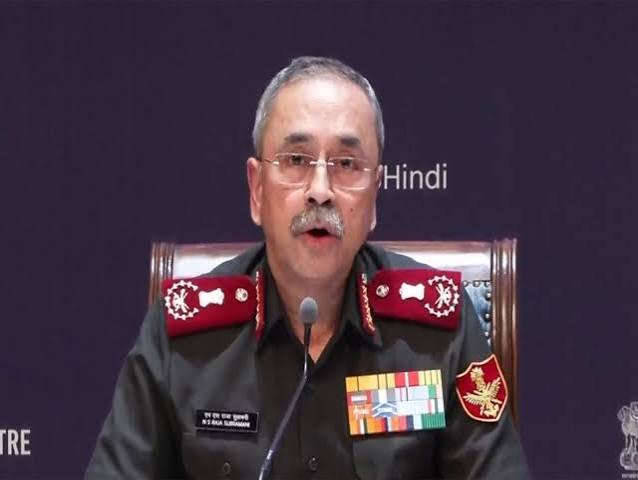
NEW DELHI, November 16 (Aalimi Nation) – Chief of Defence Staff General N.S. Raja Subramani said on Monday that Operation Sindoor showed India could fight with its own weapons, as he laid out how he expects future wars to be fought. He was speaking at a National Security Summit in New Delhi.
Addressing a session on preparing the armed forces for future conflicts, the CDS said: "Op Sindoor proved that we had the capabilities to fight India's war with India's weapons." He described the operation as a strong example of joint planning and integration among the three Services.
Operation Sindoor and indigenous systems
India launched Operation Sindoor on May 7, 2025, after the Pahalgam terror attack that killed 26 people. The government has said the operation destroyed nine major terror launchpads in Pakistan and Pakistan-occupied Jammu and Kashmir and eliminated more than 100 terrorists.
General Subramani said indigenous air defence systems such as the Akash had deterred Pakistani aerial attacks. He argued that the experience of the operation reinforced the case for self-reliance in defence manufacturing.
He also said the industry should not concentrate only on complete platforms. In his view, India also needs to make critical components such as servos, magnetometers and sensors at home, so that supply chains hold up in a long conflict.
Five factors shaping modern warfare
The CDS listed what he called determinants of modern warfare. The first, he said, is mass: advanced weapons must be paired with "cheap, mass-produced drones and equipment", and engineers must be able to devise countermeasures quickly.
The second is depth. "No country should think that they will go to war and it will be short and swift," he said, stressing industrial depth, speed of production and resilient supply chains.
He also pointed to space and satellite communication. Citing the use of satellite services in the war in Ukraine, he called for India to build independent satellite communication capability, working with the Indian Space Research Organisation and private companies.
On the speed of adaptation, he said the side with access to technology is not necessarily the side that wins. On the widening battlespace, he said: "We plan and sustain war on an industrial scale with the entire national capability." He also referred to Operation Sudarshan Chakra, which seeks to combine a defensive shield with long-range precision weapons.
A changing security environment
General Subramani said the world was "becoming more and more disruptive" and that "the capabilities and alignments that we took for granted are no longer there". He noted that the technological gap between nation-states and non-state actors is narrowing, because weaker actors can now reach advanced capabilities through social media and artificial intelligence.
The CDS also rejected suggestions that the Agnipath recruitment scheme was being rolled back, while stressing indigenous weapons, military integration and technological self-reliance as the priorities for the armed forces.
The message for industry
He said the lesson for India was to build depth in manufacturing, speed in production and independence in critical technologies before a crisis arrives, rather than after it begins.