Admiral Brad Cooper says divers and SEALs spent months clearing the strait's traffic separation scheme. A tanker was struck by a projectile three days earlier, and Iran says the waterway stays shut until Washington moves.
Aalimi Nation · International Affairs Desk
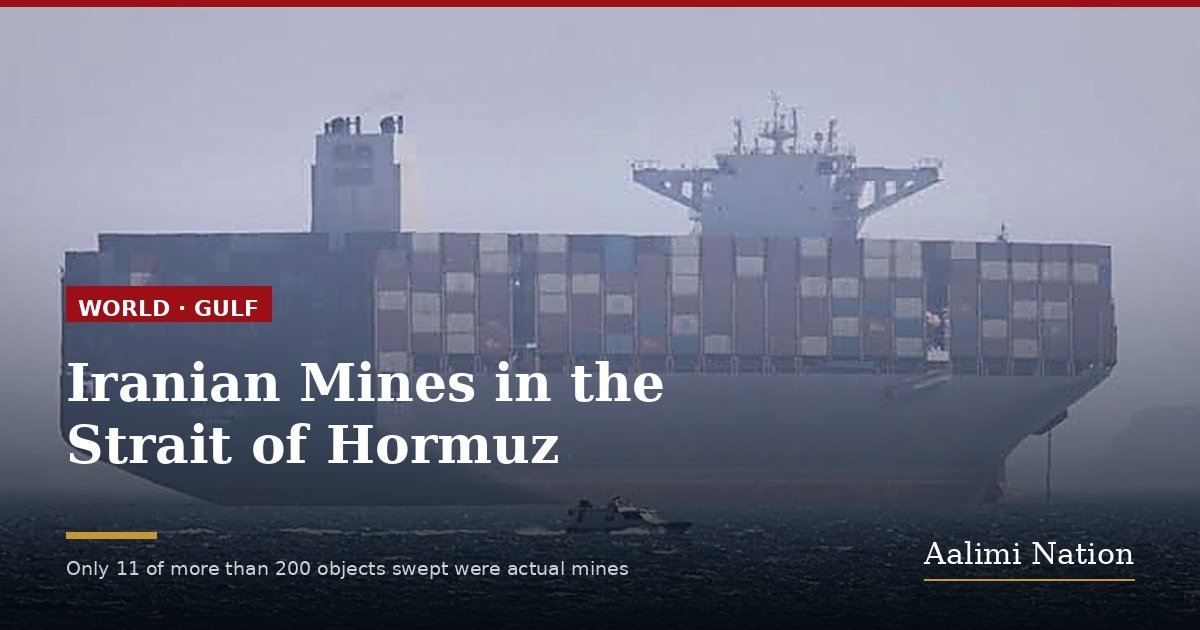
The commander of US Central Command said on Thursday that American forces have cleared Iranian sea mines from the internationally recognised shipping lanes of the Strait of Hormuz, six months after Tehran effectively closed the world's most important oil chokepoint.
"We have successfully cleared sea mines in the Strait's international shipping lanes that were laid months ago by Iran's Islamic Revolutionary Guard Corps," Admiral Brad Cooper said in a three-and-a-half-minute operational update released on Thursday evening. "Internationally recognized transit routes in the Strait are free of Iranian sea mines thanks to the incredible work of the US military."
Cooper said the clearance covered the strait's traffic separation scheme the designated lanes commercial shipping has historically used. The work was carried out by Navy divers, Navy SEALs and aircraft from the Army, Navy, Air Force and Marine Corps.
"Over the past few months, our forces meticulously and quietly cleared them of sea mine threats," he said. "The circumstances were challenging and dangerous, to say the least, but we got the job done. Bottom line: today, international shipping lanes are open, and momentum is building."
The video, which included a map and a diagram of the operation, followed doubts expressed by Washington's allies about President Donald Trump's earlier declaration that the strait had been cleared.
The numbers CENTCOM is citing
Cooper said US forces have provided coordinated protection to nearly 1,500 commercial vessels over recent months, carrying close to 750 million barrels of crude oil to global markets.
He set that against the blockade's effect on Iran itself. "While American forces have supported 750 million barrels of crude oil leaving the Gulf, Iran has exported zero oil from its shores since we resumed the naval blockade in mid-July," he said, describing the strategy as highly effective. No vessel has entered or left an Iranian port without US permission since the blockade resumed, according to CENTCOM, with passage authorised only on humanitarian grounds.
Roughly 50,000 US personnel are deployed across the region on blockade and escort duties.
Before the conflict began, about 20 million barrels of oil and petroleum products passed through the strait daily — between a fifth and a quarter of all seaborne oil trade.
What was actually in the water
One detail from the Axios reporting deserves attention, because it complicates the picture in both directions.
More than 200 mine-like objects were swept from the main lane, US officials said. Only eleven of them were actual mines, and just a few had been properly deployed.
That is a striking finding. It suggests Iran's mining campaign was less technically effective than its strategic impact implied — a small number of correctly laid weapons, surrounded by decoys and failures, was enough to close a waterway carrying a fifth of the world's energy for six months. Deterrence at sea, it turns out, does not require the mines to work. It requires shipowners and insurers to believe they might.
The traffic, and the target
While the median lane was being cleared, the US military moved tankers through a southern route close to the Omani coast.
More than 500 ships transited that corridor in the last thirty days, US officials told Axios, with around 2 per cent hit by Iranian drones or missiles. With the mines cleared, vessels can now move in both directions simultaneously under US Air Force protection.
The coalition is widening. Bahrain and Kuwait have joined the US-backed effort alongside the UAE, Saudi Arabia is expected to participate, and Washington is seeking Qatari involvement in the hope that Qatari LNG carriers will begin using the protected corridor. American officials have set a target of at least 50 ships a night through the protected routes by the middle of September.
Trump was characteristically direct in remarks to Axios. "That sucker is open. The Iranian response is very mild. They don't want us to go back at them," he said. "That's the whole ball game. The rest doesn't matter."
Two facts that sit awkwardly beside the announcement
The first is dated 25 August. The tanker Al Salam II was struck by an unidentified projectile while transiting eastbound through the strait, according to UK Maritime Trade Operations. It hit just above the waterline, opening a small hole and starting a fire the crew extinguished. Nobody was injured. The strike came as Trump posted "MISSION ACCOMPLISHED 2026" on Truth Social.
Mines are one threat. Anti-ship missiles, drones and fast attack craft are others, and clearing the seabed does not address them. Cooper's own framing that shipping lanes are open and momentum is building is more carefully worded than the political declarations around it.
The second is Tehran's position, which has not moved. An IRGC spokesman restated the condition plainly: "If the United States stops obstructing and returns to the memorandum, we can reopen the Strait of Hormuz within the framework of the agreement. If the United States does not accept our conditions, the Strait of Hormuz will not be opened under any circumstances."
Diplomacy is running in parallel and has not concluded. Iranian and Omani foreign ministers met in Tehran without reaching a deal. A separate framework under discussion would create a temporary joint navigation corridor, a joint mine-clearing project and further negotiation over a permanent corridor and the future administration of the strait. Talks continue in Muscat and Doha.
What it means from here
For India, which imports the overwhelming majority of its LPG and a large share of its crude and LNG through this water, the practical question is not whether the strait is legally open but whether underwriters price it as safe.
War-risk premiums follow incidents, not announcements. A cleared seabed, a protected corridor and 50 ships a night would eventually bring rates down but the Al Salam II was struck three days before the announcement, and one hit on a laden tanker would undo the arithmetic quickly.
The honest summary is that the mines are gone from the marked lanes, the shooting has not stopped, and the political dispute that closed the strait remains exactly where it was.