Dal Lake Is Not Just a Lake. It Is Kashmir’s Identity.
For generations, Dal Lake has stood as one of the defining symbols of Kashmir.
Surrounded by mountains, gardens, houseboats and floating vegetation, the lake is more than a scenic landmark. It is part of Kashmir’s cultural memory, environmental ecosystem and economic life. Its image has travelled across the world, becoming synonymous with the beauty and heritage of the Valley.
Yet today, serious questions are once again being raised over its protection.
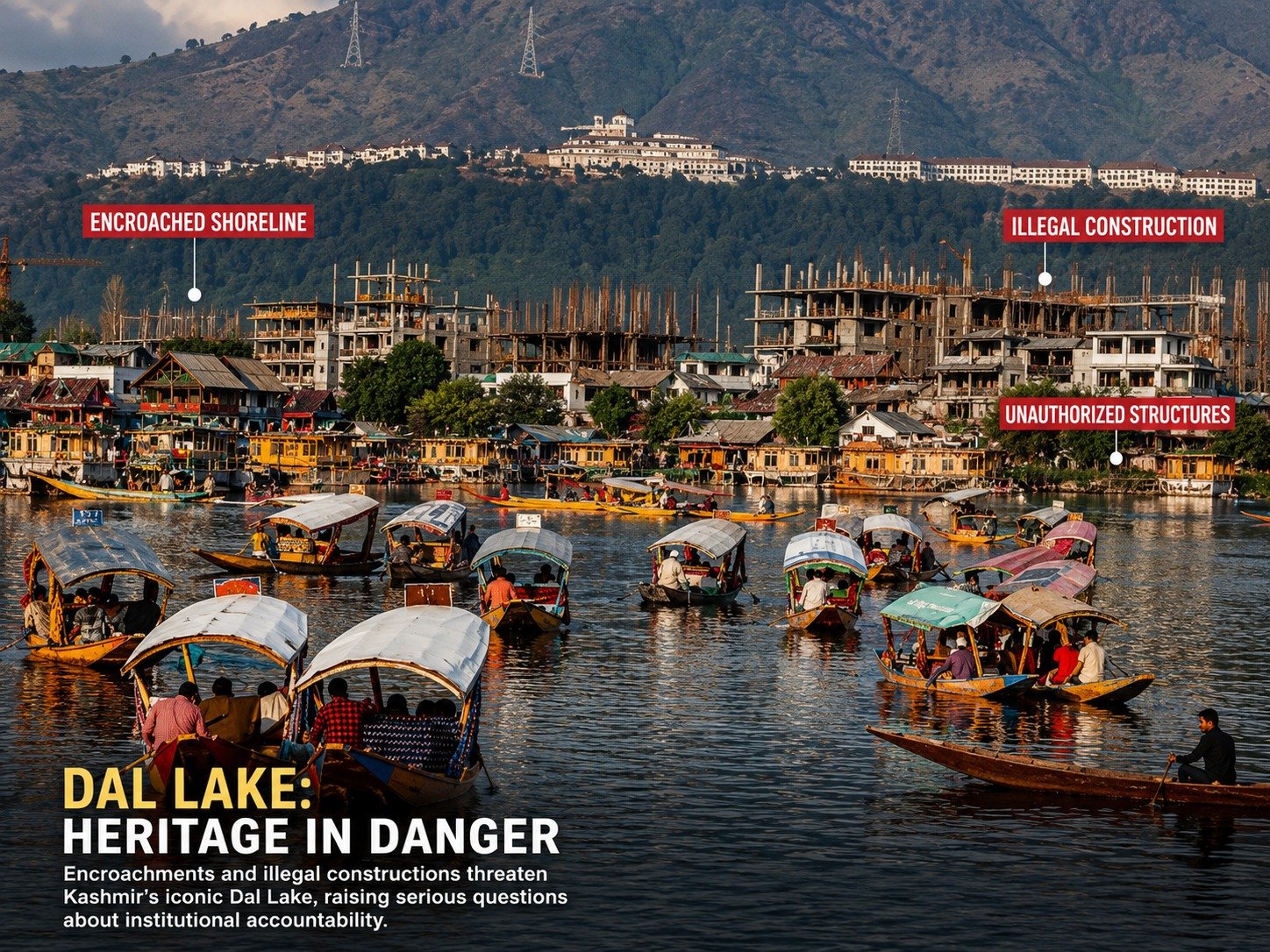
Videos and reports circulating on social media have alleged fresh encroachments and illegal construction activities in certain areas around Dal Lake. While the allegations require official verification and an impartial investigation, they have reopened a larger and more troubling debate: If Kashmir’s most famous and environmentally sensitive lake cannot be protected, where are the institutions responsible for safeguarding it?
The question is not merely about a single construction or alleged encroachment.
It is about accountability.
It is about surveillance.
And ultimately, it is about whether Kashmir is slowly losing one of its most valuable natural and historical treasures.
A Heritage Under Constant Pressure
Dal Lake is not simply a tourist destination. It is an integral part of Kashmir’s ecological and cultural landscape.
For decades, its waters, floating gardens, traditional houseboats and surrounding settlements have formed a unique ecosystem unlike almost any other urban lake in the region. But increasing population pressure, unplanned development, pollution, plastic waste, sewage discharge and alleged encroachments have placed the lake under growing environmental stress.
Environmental concerns surrounding Dal Lake are not new.
Experts and conservationists have repeatedly warned about sedimentation, excessive aquatic vegetation, untreated waste and increasing human interference. Over the years, governments have announced restoration programmes, launched cleaning drives and established specialised institutions to protect and revive the lake.
Significant public resources have been invested.
Yet the fundamental question remains:
Why does Dal Lake continue to face threats despite decades of conservation programmes and institutional intervention?
Social Media Videos Raise Fresh Questions
Recent videos circulating on social media have brought renewed attention to allegations of encroachments and unauthorised construction in and around sensitive areas of Dal Lake.
If these claims are found to be accurate, serious questions will need to be answered.
Dal Lake is not located in a remote or inaccessible region. It lies at the heart of Srinagar and remains one of the most visible and strategically important environmental zones in Jammu and Kashmir.
Multiple government and environmental agencies are responsible for monitoring and protecting the lake, including the Jammu and Kashmir Lakes Conservation and Management Authority and other administrative bodies.
This raises a critical question: How could alleged illegal activity continue without being detected at an early stage?
Citizens and environmental observers argue that effective protection cannot depend on social media videos going viral before authorities respond.
A heritage site of Dal Lake's importance requires continuous monitoring—not reactive action after public outrage.
Where Is the Monitoring System?
The controversy has brought attention to a wider issue: whether existing monitoring mechanisms are adequate.
In an era of drones, satellite imagery, Geographic Information Systems and geo-tagging, environmental protection agencies have access to technologies that can identify changes in land use and construction activity at an early stage.
This leads to several important questions:
Are sensitive areas around Dal Lake being regularly monitored?
Is drone surveillance being used effectively?
Are satellite images and GIS mapping employed to detect land-use changes?
Are new structures geo-tagged and verified?
Is there a real-time system to identify possible encroachments?
If monitoring systems already exist, why were alleged violations not stopped at an early stage?
These are questions that require official answers.
The Issue Is Bigger Than Encroachment
The larger concern is not only whether an individual or group may have encroached upon protected land.
The bigger issue is whether institutional failure allowed such activity to occur.
Public concern has increasingly focused on what many describe as a reactive governance model—where authorities act only after an issue becomes politically sensitive or gains attention on social media.
A lake as ecologically fragile as Dal requires proactive protection.
Waiting for complaints, viral videos or public pressure is not a conservation strategy.
If an encroachment is established, action against those responsible would naturally be necessary. But accountability should not stop there.
There must also be an examination of whether officials responsible for monitoring failed in their duties.
If negligence, administrative failure or any form of alleged collusion is established through a lawful investigation, accountability must extend to every level involved.
Billions Spent, But Why Do Threats Continue?
Successive governments have announced initiatives for the restoration and conservation of Dal Lake.
Funds have been allocated.
Cleaning campaigns have been launched.
Specialised agencies have been created.
Yet reports of pollution, human pressure and alleged illegal activity continue to surface.
This gap between policy announcements and ground reality demands an honest assessment.
The public has a legitimate right to ask whether the agencies entrusted with protecting Dal Lake are being independently evaluated.
How effective have restoration programmes actually been?
What measurable improvements have been achieved?
Where have conservation efforts succeeded—and where have they failed?
An independent performance and environmental audit could provide answers that routine official statements may not.
A Lake That Belongs to Future Generations
Dal Lake cannot be viewed merely as a piece of land or a real-estate asset.
It is a shared inheritance.
It belongs to the people of Kashmir, but also to future generations who deserve to inherit a living ecosystem rather than a damaged memory of what once existed.
The lake supports tourism, livelihoods and biodiversity. It is deeply connected to the emotional and cultural identity of the Valley.
Environmental experts have long warned that lake ecosystems are particularly vulnerable. Once ecological balance is severely damaged, restoration becomes extraordinarily difficult and expensive.
Some losses may be irreversible.
That is why prevention is far more important than restoration after destruction has already occurred.
Calls for an Independent and Transparent Investigation
Civil society members and environmental observers have called for an immediate, independent and transparent investigation into the latest allegations.
Among the key demands being raised are:
A complete identification of any alleged encroachments.
Verification of the legal status of land and constructions.
A clear determination of institutional responsibilities.
Investigation into any possible negligence or administrative failure.
Examination of allegations of collusion, where evidence warrants such scrutiny.
Impartial legal action against those found responsible.
Permanent monitoring of sensitive areas through modern technology.
Public disclosure of investigation findings.
The demand is clear: the issue should not end with temporary demolition drives or symbolic inspections.
The entire protection mechanism surrounding Dal Lake needs to be examined.
Call for LG and Chief Minister to Intervene
Public voices have also called on Jammu and Kashmir Lieutenant Governor Manoj Sinha and Chief Minister Omar Abdullah to take immediate notice of the matter and seek detailed reports from the concerned authorities.
The demand is not simply for a routine inquiry.
It is for a comprehensive review of how Dal Lake is being protected.
If allegations of encroachments are confirmed, the investigation should establish not only who carried out the activity but also whether institutional lapses allowed it to happen.
Because the larger question is unavoidable:
If Dal Lake—the most famous and sensitive water body in Kashmir—cannot be adequately protected, what does that mean for smaller lakes, wetlands and other natural resources across the region?
Beyond Statements and Photo Opportunities
Saving Dal Lake will require more than announcements, development plans and occasional cleaning campaigns.
It requires a permanent, transparent and technologically advanced protection system.
It requires strict enforcement.
It requires regular environmental auditing.
And above all, it requires accountability.
Those responsible for illegal encroachments must face the law if violations are established. But officials and institutions entrusted with protecting public heritage must also be answerable when serious failures occur.
Dal Lake is not the responsibility of one government or one institution alone. Society as a whole has a role in protecting it.
But the primary responsibility lies with the institutions established—and funded with public money—for precisely this purpose.
The time has come to ask a more fundamental question.
The question should not only be: Who allegedly encroached upon Dal Lake?
It should also be: Where were the institutions responsible for protecting Kashmir’s most precious natural heritage?
Until that question is answered honestly, concerns over the future of Dal Lake will remain.
And silence, perhaps, will become as dangerous as the encroachments themselves.