External Affairs Minister tells 81st UN General Assembly that countries sponsoring cross-border terrorism must be held accountable; calls for zero tolerance, protection of civilians and stronger multilateral cooperation
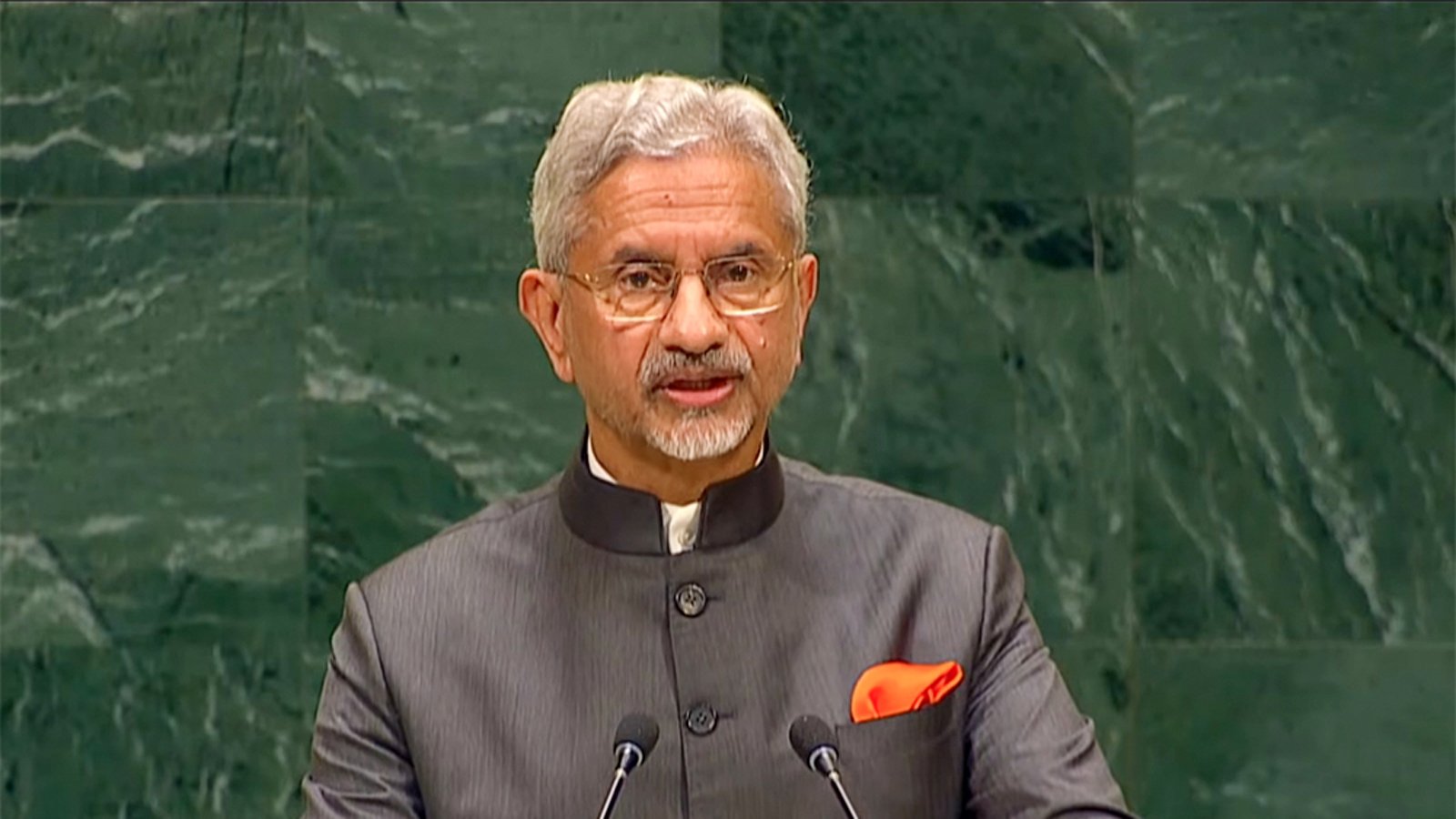
NEW YORK: India will exercise its right to defend itself against terrorism, External Affairs Minister S. Jaishankar told the 81st session of the United Nations General Assembly, while calling for a strict and uncompromising approach against terrorism.
Addressing the General Debate on Saturday, Jaishankar said terrorism continues to pose a serious threat to international peace and security. He stressed that there should be no dilution in the global fight against terrorism and argued that the financial networks supporting terrorism must also be exposed and countered.
Jaishankar said countries that sponsor cross-border terrorism must be held accountable. He also made clear that India would exercise its right to defend itself against terrorism.
‘Our Right to Defend Ourselves Will Be Exercised’
In a pointed portion of his address, Jaishankar referred to remarks made at the UN General Assembly the previous day, saying that attempts to misrepresent facts and normalise terrorism could not be accepted.
He said arguments seeking to justify terrorism or claim immunity from its consequences would not stand.
Jaishankar further stated that friendship and goodwill could not coexist with terrorism, adding that it was the responsibility of those responsible for terrorism to change their approach.
India Calls for Restraint Amid Global Conflicts
The External Affairs Minister also addressed several ongoing international conflicts and warned that continuing confrontation was undermining global peace, security and development.
Speaking about the conflict in the Gulf, Jaishankar called for restraint and de-escalation, while stressing the need to protect civilians.
India, he said, wanted uninterrupted flows of energy and commerce and opposed attacks on commercial shipping and seafarers using international waterways.
On the Ukraine conflict, Jaishankar referred to Prime Minister Narendra Modi’s position that endless war should give way to an end to war. He said India supported initiatives aimed at achieving peace and remained prepared to contribute to efforts concerning food and energy security.
India Backs Two-State Solution for West Asia
Addressing the continuing violence in West Asia, Jaishankar said India believes that a durable and lasting peace requires a Two-State solution.
He also highlighted India's humanitarian assistance and relief efforts for the Palestinian people.
‘Peace Is Not Just the Absence of War’
Jaishankar said genuine peace requires more than simply ending armed conflict.
According to him, stability, security and predictability are essential elements of lasting peace. He warned that continuous threats and pressures were pushing the international system towards greater instability.
He also criticised what he described as the growing “weaponization” of finance, market access, supply chains, technology, resources and connectivity.
According to Jaishankar, these developments are encouraging countries to pursue de-risking and diversification while weakening trust and goodwill between nations.
Global South Faces ‘4F Crisis’
Jaishankar highlighted what he described as a “4F crisis” facing the Global South — food, fuel, fertilizer and finance.
He pointed to the combined impact of a “Super El Nino”, fertilizer shortages and obstacles to grain movements, while warning that progress towards the Sustainable Development Goals was facing increasing pressure.
He also said the right of developing countries to industrialise was being affected by non-market practices and market denial.
Artificial intelligence, he added, was creating new challenges, with its misuse potentially sharpening bias and weakening mutual respect.
India Highlights Development Partnerships
The External Affairs Minister used his UN address to highlight India's development and international cooperation initiatives.
He said India's progress has implications for a significant share of the world's population and highlighted the country's digital public infrastructure, infrastructure expansion, ease of doing business, startup ecosystem, innovation and sectoral development programmes.
Jaishankar said India remained conscious of its responsibilities towards the Global South and had shared its experience and capabilities with partner countries.
He highlighted around 600 major Indian development projects across 78 countries, covering areas including infrastructure, manufacturing, agriculture, information technology and capacity building.
India’s Climate and Humanitarian Initiatives
Climate action was also highlighted as an important component of India's international engagement.
Jaishankar referred to initiatives involving clean energy, clean water, sustainable agriculture and the sharing of technology and best practices.
He also highlighted the International Solar Alliance, Coalition for Disaster Resilient Infrastructure and Global Biofuels Alliance, while noting India's engagement with African countries and Small Island Developing States.
India's humanitarian response to conflicts, epidemics and natural disasters was another major theme of the address.
Jaishankar cited India's assistance during natural disasters, including the Nepal flash floods and Venezuela earthquake, along with medical assistance and initiatives addressing shortages of food, medicines, energy and fertilisers.
India Highlights UN Peacekeeping Role
Jaishankar also highlighted India's longstanding contribution to United Nations peacekeeping operations.
He said Indian contingents were currently present in 9 of 11 UN peacekeeping mandates, adding that Indian personnel had continued to perform their duties firmly and professionally under difficult circumstances.
He also noted that an Indian woman combat helicopter pilot had received the UN 2025 Military Gender Advocate of the Year award.
India Raises Maritime Security Concerns
Maritime security featured prominently in India's concerns.
Jaishankar strongly criticised attacks on commercial shipping and seafarers, particularly across maritime routes extending from the Red Sea to the Black Sea.
He said Indian and other international seafarers had lost their lives and stressed that the safety and security of commercial shipping and seafarers must not be compromised.
India has joined Liberia and 23 other partners in an initiative aimed at mobilising global public opinion against attacks targeting commercial shipping and seafarers.
Jaishankar also stressed that respect for international law must remain central to maritime security.
India Sees AI as a Global South Opportunity
Artificial intelligence was another important component of the address.
Jaishankar said India had hosted the AI Impact Summit in February, bringing together leading experts in the field.
India views AI as a transformational driver for human empowerment, economic development and addressing problems at population scale, he said.
At the same time, he emphasised that every country should have the opportunity to develop its own AI ecosystem, models and deployment strategies according to national priorities.
India, he said, would make AI an important part of its partnership agenda with the Global South.
‘We Are Well on Our Way Towards a Multi-Polar World’
Jaishankar also spoke about the changing international order.
He said the world was moving towards a multipolar system and that the post-1945 international order was giving way to new realities.
According to Jaishankar, the transition would require adjustment, accommodation and acceptance, and some of the turbulence being witnessed globally was linked to these changes.
He called for civil conversations, broader consultations and transparent decision-making, arguing that large sections of humanity could not remain excluded from global decision-making.
He said the case for reformed multilateralism was becoming stronger.
Jaishankar Thanks UN Secretary-General
During his address, Jaishankar also acknowledged UN Secretary-General Antonio Guterres, who is set to leave office after a decade of service.
He said India valued Guterres' contributions, particularly his support for Mission LiFE.
Concluding his address, Jaishankar called on UN member states to strengthen their commitment to peace, development and prosperity.
Quoting Mahatma Gandhi, whose words are inscribed on the lawns outside the UN headquarters, Jaishankar said: “There is no way to peace; peace is the way.”
KEY TAKEAWAYS
India reiterated its right to defend itself against terrorism.
Jaishankar called for zero tolerance towards terrorism.
Countries supporting cross-border terrorism, he said, must be held accountable.
India called for restraint and civilian protection amid global conflicts.
New Delhi backed a Two-State solution for lasting peace in West Asia.
India raised concerns over attacks on commercial shipping and seafarers.
Jaishankar highlighted India's development partnerships across 78 countries.
India stressed the importance of AI cooperation with the Global South.
Jaishankar said the world is moving towards a multipolar international order.
India called for stronger and more representative multilateral institutions.
Source: Statement and address by External Affairs Minister S. Jaishankar at the 81st United Nations General Assembly, as reported in the supplied source material.