The camps at Rawalakot’s bus terminal had stood for five months. Ordinary residents of the Poonch hill town in Pakistan-Occupied Kashmir had built them with tarpaulin, firewood and patience, and they used them to ask for cheaper flour, fairer electricity bills and a real voice in how they are governed.
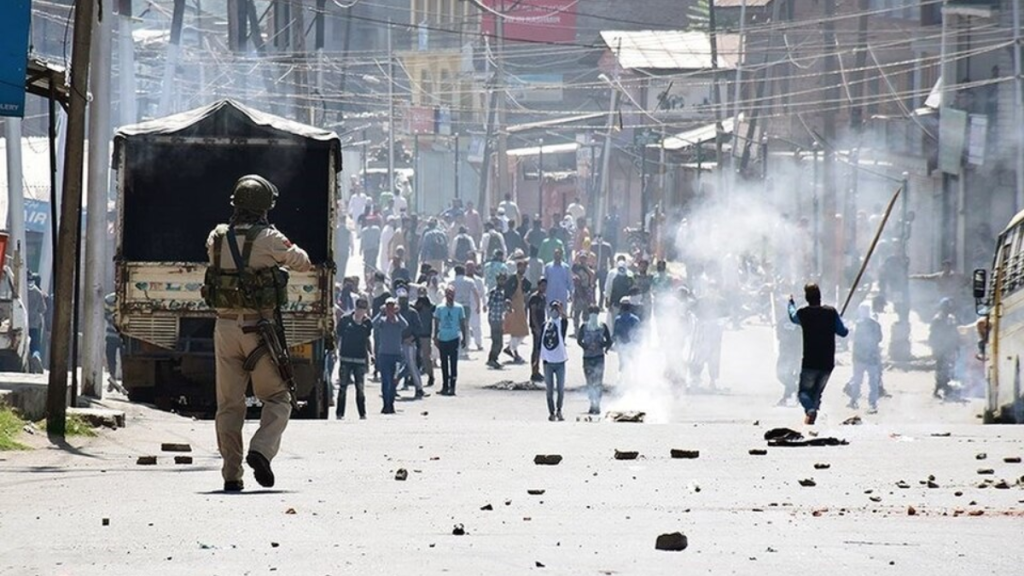
Early on Thursday, 5 November, those camps were overrun. Personnel of the Pakistan Rangers, Frontier Corps and local police moved to disperse sit-ins organised by the Jammu and Kashmir Joint Awami Action Committee (JAAC), the grassroots coalition leading months of anti-government protests in PoK. By the end of the day, seven people were dead and around 23 injured.
What followed was worse than a dispersal. Protesters alleged that armed drones were deployed, and some claimed RPG-7 rocket fire was directed at residential areas. Videos circulating on social media showed houses ablaze near protest sites at Matialmera Bus Terminal and Umar Farooq Chowk. JAAC leader Sardar Umar Nazir displayed what he described as bomb fragments recovered after alleged drone strikes on residential properties and protest camps.
Early counts differed. In a statement from Geneva, the United Kashmir People’s National Party reported at least three people killed and 18 seriously injured, alleging that security personnel used heavy machine guns, armoured vehicles and drones against protesters. Pakistani outlets pushed back. One alleged that a viral aerial image linked to the operation had in fact been taken in April 2026 and had been online for months. Responsible journalism has to keep that dispute in view. The casualty figures and the drone allegations have not been independently verified.
But a dispute over one photograph does not bring the dead back. A communications blackout cannot erase what has happened across Pakistan-Occupied Kashmir since June.
The crisis began with a government notification. On June 5, 2026, the Home Department of Pakistan-Occupied Kashmir declared the JAAC a banned organisation under the region’s anti-terrorism laws. A coalition of traders, transporters, students and civil-society activists that had run region-wide strikes over prices was suddenly classed with militant groups. Authorities also suspended internet and mobile services, sealed the movement’s office and reportedly arrested more than 100 JAAC activists. Within two weeks, the PoK administration had placed 150 members of the banned JAAC on the Fourth Schedule through ten separate notifications, the watch-list normally used for suspected extremists.
Rawalakot erupted almost at once. JAAC leader Shaukat Nawaz Mir described the events as “a massacre of our people in Rawalakot.” The state told a different story. PoK police said four law enforcement personnel had been killed since June 6, and claimed that three JAAC-linked individuals were killed due to their own “indiscriminate firing.” Even officials could not keep to a single version. An official told Dawn that at least seven civilians were killed during the Sunday clash.
The bloodiest phase came on the day Pakistan asked Kashmiris to vote. Violence broke out during the first phase of PoK’s legislative assembly elections on 27 July. JAAC executive council member Shaheen accused law enforcement of opening unprovoked fire on a peaceful march, and another committee member, Imtiaz Aslam, said 14 people were killed. Islamabad kept its account. Police displayed weapons at press conferences that they said were seized from the JAAC.
Then came the words that may define this crisis. Pakistan’s Defence Minister, Khawaja Asif, ruled out talks with the protesters, saying he would “consider them as enemies of Pakistan” and putting them in the same category as India. Even within Pakistan, the remark drew a backlash. Earlier in the crisis, the JUI-F and PPP had already criticised Asif for remarks questioning the identity of Rawalakot’s residents.
Nobody can say for certain how many people have died, and that uncertainty is part of the indictment. The Jammu Kashmir Human Rights Observatory alleged more than 50 civilian deaths by mid-July, nearly double the official tally of 28 cited by Pakistani authorities for the same period. By August, India’s Ministry of External Affairs had put the civilian death toll at 90. Figures cited after the November crackdown suggest more than 150 people have reportedly died in connection with the protests since early June. When a state shuts down the internet and allegedly withholds bodies, the numbers become one more thing it controls.
It would be comforting to call Rawalakot a one-off. The record does not allow it.
May 2024, Muzaffarabad. The JAAC led its first great march on the capital of Pakistan-Occupied Kashmir, seeking electricity priced at the cost of hydropower generation in the region. This is a region whose rivers power Pakistan’s grid. The Divisional Commissioner of Muzaffarabad said that at least three people died in firing by Rangers and another six were wounded. Islamabad then rushed through a subsidy, and that was revealing. A Rs23 billion package cut the price of 40kg of flour from Rs3,100 to Rs2,000. The demands, in other words, were affordable all along. Three people died before the state found the money.
September–October 2025. The movement returned with a six-day lockdown. The protest escalated into violent clashes between demonstrators and security forces, resulting in 10 deaths and over 100 injuries. Once again, Islamabad negotiated only after the funerals. The agreement promised that people killed on October 1 and 2 would be compensated on par with law enforcement personnel, and that cases from Muzaffarabad, Dhirkot, Mirpur and elsewhere would go to a judicial commission.
June 2026. The government tore up its own peace. It concluded that the JAAC had breached the October 2025 agreement by returning to street agitation, and reinstated 177 FIRs against the movement’s members.
The cycle is now familiar: protest, force, deaths, concessions, broken promises, then force again. Human-rights monitors have documented a recurring pattern of deadly crackdowns on JKJAAC protests, including incidents in May 2024 and October 2025 that claimed multiple lives.
The pattern also predates the JAAC. Pakistan’s first act in Kashmir, in October 1947, was to send armed tribal raiders across the border. The sack of Baramulla, with its looting, killings and attack on a mission hospital, remains a scar in the Valley’s memory. The methods have changed since then. The assumption that Kashmiri lives can be spent to serve Islamabad’s purposes has not.
Strip away the official rhetoric about “anarchy” and “terrorism,” and the JAAC’s demands look strikingly ordinary. The group has called for sweeping governance reforms, including reducing ministerial perks, cutting down oversized cabinets, and strengthening anti-corruption systems. Its 38-point charter also seeks subsidised flour, fair power tariffs, better hospitals and schools, and jobs for young people.
The most politically explosive demand concerns the assembly. The PoK Assembly has a total of 53 seats, of which 12 are reserved for people of Kashmiri origin living in Pakistan. Protesters say these seats let Islamabad interfere in PoK’s politics. Pakistan has defended them, and on June 7, 2026, the top court of Pakistan-Occupied Kashmir ruled that the 12 seats are constitutionally protected and can be abolished only by constitutional amendment. That is a legitimate legal position. A legal position, however, is not a licence to fire on the people who disagree with it.
Pakistan’s claim on Kashmir, tested at home
For more than seven decades, Pakistan has presented itself to the world as the advocate of Kashmiri self-determination. Rawalakot puts that claim to the test.
Start with the document Islamabad cites most often: UN Security Council Resolution 47 of 1948. Its sequencing is rarely mentioned in Pakistani diplomacy. In the first step, Pakistan was asked to use its “best endeavours” to secure the withdrawal of all tribesmen and Pakistani nationals. Only after that would India draw down its forces and a plebiscite follow. In India’s reading, Pakistan never fulfilled the first condition, leading to non-implementation of the rest of the resolution.
Then consider what Pakistan has done with the territory it holds. In 1963 it signed away land that was never its to give. Pakistan took control of the area during the 1947–48 war and later transferred it to China under the 1963 Sino-Pakistan agreement, a tract India measures at 5,180 square kilometres of the Shaksgam Valley. A self-appointed guardian of Kashmir’s territorial integrity handed part of Kashmir to a third country.
Now Islamabad’s spokespeople insist that all is well. Pakistan’s Foreign Office has said residents of the territory “freely enjoy their civil and political rights”. When 31 British lawmakers wrote to their foreign secretary expressing concern, the Foreign Office told them not to interfere. That defence is hard to square with a ban under terror laws, a months-long internet shutdown and a defence minister who calls protesters enemies of the state.
Perhaps the most revealing statement came from inside the government. Rana Sanaullah, an adviser to the Prime Minister, said the protesters in PoK are similar to the “mujahideen” whom Pakistan had trained in the past, who later turned against the country. In one sentence, a senior official both admitted Pakistan’s history of arming militants and smeared unarmed citizens asking for cheaper bread.
A commentary in Countercurrents summed up the contradiction: under Pakistan’s doctrine, Kashmiris may resist oppression only “provided the oppressor is India.”
To be fair, Pakistan has its own account. Officials blame the JAAC for violence and point to police casualties. They say the elections went ahead and that the territory is governed through constitutional means. Islamabad also rejected India’s remarks “in their entirety,” dismissing New Delhi’s attempt to draw parallels between Pakistan-Occupied Kashmir and Jammu and Kashmir. Every allegation against the JAAC deserves investigation. That is the point: investigation, not drones.
New Delhi has been vocal. MEA spokesperson Randhir Jaiswal called the protests a “natural consequence of Pakistan’s oppressive approach and systemic plundering of resources” from territories under its occupation.
The most credible criticism, however, has come from within Pakistan. The Human Rights Commission of Pakistan called the deaths “a stark reminder of the human cost of the tensions” and called for a “prompt, impartial and independent investigation” and for anyone responsible for unlawful use of force to be held to account. Amnesty International made the same demand. The opposition alliance TTAP said protesters were subjected to excessive force and called for accountability. When a country’s own human-rights watchdog says the state has gone too far, nobody can dismiss it as Indian propaganda.
That brings us to the most uncomfortable question in this editorial, and it is aimed at our own side of the Line of Control.
To be accurate: Kashmir’s mainstream leaders did speak in July. Chief Minister Omar Abdullah said reports of brute force being used against protesters in Pakistan-Occupied Kashmir were “deeply troubling,” and called for the targeting of civilians to stop. PDP president Mehbooba Mufti wrote that “no nation strengthens itself by disempowering its own people or silencing them at gunpoint.” National Conference president Farooq Abdullah went further and turned the question on New Delhi: “If it is our part, why don’t they speak about the killings there”.
These statements matter, and AALIMI NATION acknowledges them. But they were made once, in a single news cycle. When drones were reported over Rawalakot this week, Srinagar’s leaders were largely quiet. As this edition went to press, our desk could find no fresh, sustained statement from the region’s major parties on the November killings. There has been no all-party appeal, no resolution in the Legislative Assembly, and no delegation demanding UN access.
Why? Several explanations are offered privately in Srinagar’s political circles. None of them is good enough.
Mainstream parties worry that strong criticism of Pakistan will be absorbed into New Delhi’s narrative and claimed by their rivals. The fear is real but misplaced. Defending a civilian’s right to life does not endorse any government. It is the minimum test of a politics built on human rights.
Every leader who condemns firing on protesters across the LoC knows their own record will be raised. Within days of the July statements, a senior BJP leader said Omar Abdullah and Mehbooba Mufti must answer for civilian killings during their own tenures. Kashmir’s history of pellet injuries and protest deaths is real and must be debated honestly. But past failures are a reason for consistency, not silence. A leader who has seen what bullets do to a protest crowd should be the first to say it must not happen anywhere.
Some leaders have built their politics on calls for India–Pakistan engagement, and they fear that harsh words for Islamabad close that door. Dialogue that cannot even name the killing of civilians is not dialogue. It is diplomacy at the expense of the dead.
The voices most noticeably absent are not the mainstream ones. They belong to those who for decades looked to Islamabad as Kashmir’s protector and rallied around its slogans. If Pakistan were truly the guardian of Kashmiri dignity, Rawalakot should be their loudest cause. Their silence says more than any speech could.
Kashmiri politicians often remind us that Kashmir is not just land but people. The people of Rawalakot, Muzaffarabad, Mirpur and Bagh share our language, our family ties and much of our history. Many families in Poonch and Uri have relatives on the other side of the LoC. A mother burying her son in Rawalakot is no less a Kashmiri mother because a ceasefire line runs between her and Srinagar.
If Kashmir’s leaders speak for the rights and dignity of Kashmiris, that responsibility cannot end at the Line of Control.
AALIMI NATION calls for these specific steps:
An independent investigation. HRCP and Amnesty International have both called for it. Pakistan should allow it, with full access to Rawalakot, its hospitals and its morgues.
UN scrutiny. UN human-rights experts have already written to the Government of Pakistan about alleged human rights violations in Pakistan-Occupied Kashmir, under reference AL PAK 4/2026. Islamabad should respond publicly and allow a visit.
Bodies returned, detainees accounted for. JAAC alleges that the bodies of several activists killed by law enforcement agencies have not been handed over to their families. No grieving family should be denied a funeral.
Lift the ban and restore communications. A civic coalition that negotiated and signed an agreement with the federal government in October 2025 cannot credibly be called a terrorist group in June 2026.
Implement the October 2025 accord, including its promise of judicial inquiries into earlier killings.
A clear voice from Srinagar. The Jammu and Kashmir Legislative Assembly should pass a humanitarian resolution calling for an end to the use of force against civilians in Pakistan-Occupied Kashmir, for independent investigation and for international humanitarian access. Kashmir’s political parties should say it together.
People in Rawalakot did not take to the streets for territory or ideology. They went out because flour cost too much, electricity bills had become unbearable, their children had no jobs, and they had no real say over who governed them. They were met with an anti-terror ban, a communications blackout, a minister who called them enemies and, they say, drones overhead.
Pakistan has spent seventy-nine years telling the world it speaks for Kashmiris. In Pakistan-Occupied Kashmir, the Kashmiris it governs are telling it something different. The world should listen. So should Srinagar.
Human rights are not conditional. Justice cannot have borders.