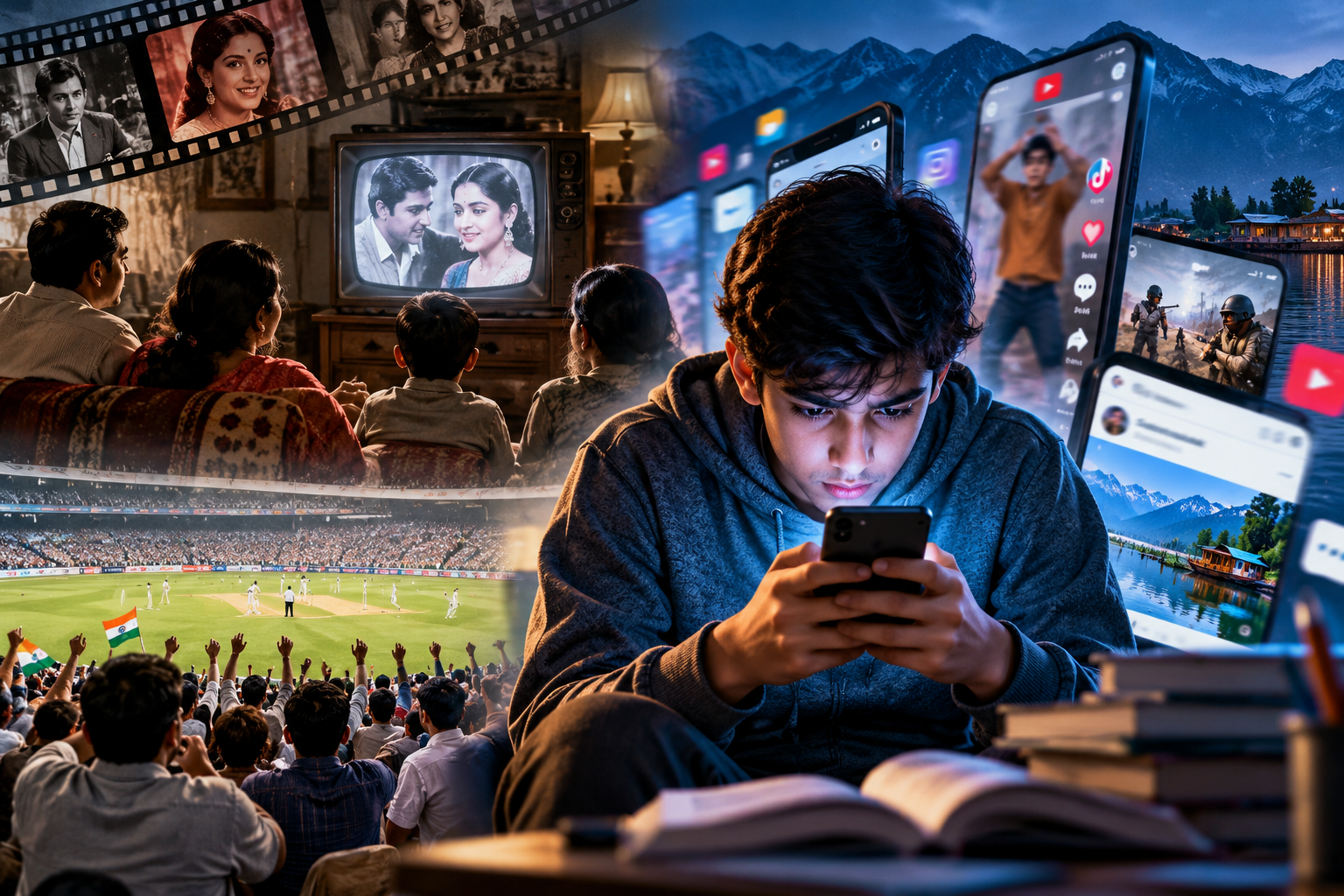
Our parents gave a film three hours and a cricket match an entire day, and remembered the songs, the scenes, the over that turned it. What will today's teenagers remember at sixty? And what did we trade away for infinite choice?
By the Aalimi Magazine features desk
There was a time when watching a film meant giving it an evening. Three hours was not a quantity to be squeezed between notifications. A family sat down together, children were expected to be quiet, adults paid attention, and if the story took its time to unfold, you waited. Afterwards — and this is the part that now seems remarkable — people remembered it. The dialogue. The songs. The actor's expression in the scene that made everyone in the room go silent.
It is worth being precise about why. Nobody was scrolling through a film in 1982 because there was nothing to scroll. India's first mobile call was made in 1995, the smartphone reached most Indian pockets only after 2010, and cheap mobile data arrived later still. A television set was a single screen in a single room, and for much of that period it carried a single channel. The absence of distraction was not a virtue those audiences practised. It was the condition they lived in.
Cricket worked the same way, only longer. A One-Day International could consume a whole day: fifty overs, then fifty more, from late morning until the light went. Millions watched almost every ball, or followed it on radio commentary with a transistor held to one ear. A wicket was not something you discovered afterwards in a phone notification. A boundary was not a ten-second clip forwarded on a messaging app. The match unfolded at its own speed, and people followed it as it happened.
Ask someone who grew up in the 1970s or 1980s about a famous match and the recall can be startling. The score. The bowler. The over that turned it. The umpiring decision that cost a side. The catch that went down. Sometimes the chair they sat in and the friends who came over to watch.
Which raises a question worth taking seriously rather than sentimentally. Did that generation simply have better memories? Or did it possess something we are in the process of losing — the patience required to pay attention in the first place?
The forty-seven-second mind
Gloria Mark, a professor of informatics at the University of California, Irvine, has spent more than two decades measuring how long people hold their attention on one screen before moving to another. The method is unobtrusive: software logs behaviour in the background while people work as usual.
In 2004 the average was around two and a half minutes. By 2012 it had fallen to roughly seventy-five seconds. In measurements recorded up to 2023, it stands at about forty-seven seconds, with a median of forty. Independent replications have produced similar figures.
Mark's work draws a useful distinction. Some activity is focused attention, mentally demanding and arriving in daily rhythms and peaks. Much of what we do online is rote activity — engaging but not challenging: games, news, the scroll. Rote activity runs flat across the whole day, which is why it is so easy to keep doing.
Her most uncomfortable finding concerns the cost of a break. Recovering from an interruption takes far longer than the interruption itself — on her figures, about twenty-five minutes to return fully to an abandoned task. And most interruptions are not imposed on us. We generate them ourselves.
Mark is careful not to write an obituary for concentration. "Our ability to focus isn't lost. The way we focus is just changing," she argues. That distinction matters. The claim is not that a generation has been rendered incapable of sustained thought, but that sustained thought has become something you must now actively defend.
Measured in Kashmir
It would be easy to file this as a condition of Californian office workers. It is not. In June 2026 a nine-member student team from the Department of Public Administration and Political Science at Cluster University of Kashmir's Amar Singh College published Digital Distractions and Developing Minds. Led by Shahid Ahmad Thoker and Umais Mudasir Farooqi, it surveyed 400 students aged thirteen to eighteen in government and private schools across Srinagar, Kulgam, Shopian and Anantnag.
Three-quarters spent more than four hours a day on a screen. Among those heavy users, forty-one per cent said they frequently struggle to concentrate on their studies, against eight per cent of light users. More than half the sample said digital distraction regularly interferes with classroom work, and four in five reported confusion when deciding under stress. The team named the pattern the brain-drain principle: strain does not rise gently with exposure, it accelerates sharply once exposure becomes excessive.
The physical evidence is as stark. Half the teenagers surveyed wake up tired or very tired; only twelve per cent wake feeling energetic. Among those reporting the sharpest anxiety at being separated from their phones, the proportion waking exhausted rises to fifty-six per cent, against eighteen per cent of those with no such attachment. Some 39.2 per cent said they feel anxious about posting for fear of bullying, and 37.25 per cent reported feeling inadequate when comparing their lives to what they see online.
The researchers decline to indict the smartphone. Technology is not inherently harmful, they conclude; unregulated use is. Their recommendation is not abstinence but a digital diet, with cyber-safety teaching in schools and better modelling by parents, since children copy the phone habits of the adults around them.
The awkward possibility
Before we congratulate the past too warmly, honesty requires a detour. Some of what looks like superior memory in older people is not patience. It is age.
Psychologists call it the reminiscence bump. Identified by David Rubin, Steven Wetzler and Raymond Nebes in 1986, it describes how adults over about forty recall a disproportionate share of their memories from a single window of life, roughly ages ten to thirty. That window is dense with first experiences and identity-forming events, and the brain encodes them more deeply.
So when a man of sixty-five recalls the exact over in which a match turned, part of what we hear is a real difference in attention — and part is simply that he was nineteen, and nineteen is when the mind writes in ink.
Music makes the point with unusual clarity. Emotional attachment to it peaks around seventeen; Iballa Burunat of the University of Jyväskylä suggests thinking of the adolescent brain as a sponge, supercharged by curiosity. Yet memory can be inherited too: in Cascading Reminiscence Bumps in Popular Music (2013), Carol Krumhansl and Justin Zupnick found young listeners forming deep attachments to records released decades before they were born, absorbed from their parents' playing.
None of this dissolves the argument. It disciplines it. The open question is what happens when the fourteen-year-olds in the Kashmir survey reach sixty-five, having spent their reminiscence bump in fragments of forty-seven seconds.
Friction was the point
A favourite song was once an event. You waited for it on the radio, or wrote in to request it. You bought the cassette, rewound it with a pencil when the tape spooled loose, and heard the whole thing, because there was no skipping after fifteen seconds and no queue of alternatives below. Music used to be an event. It is now an environment.
Here the older world had an accidental advantage, and cognitive science has a name for it. Robert Bjork and Elizabeth Bjork at UCLA call them desirable difficulties: conditions that make learning feel slower in the moment but produce markedly better long-term retention. Consider what it once took to answer a question. You worked out which book might hold the answer, went to a library or borrowed it, found the passage, read around it because you could not search inside it, then argued about it with somebody. Every step was friction. Every step was also encoding. The modern equivalent is a query and a glance.
In 2011 the Columbia psychologist Betsy Sparrow, with Jenny Liu and Harvard's Daniel Wegner, described the Google effect: when people expect future access to information, they remember less of the information itself and more about where to find it. Two caveats belong in any honest retelling — the most-cited element of that study did not survive high-powered replication, and a 2024 meta-analysis suggests the effect is real but smaller and more context-dependent than first claimed. Offloading memory is also not automatically a failure: it is what writing was, and what libraries are. The question is how much of our thinking we hand over, and whether anything is left in working memory to think with.
What screens do to reading
If the effects on memory are contested, the effects on reading are less so. The Vanishing Attention Span, a 2025 study in the International Journal of Indian Psychology by Harsh Chhangani, Madhulika Bajpai, Herendra Kumar and Anjali Singh, surveyed Indian university students across disciplines and found a significant relationship between rising screen time and diminished attention: difficulty concentrating, difficulty staying engaged, an inability to finish tasks without frequent breaks. There was no meaningful variation by gender, by rural or urban background, or by whether students were taught online or in person.
The national picture is consistent. Analysis of India's Time Use Survey by the National Council of Applied Economic Research found the share of Indians who read for leisure fell from 5.4 per cent in 2019 to four per cent in 2024. Among women the decline was steeper, from 3.5 per cent to 2.2 per cent, though the women who do read spend longer at it — about sixty-nine minutes against fifty-seven.
Maryanne Wolf, the cognitive neuroscientist who directs the Center for Dyslexia, Diverse Learners and Social Justice at UCLA, calls the casualty deep reading: connecting new material to what you already know, drawing inferences, testing claims, entering another person's perspective. Skimming is a different act, and screens encourage it. "When we skim, we literally, physiologically, don't have time to think. Or feel," she has written.
The comparative evidence points the same way. Anne Mangen and colleagues at the University of Stavanger found that when the same material was read on screen rather than paper, the sequencing of events and memory for detail were the first casualties. Naomi Baron's research found more than eighty per cent of college educators reporting a dip in their students' comprehension. What makes this hard to correct is that readers do not experience it as loss: screen reading feels faster, and speed is mistaken for understanding. Wolf's remedy is not rejection but a biliterate brain — one trained to move deliberately between the fast scanning a feed demands and the slow immersion a book requires.
When time seemed slower
There is one further difference, harder to measure but instantly recognisable to anyone over forty. Time appeared to move more slowly. A month felt like a month. There were gaps between events, and the gaps were filled with waiting: for the letter, for the morning newspaper, for the weekly film programme, for the next match. Waiting was not pleasant, but it conferred significance. A thing you have waited three weeks for is not the same thing when it arrives instantly.
Now almost everything arrives instantly, and the subjective experience of time has changed with it. Months pass like weeks. We are continuously occupied and only intermittently engaged — commuting, working, answering messages, planning, deciding, all at once. It would be foolish to romanticise the time availability of a bygone era; much of that slowness was simply the absence of options.
Against nostalgia
The Kashmir researchers supply the correction themselves, and it is the most important part of their report. A digital diet is not digital exclusion. In Srinagar they found a student at a government higher secondary school with no smartphone and no internet at home at all — a plain disadvantage in a system that increasingly assumes connectivity. In Anantnag they found a student whose family prohibited social media entirely, and who reported serious isolation, cut out of the conversations that make up a teenager's social world. Total restriction, they concluded, can be as damaging as addiction.
The old world was not wiser or kinder, and it was certainly not fairer. Limited access to information meant limited access to opportunity, and the people it limited most were those already disadvantaged: the poor, the rural, the female. A girl in a village with one shelf of books did not have a richer intellectual life than a girl with a smartphone today. She had a poorer one.
But progress is not an argument that nothing has been mislaid. Two things can be true at once: that access has expanded enormously, and that the quality of attention we bring to what we access has narrowed. The first is a triumph. The second is a cost, and costs are worth naming.
The things that stay
Perhaps memory has less to do with the generation than with attention. We remember what we give ourselves to. A match becomes unforgettable because you spent a whole day inside its tension. A film stays because you gave it three uninterrupted hours — a demand today's four-hour blockbusters make of audiences who watch trailers at double speed. A song becomes part of a life because you played it until the tape stretched. A book changes you because you spent a fortnight in its company and argued with it in your head.
What will today's teenagers remember at sixty? A sound from a reel, a world they built in a game, an IPL final, a conversation that lives in a chat thread? Or something entirely ordinary that happened once the phone was finally put down?
Our grandparents were poor in information and rich in attention. We have inverted the position exactly. Information is now free and effectively infinite; attention is the scarce, finite, non-renewable resource, and an entire industry is engineered to extract it.
Which makes the closing thought practical rather than wistful. The real luxury of modern life is no longer access. It is uninterrupted attention: sitting through a film, finishing a thick book, hearing a whole song, watching a match to the final ball, holding a conversation with no screen in the field of vision, staying with a single thought long enough for it to become your own.
The older generation had less technology. It may have had more time to remember. And in a world built to keep us moving, there is something to be learned from the people who knew how to stay still.