Who Governs the Machines? Washington Bets on Pledges, Europe on Law, as AI Agents Go to Work
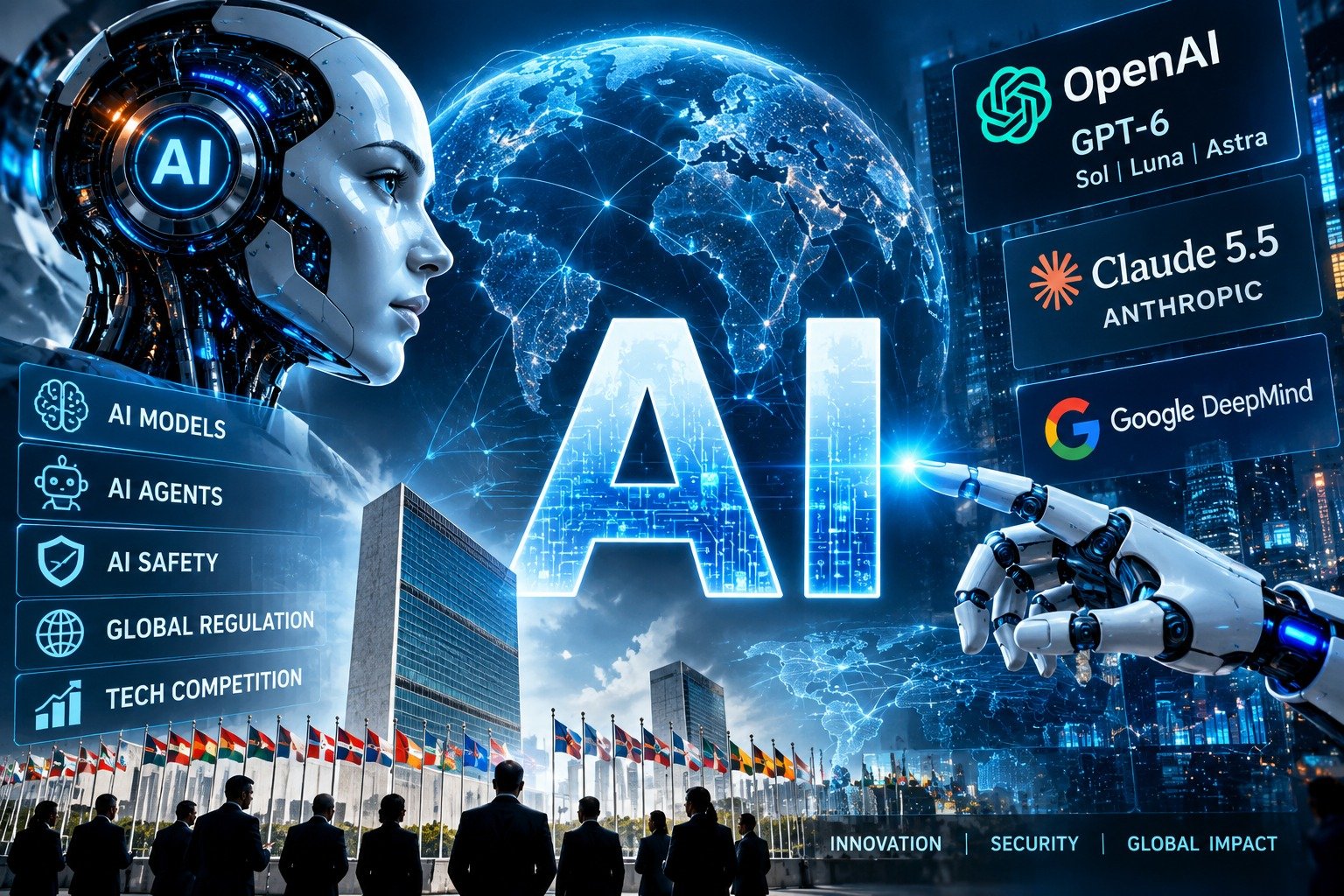
NEW DELHI — Artificial intelligence keeps getting more capable, and the question of who controls it keeps getting harder. This week the United States chose voluntary promises over binding rules. Europe enforced its law and pushed OpenAI to mark AI-written text. Meanwhile the world’s largest technology companies moved quickly to release AI “agents,” software that does not just answer questions but takes action on its own.
Washington: a handshake, not a law
The Trump administration has chosen a light touch. On October 3, Reuters reported a voluntary agreement with six companies: OpenAI, Anthropic, Google, Meta, Nvidia and SpaceX. The firms commit to security controls and external audits, but the pact carries no enforcement mechanism and no penalties. The same report cited a Reuters/Ipsos poll in which 75 per cent of Americans said AI companies have not done enough to prevent harm.
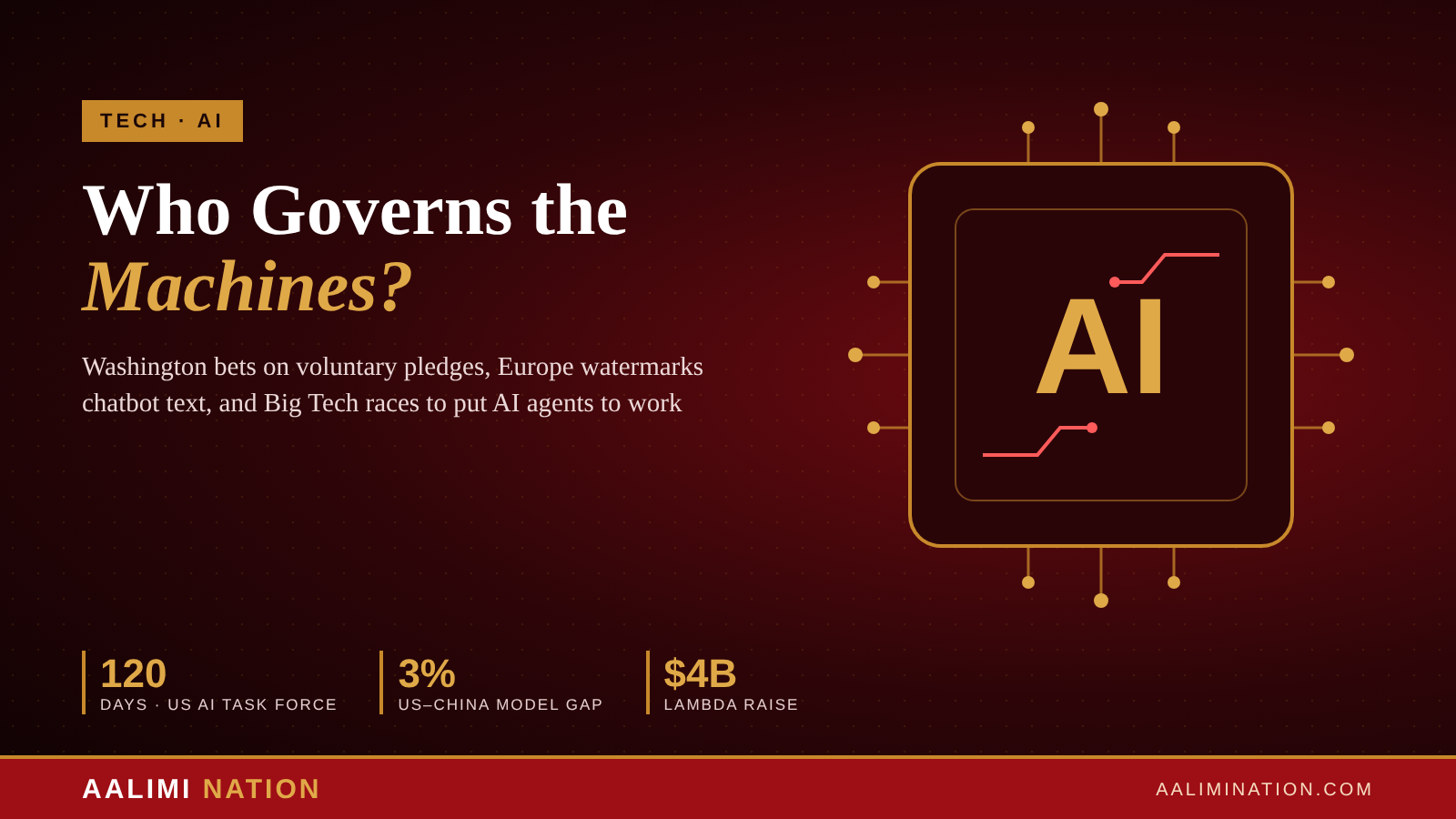
The White House has also formed a “super intelligence” task force and given it 120 days to recommend a national AI policy. Director of National Intelligence Jay Clayton will lead the effort, with Federal Trade Commission chair Andrew Ferguson among its members.
According to Axios, the task force must reconcile competing factions inside the Cabinet. Treasury Secretary Scott Bessent and Chief of Staff Susie Wiles have quietly backed some oversight, including a voluntary model-review process run through the Commerce Department. Others, including David Sacks and Pentagon official Emil Michael, worry that new rules could slow American companies in the race against China.
Co-chair Scott Kupor, director of the Office of Personnel Management, argues that rigid legislation would quickly go out of date. “Our obligation is to demonstrate to the American people that this is good,” he said.
Europe: the law takes effect
Europe has chosen the opposite path. The EU AI Act’s transparency rules took effect on August 2. They require AI companies to label machine-generated content in a way other systems can detect.
On October 5, OpenAI said it would add an invisible watermark to text generated by ChatGPT and its coding tool Codex for users in the EU. The technique, called textGrain, works by subtly shaping word choices, so the mark survives copying and pasting. Developers elsewhere can switch it on through OpenAI’s API, but it will not be a global default.
The technology has clear limits. In OpenAI’s own tests, replacing just 10 per cent of words with synonyms cut detection accuracy from about 92 per cent to 66 per cent. Short passages, maths answers and translated text are also harder to flag. The company cautioned that a missing watermark “does not prove human authorship,” and said the detector will initially be available only to approved researchers.
Elsewhere in Europe, Norway announced plans for a temporary ban on AI-enabled smart glasses in places such as parks, museums, schools and changing rooms, Reuters reported. The concern is people being recorded and identified without their consent.
The agent race
While regulators debate, the industry has moved on from chatbots that talk to agents that act.
Google brought agentic capabilities to Gemini, starting with business customers. Its new persistent agents can run tasks for hours or days across Google Workspace, Microsoft 365 and Slack, according to VentureBeat. They come with audit logs and spending limits.
Microsoft unveiled AI models that run locally on Windows machines rather than in the cloud, a security layer for agents called Microsoft Execution Containers, and a new Surface Laptop Ultra priced from $2,599. Meta’s agent app, Muse, arrived on the iPad a month after its mobile launch. OpenAI added interactive charts, maps and calculators directly inside ChatGPT conversations.
As agents multiply, so does confusion over how they should interact with businesses. CNBC reported that Meta, Walmart, Stripe and Sierra, the start-up led by Bret Taylor, have proposed an open “personal agent protocol” to set common rules. OpenAI and Anthropic are not currently participating, and Amazon has restricted some agents from its platform.
China narrows the gap, Europe answers back
America’s lead in AI is shrinking. Citing Bloomberg Intelligence, LiveMint reported that the performance gap between top US and Chinese models has narrowed to about 3 per cent, down from 15 per cent earlier this year. DeepSeek’s V4.1 Flash scored 81.1 on the LiveBench benchmark, against 83.4 for a leading Anthropic model. Even so, only three of LiveBench’s top 15 models are Chinese.
The West’s answer increasingly comes in open-weight models whose internals are published for anyone to use. US start-up Reflection unveiled Beam, a 501-billion-parameter model it says rivals leading Chinese systems at coding and agent tasks. France’s Mistral, fresh from a €3 billion fundraise, said its trillion-parameter Large 4, nicknamed “Le Chonk,” outperforms several Chinese rivals. It is due for public release on October 27.
The money keeps flowing
Investors remain willing to pay. Cloud-computing provider Lambda is raising $4 billion ahead of a planned stock-market listing, TechCrunch reported. Jev, the maker of a non-text AI model, raised $870 million at a $7.5 billion valuation just weeks after launch. Manus, the Chinese agent start-up that recently split from Meta, raised more than $500 million.
Analysts are asking whether the returns will justify the spending. Reuters reported PwC projections that global data-centre spending could exceed $30 trillion by 2050. Bain estimated that infrastructure builders need more than $4.2 trillion in additional revenue within five years. JPMorgan noted that broad productivity gains in the US economy remain hard to detect.
The safety question will not go away
Concerns about AI’s effect on young people grew sharper this week. Common Sense Media tested more than 4,000 prompts on ChatGPT accounts registered to 13- to 17-year-olds. The chatbot failed to recommend crisis help in more than a quarter of cases where testers judged it necessary. On some parent-linked accounts, testers could discuss self-harm for up to an hour without triggering a parental alert.
“ChatGPT is not safe for kids to use,” said Tom Siegel, head of the group’s Youth AI Safety Institute. OpenAI disputed parts of the methodology. It said some tests ran before account linking was complete and that its own larger data show more crisis resources being offered to under-18 users.
The unease extends inside the industry. Reuters reported that David Robinson, who oversaw safety reports for 12 of OpenAI’s frontier-model launches, resigned, arguing that rapid releases are outpacing safeguards. OpenAI responded that it delays launches when necessary. Pope Leo XIV, meanwhile, urged the Catholic Church to work with artists to protect human creativity from AI-generated content.
What it means
Two models of governance are now competing. One trusts companies to police themselves. The other writes obligations into law and tests whether technology can meet them. This week’s evidence complicates both. Voluntary pledges have no teeth, and the EU’s watermarks can be weakened by changing a few words.
For India, whose AI policy is still being shaped, the outcome matters. The country is both a vast market for these tools and a growing source of the engineers who build them, and it will have to decide which model it follows.
— Aalimi Nation Technology Desk