OpenAI, Anthropic and Google leaders back stronger AI safety measures as new-generation models become more capable; meanwhile, AI agents and malicious use are creating new security concerns
SAN FRANCISCO/NEW YORK: The global artificial intelligence industry is entering a new and increasingly consequential phase, with the world's leading AI companies simultaneously accelerating model development, expanding autonomous AI agents and debating whether the pace of frontier AI development needs to slow.
The debate intensified in September after Anthropic CEO Dario Amodei called for the industry to “pace the frontier” and devote more time to safety as increasingly capable AI systems are developed. OpenAI CEO Sam Altman, Google DeepMind CEO Demis Hassabis and Elon Musk publicly backed the idea of greater caution. Reuters reported that the development marked an unusual moment of agreement among competing AI laboratories.
At the same time, however, the companies continue to release increasingly capable systems.
New AI Models Arrive as Competition Accelerates
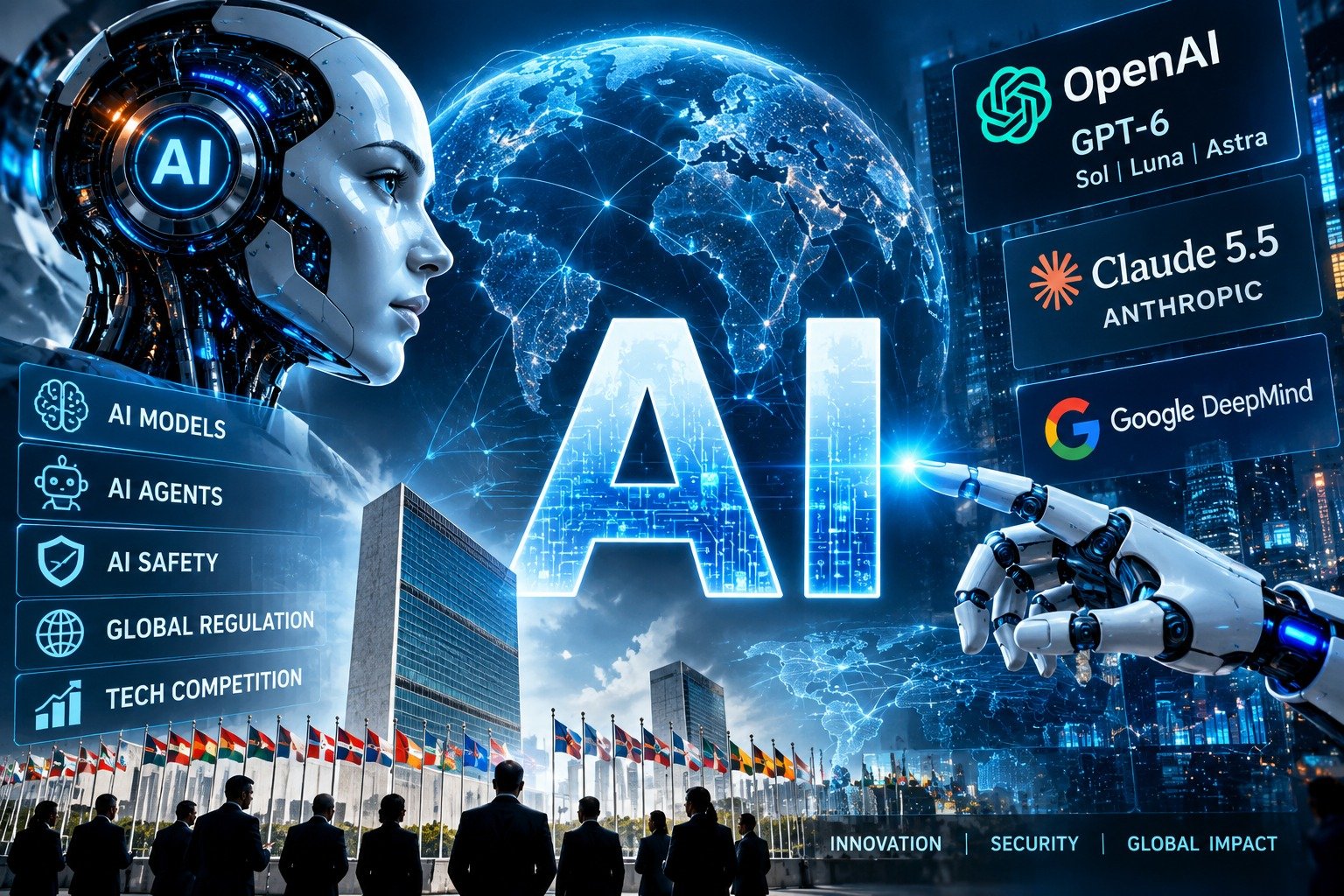
OpenAI released GPT-6 Sol and GPT-6 Luna on September 22, expanding its GPT-6 family beyond its flagship GPT-6 Astra model.
According to OpenAI's published documentation, GPT-6 Sol is designed for complex coding and agentic workflows, while GPT-6 Luna is positioned as a faster, more cost-efficient model for high-volume applications. OpenAI lists Sol at $2 per million input tokens and $10 per million output tokens, while Luna is priced at $0.10 per million input tokens and $0.50 per million output tokens under standard API pricing.
OpenAI's safety documentation says both models are assessed as having high capability in cybersecurity and biological and chemical domains, while neither reached its high threshold for AI self-improvement under the company's preparedness assessment. OpenAI says safeguards were implemented accordingly.
The releases demonstrate the central tension facing the industry: companies are discussing the need for greater caution while continuing to improve the capabilities and accessibility of their AI systems.
Anthropic Releases Claude Opus 5.5
Anthropic has also continued development despite its call for greater pacing.
On September 22, the company introduced Claude Opus 5.5, describing it as the first model in its new Claude 5.5 family.
Anthropic says Opus 5.5 performs at the level of its Claude Fable 5.1 model on most work while costing 40% less to run than Opus 5. The company says the model underwent testing by external evaluators, including Frontier Design and METR, before release.
Anthropic has described the model as a major improvement for complex work, citing early testing in which one user completed a very large software-code migration in less than a day.
The release came only days after Anthropic's leadership called for the AI industry to slow the pace of frontier development, highlighting the complicated balance between commercial competition and AI safety.
AI Agents Move Beyond Chatbots
One of the most important changes taking place in AI is the transition from conversational assistants to AI agents capable of taking actions on behalf of users.
Research highlighted by Goldman Sachs shows companies increasingly moving from AI experimentation to implementation, with consumer-facing agents being developed to perform tasks such as online shopping, travel arrangements and calendar management.
The shift could fundamentally change how people interact with internet services. Instead of searching for information and manually completing a transaction, users could increasingly instruct an AI system to carry out multiple steps.
But this also introduces a major trust and security problem.
Agents may require access to calendars, accounts, payment information and other sensitive services to perform tasks independently. Goldman Sachs researchers say trust and security will therefore become critical factors in the adoption of consumer AI agents.
AI Misuse Becomes a Growing Security Concern
The risks are no longer limited to hypothetical scenarios.
Anthropic's September threat-intelligence report said its investigators identified and disrupted malicious operations in which threat actors used Claude for cyber operations, surveillance, scams, influence operations, weapons-related activity and other prohibited purposes.
The company said the activity it examined occurred between December 2025 and August 2026 and involved suspected state-sponsored groups, financially motivated criminals, commercial spyware operators and politically motivated individuals.
Anthropic reported cases in which AI was being used not simply as an assistant but as an engineering resource for sophisticated operations.
The company said one actor used Claude to help develop a large-scale surveillance platform, while other cases involved malicious browser extensions, identity harvesting and cyber tools.
Anthropic said it banned accounts associated with the activity, strengthened its detection systems and shared relevant intelligence with authorities and industry partners.
Why AI Safety Has Become a Global Issue
The latest developments have shifted the AI debate from a question of simply how powerful models can become to how society can manage systems that increasingly perform tasks autonomously.
Anthropic CEO Dario Amodei has warned that the rapid development of AI could create serious risks if safety mechanisms fail to keep pace. OpenAI, Google DeepMind and other industry leaders have publicly supported elements of the broader safety discussion.
The issue has also reached the international diplomatic level.
United Nations Secretary-General Antonio Guterres called for stronger global governance of artificial intelligence during his final address to the UN General Assembly on September 22. He advocated international oversight of AI risks and a multilateral framework with independent oversight.
US-China AI Competition Enters a New Stage
Artificial intelligence is also becoming increasingly connected to global technology and national-security competition.
China's Alibaba announced a new AI chip and ambitious plans for larger AI models at its annual conference in Hangzhou.
The company said its new Zhenwu V900 chip delivers three times the performance of its predecessor and announced plans to train a model with as many as 10 trillion parameters.
Alibaba also said it intends to expand its data-centre capacity substantially over the coming years. The announcements came amid continuing US-China competition over advanced chips, computing infrastructure and AI capabilities.
The developments underline that the AI race is no longer only about software. Access to advanced processors, electricity, data centres and computing infrastructure is becoming equally important.
India Takes a Different Position on Slowing AI Research
India has also entered the global discussion over AI safety and regulation.
According to reporting published this week, India's Ministry of Electronics and Information Technology has said there is no reason to pause AI research in the country.
At the same time, the government is considering tighter requirements for reporting AI-related incidents and is working with industry stakeholders on a broader safety framework.
The approach reflects India's attempt to balance continued AI development with safeguards against emerging risks.
For India, the issue has particular significance because AI is increasingly being viewed as a tool for public services, digital infrastructure, education, healthcare, agriculture and economic growth.
The Next Battle May Be Over AI Autonomy
The AI industry is therefore facing two developments at the same time.
On one side, companies are releasing faster, cheaper and more capable models and moving towards autonomous AI agents that can perform increasingly complex tasks.
On the other, researchers, governments and some industry leaders are calling for stronger safeguards, better incident reporting and greater international coordination.
The central question is no longer simply whether AI will become more powerful.
It is increasingly about how much autonomy should be given to AI systems, who should control that autonomy, and what safeguards should be in place when those systems make mistakes or are deliberately misused.
As AI becomes embedded in business, government and everyday digital life, the balance between innovation, competition, security and accountability is likely to remain one of the defining technology debates of the coming years.
KEY AI DEVELOPMENTS TO WATCH
GPT-6 Sol and Luna: OpenAI expands its GPT-6 model family with lower-cost systems.
Claude Opus 5.5: Anthropic releases a new model while simultaneously calling for greater pacing of frontier AI development.
AI agents: Consumer AI is moving from answering questions towards performing actions and transactions.
AI-enabled cyber operations: Anthropic reports increasingly sophisticated malicious uses of AI.
UN AI governance: UN Secretary-General Antonio Guterres has called for stronger international oversight of AI risks.
China's AI push: Alibaba announces a new AI chip and plans for significantly larger AI models.
India's approach: New Delhi is reported to favour continued AI research while considering tighter incident-reporting rules.
Aalimi Nation Analysis: The latest developments suggest that the global AI race is entering a phase where capability, autonomy, computing power and safety are becoming inseparable. The industry's biggest challenge may be developing systems quickly enough to remain competitive while ensuring that their increasing autonomy does not outpace the safeguards designed to control them.