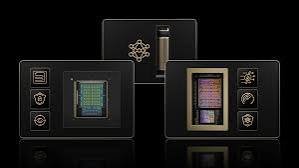
BERLIN, October 22 (Aalimi Nation) – Nvidia on Wednesday unveiled the OpenShell Reference Architecture at its GTC Berlin conference, a design for running artificial intelligence agents within fixed limits across data centres and edge devices.
The Nvidia OpenShell architecture is built on OpenShell, the company's open-source runtime that sets boundaries on what an AI agent is allowed to do. The software is released under the Apache 2.0 licence and forms part of an agent safety platform that Nvidia introduced in September.
Nvidia said the design assigns different jobs to different hardware. The models themselves run on Vera Rubin systems, while the agent software and tools run on Vera CPUs. Monitoring is handled separately on BlueField-4 data processing units running Nvidia Sentry, a component that watches agent behaviour from outside the main system and can quarantine an agent that leaves its boundaries.
Founder and chief executive Jensen Huang said in his keynote: "AI capability and safety must advance together." He added: "With the OpenShell Reference Architecture, agents can think on Rubin, act on Vera and be governed on BlueField."
For smaller deployments, Nvidia said the architecture extends to its RTX Spark, DGX Spark and DGX Station systems at the edge.
Nvidia said model developers including Anthropic, OpenAI, Google and Meta can run their agents on OpenShell infrastructure. Companies named as working with the architecture include Cisco, CrowdStrike, Dell Technologies, Google Cloud, Microsoft, SAP and ServiceNow. Nvidia said the design is available now.
The announcement reflects a growing concern among enterprises that autonomous software agents, which can browse, write code and take actions on behalf of users, need controls that sit outside the agent itself. Placing the monitor on separate hardware is intended to keep an agent from tampering with the system that supervises it.
The company also announced DSX POD, a reference design for complete Vera Rubin AI factories built by partners inside modular containers that are integrated and tested before delivery. Nvidia said that once site utilities are ready, on-site deployment can shrink from about six months to 14 days.
It said Vera Rubin is in full production and designed to be fully liquid cooled, with each node able to be assembled in under five minutes, compared with roughly two hours for a Grace Blackwell node. Nvidia also described power-management features intended to let facilities deliver the same output on less power and adjust consumption to grid conditions.
Companies are moving from chatbots to agents that carry out tasks, which raises questions about security, accountability and compliance, especially in regulated sectors. A reference architecture gives enterprises and equipment makers a common blueprint, and the open-source runtime lets outside developers inspect how limits are enforced.