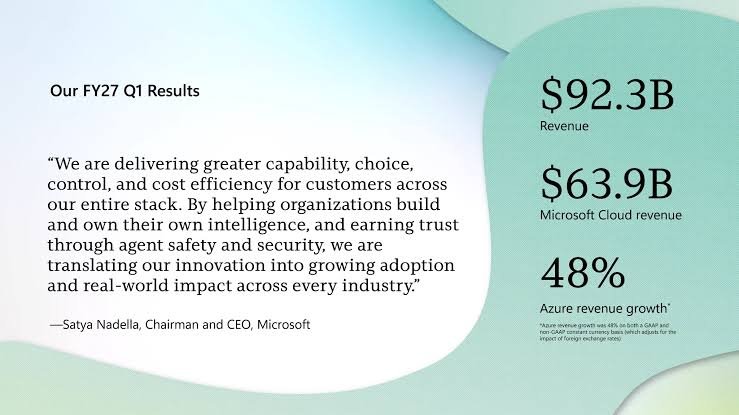
REDMOND, Washington, October 28 (Aalimi Nation) – Microsoft said its Azure cloud business generated $33.2 billion in revenue in the September quarter, up 48 per cent from a year earlier, as demand for cloud and artificial intelligence services pushed the company to another record. The Microsoft Azure revenue figure beat the company's own forecast of 44 to 45 per cent growth and marks the first time it has reported the unit's quarterly revenue in dollars.
For its fiscal first quarter, ended September 30, Microsoft reported total revenue of $92.3 billion, up 19 per cent, its tenth straight quarterly revenue record. Net income on a GAAP basis was $36.6 billion, up 32 per cent. Microsoft Cloud revenue reached $63.9 billion, up 30 per cent, while Microsoft 365 contributed nearly $28 billion.
Capital spending hit an all-time quarterly high of $45.2 billion. The company said its commercial remaining performance obligation, a measure of contracted revenue yet to be recognised, rose 73 per cent to $677 billion.
Not all Azure revenue comes from artificial intelligence, so the new figure does not by itself separate AI demand from conventional cloud use. Businesses also run conventional software on the platform, so the new figure does not by itself show how much of the growth is AI-driven.
Microsoft also said it booked $10 billion in revenue from OpenAI during the quarter, equal to about 11 per cent of its total. Microsoft has not broken the amount down between its different arrangements with the AI developer, and the company did not say how much of Azure's growth came from it. For the previous full fiscal year, revenue linked to OpenAI was $24.1 billion, according to the company's disclosures.
The size of that relationship is likely to draw attention from investors, because it shows how much of Microsoft's growth now rests on one customer and partner. OpenAI owed Microsoft $7.2 billion as of September 30, up from $6 billion in June, according to the same disclosures.
Microsoft also reorganised how it reports results into two segments, Agents and Infra, and Devices and Consumer. The Devices and Consumer segment generated $15.5 billion in revenue, down 3 per cent from a year earlier.
Cloud infrastructure is the main battleground for the companies building and selling AI services, and Azure's growth shows demand for computing capacity has not slowed. The $677 billion backlog suggests large customers have committed to multi-year spending, which supports the company's plans for further data centre construction. At the same time, the record capital spending shows the expense of keeping up with that demand.
Investors will look for how quickly Microsoft can turn the backlog into revenue, whether Azure growth stays above its forecast range, and whether the company gives more detail on the OpenAI relationship in coming filings.