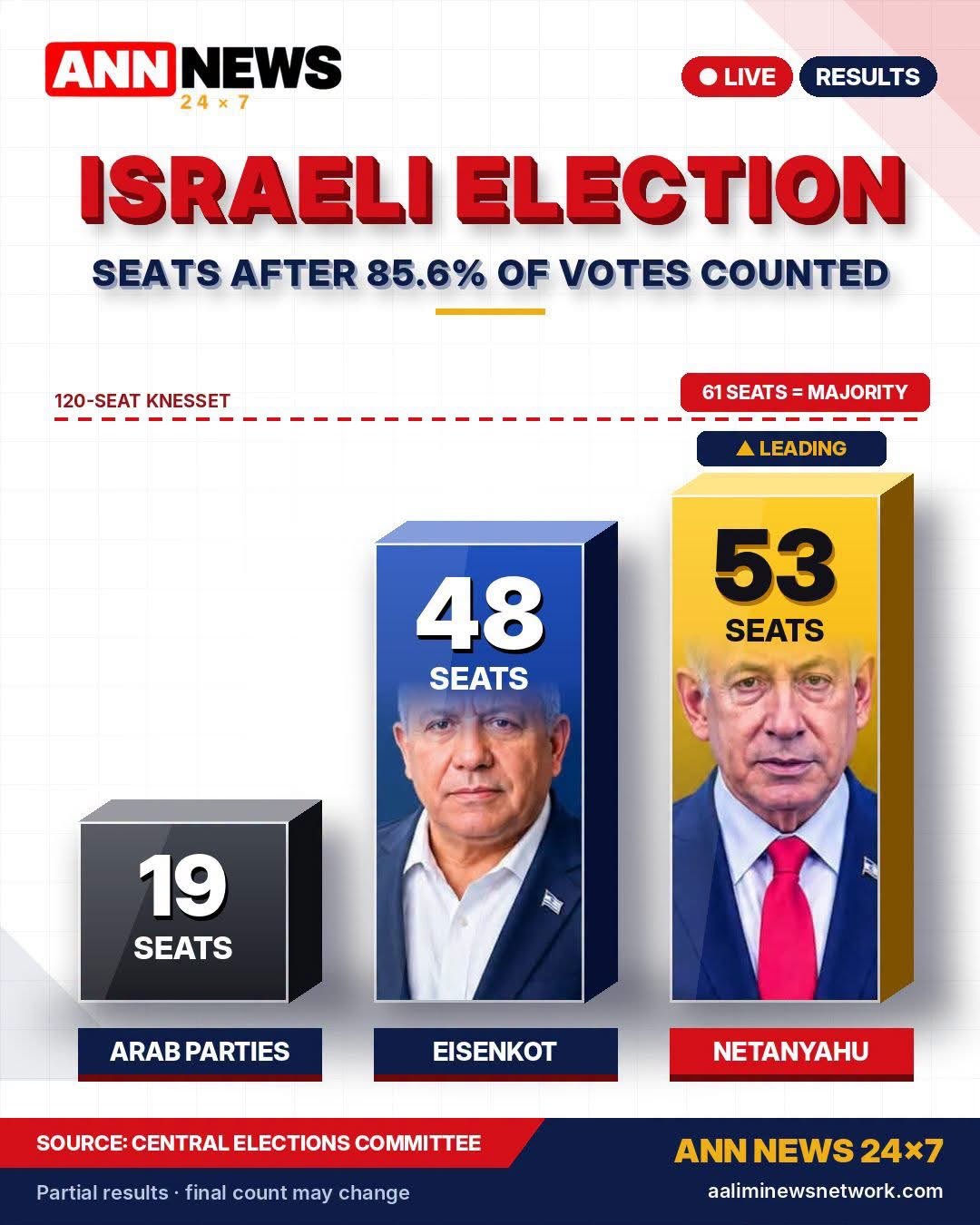
JERUSALEM, October 28 (Aalimi Nation) – With about 85 per cent of the vote counted, neither Prime Minister Benjamin Netanyahu's right-wing and religious bloc nor the alliance led by former military chief Gadi Eisenkot has the 61 seats needed for a majority in Israel's 120-member Knesset, leaving the Israel election result open to weeks of coalition bargaining.
Where the count stands
Projections based on the count, with 93 per cent of polling stations reporting, put Netanyahu's bloc at 53 seats, eight short of a majority. Eisenkot's camp, which includes his Yashar party, was on 48, while predominantly Arab parties were on about 19. Another tally, taken when roughly 84 per cent of ballots had been counted, gave the Netanyahu bloc 54 seats, Eisenkot's bloc 49 and the Arab parties 17, so the exact totals are still shifting by a seat or two.
Likud remained the largest single party with about 26 seats. Yashar was projected at 21, followed by the Beyachad list with 12 and the Democrats with eight. Exit polls issued when voting closed had shown the two main blocs level at 51 seats each.
Turnout was 77.7 per cent, the highest since 1999 and 7.1 percentage points above the 2022 election.
What is still to be counted
More than 500,000 so-called double-envelope ballots, including votes from soldiers and from voters outside their assigned stations, remain to be tallied. The Central Elections Committee has said counting of these ballots is due to begin around midnight on Wednesday and finish on Thursday evening. Results from Kfar Saba, Ra'anana, Sakhnin and Kafr Qasim had not yet reached the committee, which said those ballots were counted locally. The final tally is expected by Friday, while official results are due to be published formally on November 4.
Reactions from the leaders
Netanyahu said Likud had come out on top. "The Likud party is the largest party – nobody can compete with us," he said, adding that the right-wing bloc had what he described as a decisive majority. He also urged supporters to unite, saying the Zionist majority "must come to its senses and unite".
Eisenkot struck a different note. "The public chose change," he said, calling the result "a new start". Yair Golan, leader of the Democrats, said on his side: "Netanyahu lost. I know how to count to 120." Yousef Jabareen of the Joint List said the Netanyahu government had made life miserable for every Arab citizen.
What happens next
Under Israel's process, parties will start negotiating at once to try to assemble 61 seats. President Isaac Herzog will consult party leaders on whom they back for prime minister and then nominate the candidate he considers best placed to form a government. That nominee has up to 42 days to do so.
If no coalition emerges, Netanyahu's current cabinet continues as a caretaker government, which keeps its formal powers but is expected to show restraint on major, irreversible decisions. A decision to go to war would still require approval from the government or the security cabinet. If no government can be formed at all, fresh elections would be called.