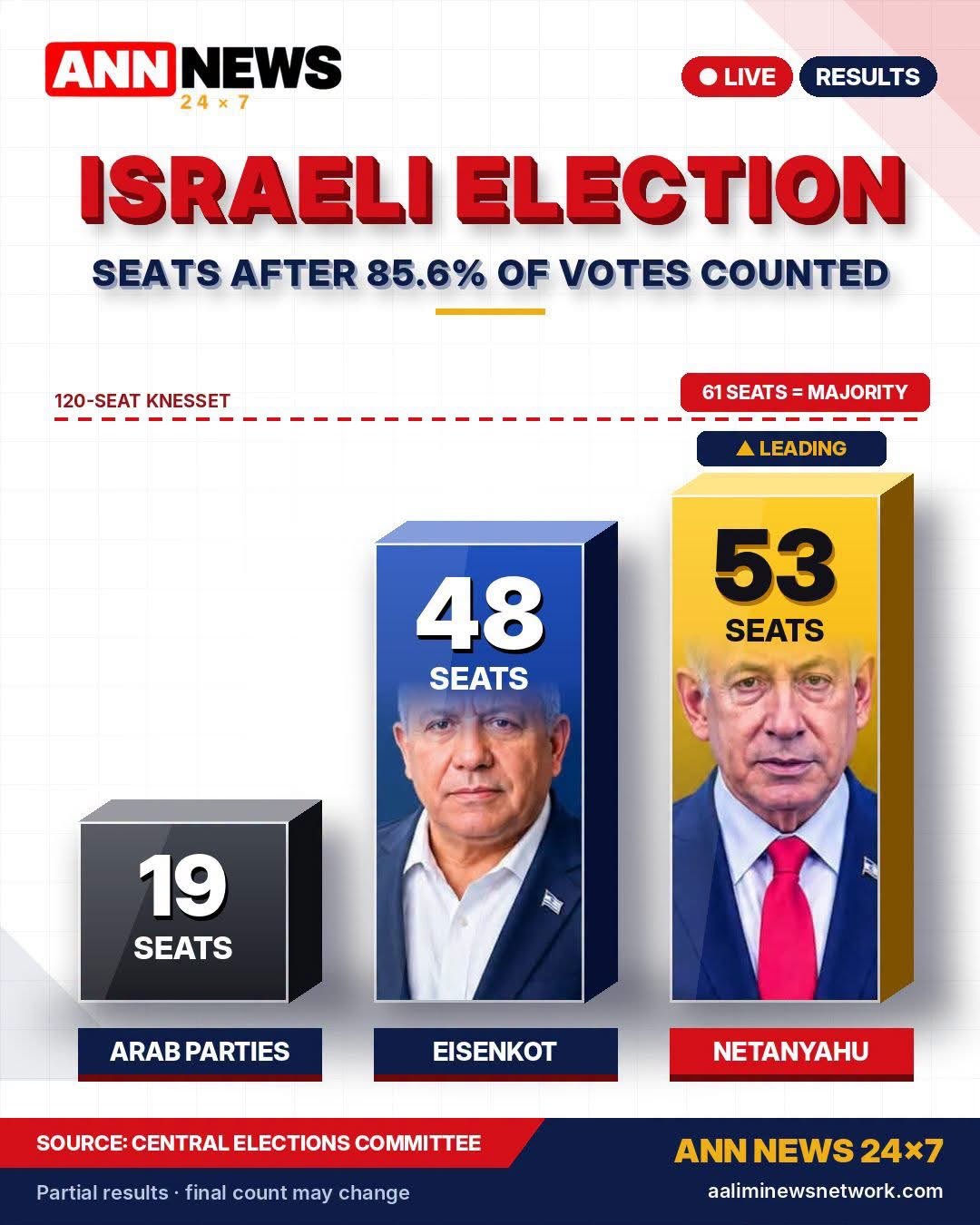
JERUSALEM, October 29 (Aalimi Nation) – With about 90 percent of the vote counted, Israel's election has produced no clear winner, leaving neither Prime Minister Benjamin Netanyahu's bloc nor the opposition alliance led by Gadi Eisenkot close to the 61 seats needed for a majority in the 120-member Knesset.
According to the latest count, Netanyahu's bloc is on course for 53 seats and Eisenkot's bloc for 48. Arab-led parties, including the Joint List and Ra'am, are projected to win about 19 seats between them, which would be a record. Earlier partial counts showed slightly different totals, and the figures moved as results came in. More than five million votes had been counted by 9 pm local time on Wednesday, and exit polls earlier in the week had already pointed to a tight race.
Israel election results await special ballots
The outcome could still shift. More than 500,000 "double-envelope" ballots, cast by soldiers, diplomats and others who voted away from their assigned polling stations, are yet to be counted. Counting of these votes was due to continue through Thursday, with final results expected on Thursday evening. They could change the distribution of seats, although it was not clear whether they could alter the balance between the blocs.
Netanyahu remains caretaker prime minister until a new government is formed. President Isaac Herzog is due to begin consultations with party leaders next week, once official results are released, and has urged parties to avoid another election.
Leaders respond
Eisenkot said his alliance was focused on bringing change. "The public chose change," he said, and described the goal as a "Zionist mobilisation government".
Netanyahu called for unity among his supporters. "The Zionist majority must come to its senses and unite," he said.
Democrats chair Yair Golan said: "Netanyahu lost. I know how to count to 120."
The Joint List said high Arab turnout had been decisive in keeping Netanyahu short of a majority. Its chair, Yousef Jabareen, said: "We will be prepared to pave the way for removing the Netanyahu, Ben-Gvir and Smotrich government." He added that the party could support an anti-Netanyahu government from outside but would not join it.
Allegations and coalition arithmetic
Netanyahu and his Likud party have alleged voter fraud by Arab parties. Likud said it was passing what it described as evidence to the police, the Shin Bet security service and the Central Elections Committee. The claims have not been independently verified, and the Joint List has said the result reflects high Arab turnout.
Both Netanyahu and Eisenkot have ruled out forming a minority government that relies on Arab-led parties. That leaves few straightforward routes to 61 seats. Analysts have suggested that a unity government, possibly including Eisenkot, is one option, but they say it is far from certain.
Herzog's consultations will begin once the final tally is published.
Until a coalition emerges, Netanyahu's government will continue in a caretaker role.
Several outcomes remain open, from a broad unity arrangement to a further election.