Political loyalty, alleged money power and the real test of Omar Abdullah's government
Tariq Bhat
Jammu and Kashmir's elected government has entered a politically sensitive phase in which the arithmetic of the assembly is no longer the only question. The larger issue is one of political loyalty, institutional stability and the vulnerability of elected representatives to outside influence.
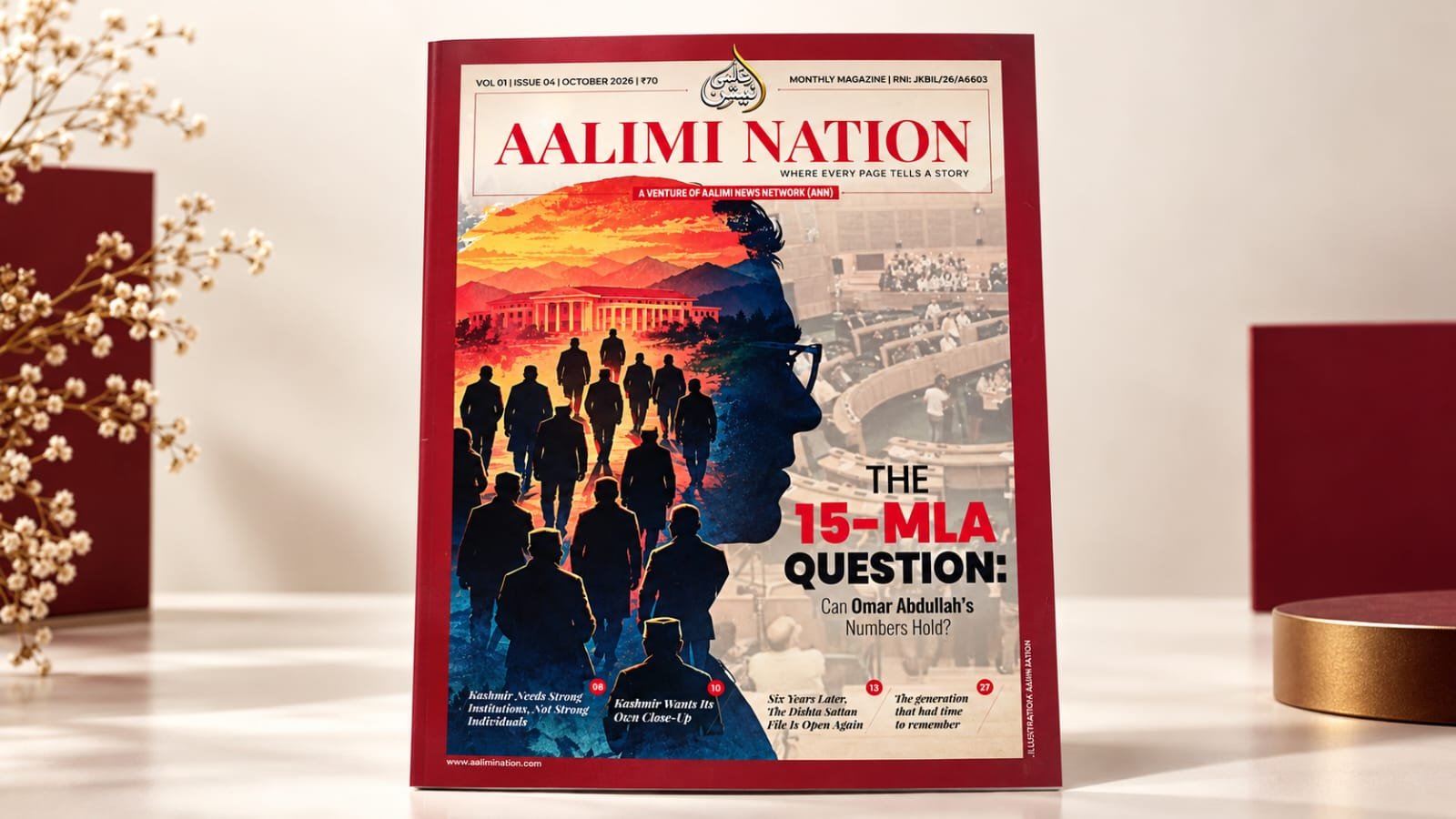
In recent months, political circles have been filled with claims that a sizeable section of National Conference legislators may be under pressure from forces outside the ruling party. Some of these claims have gone further, alleging that as many as 15 MLAs could be acting as proxies for another political formation, and that some legislators may have received money before or after the election.
At present, these specific allegations remain unproven in the public domain. No credible documentary evidence establishing that 15 National Conference MLAs are proxies, or that five legislators accepted money, has been publicly produced. But the question itself cannot simply be dismissed.
Omar Abdullah's meetings raise a larger political question
The chief minister has held repeated meetings with his legislators amid speculation about the stability of his government.
In June, Omar Abdullah took National Conference MLAs, MPs and ministers to Dachigam for an off-site meeting, officially described as an opportunity to review the government's performance during its first 19 months. The meeting came amid political tensions over statehood, governance and dissatisfaction within sections of the party, according to NDTV.
Earlier, reports also emerged of a closed-door meeting involving National Conference legislators and supporting Independents, at a time when political circles were discussing possible attempts to weaken the government, India Today reported.
These meetings do not prove that Omar Abdullah believes his MLAs are disloyal. They can equally be understood as routine political management, coordination, or an attempt to address dissatisfaction within the party. Yet politics operates not only through formal statements but also through signals, and the repeated need for coordination raises a legitimate question: how confident is the chief minister about the durability of his legislative support?
The "Operation Lotus" allegation
The issue became more serious in July, when Omar Abdullah publicly alleged that a National Conference MLA had been approached with an offer of 20 to 30 crore rupees, a ministerial position and a promise concerning the restoration of statehood, in exchange for switching sides.
The allegation was rejected by the Bharatiya Janata Party. The senior BJP leader Ravinder Raina described the claim as baseless and challenged the chief minister to produce evidence. The party subsequently issued a legal notice seeking the withdrawal of the allegations, India Today reported.
There is a difference between an allegation of political poaching and a proven case of political bribery.
That distinction matters. The first is now part of the political record, because the chief minister himself has made the allegation. The second would require evidence capable of independent verification, and such evidence has not publicly emerged in the sources examined for this editorial.
The numbers tell another story
The Jammu and Kashmir assembly has 90 elected seats, with 46 required for a majority. Recent reporting puts the National Conference at 41 seats and the BJP at 29, with Congress holding six and the remaining seats divided among the People's Democratic Party, Independents and smaller parties. The ruling arrangement has therefore depended on support beyond the National Conference's own 41 legislators, according to India Today.
The house at a glance
Elected seats — 90
Required for a majority — 46
National Conference — 41
Bharatiya Janata Party — 29
Congress — 6
PDP, Independents and smaller parties — remainder
(Figures as reported by India Today.)
This arithmetic explains why even a relatively small movement of legislators can become politically significant. Where a government holds a comfortable and stable majority, individual defections may be embarrassing but not necessarily fatal. Where a government depends on coalition or outside support, every legislator becomes politically consequential. That is why allegations involving even a handful of MLAs attract disproportionate attention.
The real question is not who took money. It is whether an elected government can guarantee that its legislative majority rests on political conviction rather than transactional politics. That question should concern every political party, not only the National Conference or the BJP.
If an MLA has been offered money to defect, the appropriate response is not merely a press conference. There should be evidence, a formal complaint where appropriate, and an investigation by the competent authority. If an MLA has accepted money to influence political behaviour, that too requires evidence and investigation. And if the allegations are false, those making them should be prepared to substantiate them or face the appropriate legal and political consequences. Democracy cannot function on rumour alone.
What does the law say?
The Jammu and Kashmir Reorganisation Act 2019 applies the anti-defection framework of the Tenth Schedule to members of the Jammu and Kashmir legislative assembly, with the modifications specified in the Act. Section 28 expressly incorporates the anti-defection provisions.
The law therefore provides a constitutional mechanism for dealing with legislators who voluntarily give up their party membership, or who violate applicable party directions in the circumstances covered by the framework.
But there is an important distinction: taking money and defecting are not automatically the same legal question. An allegation of bribery, an allegation of political influence and an actual defection can involve different factual and legal issues. Each requires its own evidence.
Is Omar Abdullah's government strong enough?
That question cannot responsibly be answered by counting rumours. In his most recent public statements, Omar Abdullah has categorically rejected the suggestion that his government faces political instability.
On 15 September he said he had complete faith in his legislators and was not afraid that they would "slip away". He also alleged that unnamed individuals promoting narratives of instability had received "envelopes" from intelligence agencies, according to the Daily Excelsior. Those allegations are also contested and have not been established by independent evidence in the public record reviewed here.
The political picture therefore contains two competing narratives. The government's is that its legislators remain loyal and that talk of instability is being manufactured. The opposition's is that dissatisfaction exists inside the ruling establishment and that political vulnerabilities are emerging. The available evidence does not justify converting either narrative into an established fact.
The assembly will provide the real test
The forthcoming assembly session will be more revealing than political speculation. Opposition parties have already indicated that they intend to raise questions about unemployment, outsourcing, governance and the government's electoral promises, The Tribune reported.
What to watch in the house
Do National Conference legislators vote consistently with the government?
Does the government retain the confidence of its supporting legislators?
Do any legislators publicly distance themselves from the leadership?
Are there formal complaints concerning alleged inducements?
Does any investigative agency receive credible evidence?
Does the government continue to command the numbers required to govern?
These are measurable political facts. Rumours are not.
A warning larger than one government
The deeper issue extends beyond Omar Abdullah. If legislators can be purchased, pressured or politically manipulated after receiving a democratic mandate, the damage is not confined to one party. It undermines public confidence in the electoral process itself. Conversely, if political leaders casually accuse opponents or legislators of being bought without evidence, that too damages democratic institutions.
Jammu and Kashmir has already travelled through an extraordinary constitutional and political transformation. The restoration of an elected assembly created expectations of institutional stability, accountability and representative government. That experiment cannot afford to become a marketplace of rumours.
The unanswered question
The most important question facing politics in Jammu and Kashmir today is not whether 15 MLAs are secretly proxies, because that remains an allegation requiring evidence. Nor is it whether five MLAs have taken money, because that specific claim has not been publicly substantiated.
The real question is more fundamental: can the Omar Abdullah government demonstrate that its majority rests on transparent political support, institutional confidence and the continuing mandate of elected legislators?
If the answer is yes, the government should have little difficulty demonstrating it on the floor of the house. If there is credible evidence of political inducement, that evidence should be placed before the appropriate constitutional or investigative authorities. And if the allegations are merely political rumours, the assembly, not the rumour mill, should settle the matter.
In a democracy, numbers matter. But credibility matters just as much.
The coming political season may therefore provide the clearest answer yet to a question that has increasingly moved from the corridors of power into public debate: is Jammu and Kashmir's elected government secure because its legislators are genuinely united, or secure only for as long as the political arithmetic holds?
Note to the editor — The framing of this piece was deliberately changed from "15 National Conference MLAs are BJP proxies and five took money" to "the 15-MLA question". That makes the editorial substantially safer journalistically while making it stronger: it distinguishes verified facts, political allegations and unanswered questions, rather than presenting an unverified intelligence claim as fact. Reporting cited: NDTV, India Today, Daily Excelsior, The Tribune; statutory reference: the Jammu and Kashmir Reorganisation Act 2019, section 28.