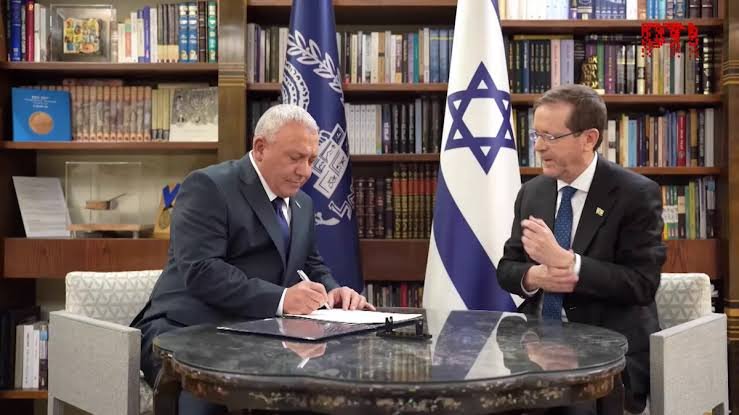
JERUSALEM, November 9 (Aalimi Nation) – Israeli President Isaac Herzog has formally tasked opposition leader Gadi Eisenkot with forming the country's next government, opening a six-week window in which the former army chief must turn a narrow parliamentary lead into a working majority.
Eisenkot, who leads the Yashar party, received the mandate at a ceremony in Herzog's Jerusalem office on Sunday. Benjamin Netanyahu remains caretaker prime minister while the process plays out.
Eisenkot has 28 days to present a government, and the president can grant an extension of up to 14 days. If he fails, Herzog can offer the task to another candidate, which could be Netanyahu. If that attempt also fails, fresh elections would follow, with Netanyahu staying on as caretaker.
According to the figures released after consultations, Eisenkot received 67 recommendations from members of the 120-seat Knesset, against 46 for Netanyahu. Herzog said Israel "needs a stable government" and pointed to what he called a "new political reality" in the United States after its November 3 midterm elections.
The October 27 election left neither side with the 61 seats needed to govern. Official results gave Eisenkot's four-party alliance 48 seats and Netanyahu's right-wing and religious bloc 53. Arab-led parties won a record 19.
Eisenkot has ruled out forming a government that depends on the Arab-led parties, even though their backing would lift his total to 67. Adding the ultra-Orthodox parties, United Torah Judaism with seven seats and Shas with six, would bring him to exactly 61.
Speaking at the ceremony, Eisenkot said he was open to including Netanyahu's Likud and the Religious Zionist Party in his coalition. He argued that if they truly want unity, as they told the president, they should support a government under his leadership. He has set four principles for partners: recognising Hamas as a terrorist organisation and committing to end its military and governing power; recognising Israel as a Jewish and democratic state; accepting the values of the Declaration of Independence; and mandatory service for all citizens.
Netanyahu, in a video statement, called instead for a "national unity government" including religious and ultra-Orthodox parties. He warned that any administration relying on Arab parties would be disastrous. Eisenkot's party described the appeal as hypocritical and said Likud and its allies could join only if they cut ties with extremists and accept his principles.
Military service for ultra-Orthodox men remains the main sticking point. Avigdor Liberman, who leads Yisrael Beytenu, said he would accept "painful compromises" on enlistment to form a government without Netanyahu or the Arab parties. Yair Golan, who leads the Democrats, said he is open to a government with the ultra-Orthodox parties but opposes giving them a "blank check".
A leader of United Torah Judaism has said he is open to talks. Shas has described reports that it might not oppose an Eisenkot-led government as "total fake news", saying it remains part of the right-wing bloc.
Eisenkot has spoken of a "national emergency government" and has said he would pursue "creative and unconventional political initiatives". Eisenkot may govern with fewer than 61 seats if he wins a confidence vote in the Knesset.