
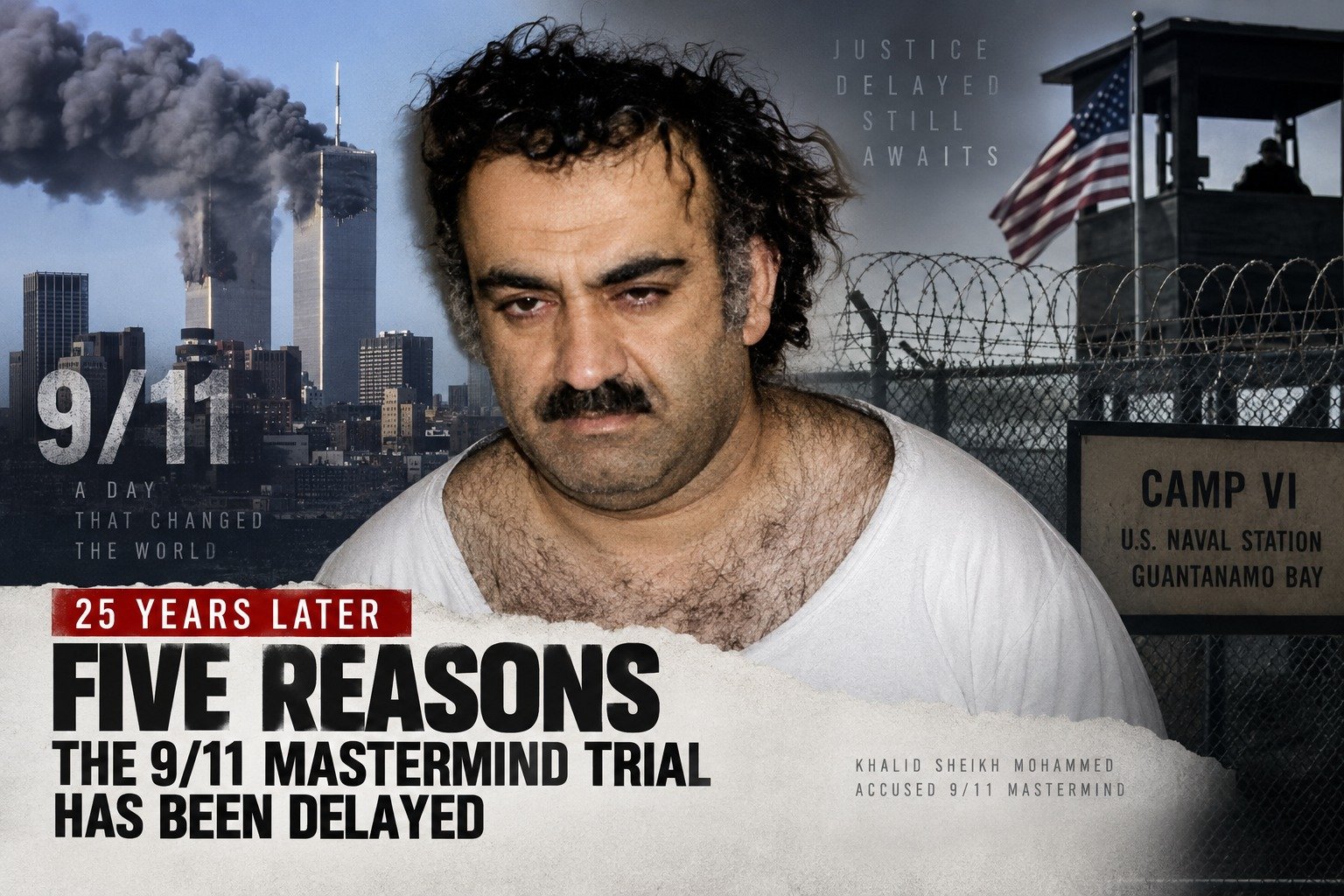
Twenty-five years after the September 11, 2001 attacks, one of the most consequential terrorism cases in modern history remains without a final verdict.
Khalid Sheikh Mohammed, accused by US authorities of being the principal planner of the attacks that killed nearly 3,000 people, was arrested in Pakistan in 2003. More than two decades later, his trial has yet to begin.
In the latest development, a military judge at Guantanamo Bay has set June 5, 2028, as the date for proceedings against Mohammed and four other defendants to begin. However, several unresolved legal issues could still threaten that timetable.
Here are five major reasons why the case has taken so long.
1. CIA Detention and Allegations of Torture
A central complication in the case stems from Mohammed's years in CIA custody.
After his capture in Pakistan in 2003, Mohammed was held at secret detention sites and subjected to harsh interrogation techniques, including simulated drowning, commonly known as waterboarding.
Defence lawyers have argued that statements obtained during this period were the product of coercion and therefore should not be admissible in court.
The dispute over the reliability and admissibility of those statements has consumed years of pre-trial litigation.
2. A Key Confession Was Excluded
The circumstances surrounding Mohammed's interrogations have also affected the prosecution's evidence.
A military judge excluded a significant confession Mohammed made in 2007, ruling that it had been obtained after severe coercion and at a time when he did not have access to a lawyer.
Prosecutors subsequently decided to pursue the case without relying on that confession in an effort to avoid further delays.
They maintain that other evidence—including communications records and financial information—can support the prosecution's case.
3. The Court Is Dealing With CIA Secrets
Another major obstacle involves classified information concerning the CIA's former detention and interrogation programme.
The court has had to balance the defendants' right to examine evidence and challenge the government's case against the government's obligation to protect classified information and national-security secrets.
As a result, proceedings that would ordinarily be handled as routine pre-trial matters have developed into lengthy legal disputes over what evidence can be disclosed, presented and challenged in court.
4. An Unusual Military Commission System
The case is not being heard in a conventional US federal court.
Instead, Mohammed and the other defendants are being tried through a military commission at Guantanamo Bay, an extraordinary legal system established for certain terrorism cases.
The proceedings have faced repeated institutional disruptions, including changes involving judges, prosecutors and defence teams.
The COVID-19 pandemic and the logistical difficulties associated with conducting complex litigation at Guantanamo also contributed to the delays.
5. A Plea Deal Created Another Legal Battle
The case took another unexpected turn in 2024 when prosecutors reached plea agreements with Mohammed and two other defendants.
Under the agreements, the defendants would plead guilty in exchange for avoiding the death penalty and receiving life imprisonment rather than going through a full capital trial.
However, then-US Defense Secretary Lloyd Austin intervened and withdrew his approval of the agreements.
That decision triggered another legal battle over whether the defense secretary had the authority to revoke agreements after they had been reached.
In July 2025, a US federal appeals court backed the government's position concerning Austin's authority to withdraw the agreements, sending the case back toward trial.
A Trial Still Waiting for Its Day
The extraordinary delay in the 9/11 case cannot be attributed to a single legal obstacle.
Instead, it is the result of several overlapping battles involving allegations of torture, the admissibility of confessions, classified CIA information, the unusual military-commission system and the collapse of plea agreements.
On paper, the June 2028 trial date provides a clearer path forward.
But after more than two decades of litigation, the history of the case offers little guarantee that the proceedings will begin on schedule.
For the families of the nearly 3,000 people killed on September 11, 2001, the case remains an enduring wait for accountability in one of the defining tragedies of the 21st century.