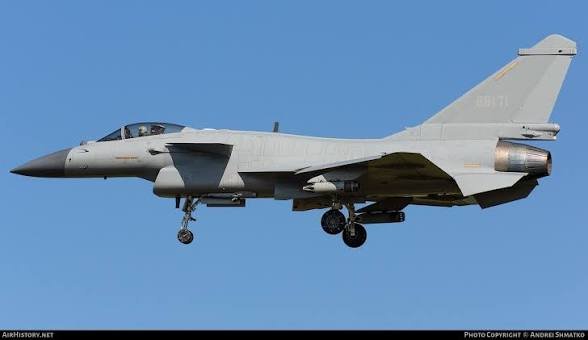
Bangladesh’s move towards acquiring China’s J-10CE multirole fighter deserves careful attention in New Delhi—not because a relatively small fleet of aircraft could suddenly alter the balance of power with India, but because the purchase could become part of a much larger transformation in the military geography surrounding India.
NEW DELHI — A new Chinese fighter is approaching India’s eastern neighbourhood
Bangladesh is advancing towards formal negotiations with China over the J-10CE, along with other military equipment. Bangladesh's prime ministerial adviser Zahed Ur Rahman has said the aircraft's reported performance during the 2025 India-Pakistan conflict was among the factors considered by Dhaka.
Reports have cited a potential purchase of 20 to 24 aircraft, but the precise number, cost and delivery schedule remain subject to the final negotiations and approvals.
For India, therefore, the question should not be whether Bangladesh is suddenly becoming a military peer.
It is not.
What happens when Chinese combat-aircraft technology begins appearing on both sides of India's land frontier?
Pakistan already operates the J-10CE. Bangladesh could become another operator.
That is the development New Delhi should study carefully.
The J-10CE is not an ordinary upgrade
The J-10CE is the export version of China's J-10C and is generally regarded as a modern 4.5-generation multirole fighter.
Its significance lies less in its appearance or speed than in its sensor-and-weapons architecture.
The aircraft is associated with an AESA radar, modern electronic warfare and datalink capabilities, and China's PL-series air-to-air missiles. These capabilities are designed to allow engagements at beyond-visual range, where the outcome can depend as much on sensors, networking, electronic warfare and missile performance as on the aircraft's manoeuvrability.
This is an important distinction.
A modern air battle is no longer simply:
fighter versus fighter.
It is increasingly:
sensor versus sensor, network versus network, electronic warfare versus electronic warfare—and missile versus missile.
That is precisely where India should concentrate its attention.
The real concern for India is not Bangladesh alone
Bangladesh has every sovereign right to modernise its armed forces and choose its suppliers.
India should not interpret every Bangladeshi defence purchase as an anti-India move.
But geography matters.
Bangladesh sits directly beside India's eastern states and close to the strategically important Siliguri Corridor, the narrow land connection linking India's northeastern states with the rest of the country.
A modern fighter fleet in Bangladesh would not give Dhaka the ability to dominate India's eastern airspace. India's overall military resources remain substantially larger.
But it does introduce a more capable combat-aircraft force into a part of the region where India must already account for China.
That creates an additional planning requirement for the Indian Air Force.
The Pakistan connection makes the development more important
The J-10CE's presence in Pakistan gives the Bangladeshi acquisition an additional strategic dimension.
Pakistan has already established the aircraft within its air-force structure. Bangladesh adopting the same platform would mean that two countries on India's western and eastern strategic peripheries could operate a common Chinese fighter family.
That does not mean Pakistan and Bangladesh will automatically coordinate militarily.
There is no evidence to support such a conclusion.
But from India's planning perspective, common Chinese-origin platforms could eventually create similarities in training, logistics, weapons familiarity and operational concepts.
That possibility is more important than the headline number of aircraft.
India should not panic but it should not be complacent
There is a temptation in Indian strategic commentary to react to every Chinese military acquisition with a simple demand:
Buy more fighters.
That is necessary but insufficient.
India's response should be built around five priorities.
1. Build the eastern air picture
India needs a comprehensive and continuously updated surveillance picture across the eastern theatre.
That means integrating:
ground-based radars;
airborne early-warning and control aircraft;
satellites;
unmanned surveillance systems;
electronic intelligence;
secure data links; and
real-time command-and-control networks.
The objective should be to detect, classify and track an aircraft before it becomes a tactical surprise.
The lesson from modern air warfare is straightforward: the side that sees first, understands first and communicates first gains a major advantage.
2. Accelerate indigenous fighters but focus on capability, not headlines
India cannot afford a prolonged fighter shortage.
The government has already ordered 97 additional Tejas Mk1A aircraft, while the Indian Air Force has sought a larger fighter fleet and is simultaneously backing the development of the Tejas Mk2 and Advanced Medium Combat Aircraft (AMCA). India's integrated air-command-and-control architecture and next-generation air-defence programmes are also being strengthened.
The answer, however, is not to choose between indigenous production and foreign fighters.
India needs both.
The immediate requirement is to expand combat-aircraft availability while simultaneously developing the next generation of indigenous systems.
The strategic objective should be:
more aircraft today, better aircraft tomorrow, and an indigenous ecosystem in the long term.
3. Counter the J-10CE at the system level
India should avoid framing the challenge simply as:
Rafale versus J-10CE.
That is an outdated way of looking at modern air warfare.
The more relevant comparison is:
Indian integrated air power versus Chinese integrated air power.
A Rafale, Su-30MKI or Tejas operating inside a superior Indian sensor and command network can have a very different combat value from the same aircraft operating independently.
India therefore needs to prioritise:
AESA radars + AWACS + electronic warfare + data links + long-range missiles + airborne and ground sensors + resilient command-and-control.
This is where India's technological investment should concentrate.
4. Strengthen the eastern flank without militarising the relationship with Bangladesh
This is perhaps the most important point.
India should not respond to Bangladesh's purchase by pushing Dhaka further towards Beijing.
That would be strategically counterproductive.
If India treats every Bangladeshi defence decision as hostile, it could unintentionally create exactly the Chinese strategic dependency New Delhi fears.
Instead, India should pursue a parallel diplomatic strategy.
New Delhi should keep defence and security channels open with Dhaka while expanding cooperation in areas where both countries have direct interests:
border management, counterterrorism, disaster response, maritime security, intelligence coordination and economic connectivity.
Bangladesh should continue to have reasons to maintain a balanced foreign policy.
India's objective should not be to prevent Bangladesh from buying weapons.
It should be to ensure that Bangladesh does not become strategically dependent on China for its entire security architecture.
5. Watch the infrastructure, not just the fighters
This may ultimately be more important than the aircraft themselves.
A fighter fleet becomes strategically significant when it is supported by:
hardened aircraft shelters;
fuel and ammunition infrastructure;
maintenance facilities;
advanced radar coverage;
secure communications;
electronic warfare systems;
UAVs;
long-range missiles;
dispersal bases; and
trained personnel.
Therefore, India's intelligence agencies and military planners should pay close attention to how Bangladesh develops the infrastructure surrounding its new aircraft.
The aircraft themselves are only one component of the equation.
The Siliguri question
India's strategic concern is particularly acute around the Siliguri Corridor, often referred to as India's “Chicken's Neck”.
But this issue must also be approached carefully.
The presence of J-10CE aircraft in Bangladesh does not mean that Bangladesh intends to threaten the corridor.
There is currently no evidence establishing such an intention.
Nevertheless, any modern combat-aircraft capability located in the wider vicinity of this strategically sensitive region inevitably becomes part of Indian contingency planning.
The appropriate response is therefore deterrence through preparedness, not speculation about Bangladeshi intentions.
India should ensure that the corridor and the broader Northeast are protected by layered air defence, dispersed military infrastructure, rapid-reaction capabilities and sufficient combat-aircraft coverage.
China is the bigger strategic story
Ultimately, Bangladesh's J-10CE decision is less about the aircraft than about China's expanding defence ecosystem in South Asia.
China is already Pakistan's principal military technology partner.
Bangladesh is one of China's longstanding defence customers.
The J-10CE could deepen that relationship by placing a sophisticated Chinese combat platform inside Bangladesh's military structure.
The aircraft therefore creates a long-term relationship involving training, weapons, maintenance, spare parts, upgrades and technical support.
That is how defence sales become strategic influence.
A fighter jet is purchased once.
The ecosystem around it can last for decades.
India must also learn the right lesson from the 2025 air war
Bangladesh's stated interest in the J-10CE has been influenced partly by its assessment of the aircraft's reported performance during the India-Pakistan conflict of May 2025.
But India should be cautious about accepting any simplified narrative that the conflict proved that one aircraft is inherently superior to another.
Pakistan made claims about Indian aircraft losses that New Delhi disputed, while outside reporting has produced a more complicated picture.
The correct military lesson is not:
“J-10 defeated Rafale.”
The more useful lesson is:
long-range missiles, electronic warfare, airborne surveillance, tactical networking, pilot training, intelligence and command-and-control can determine the outcome of modern air combat.
That is a much more valuable lesson for India.
What New Delhi should do now
India's response should therefore have four layers.
Military
Strengthen eastern air-defence and fighter readiness, particularly around strategically important areas in the Northeast and eastern India.
Technological
Accelerate AESA radar, electronic warfare, long-range air-to-air missiles, unmanned systems, AEW&C and secure battlefield networking.
Industrial
Increase the production rate of Tejas Mk1A, accelerate Tejas Mk2 and AMCA, and expand India's domestic supply chain for engines, sensors, weapons and avionics.
Diplomatic
Maintain a strong relationship with Bangladesh and prevent the defence relationship between Dhaka and Beijing from becoming a broader strategic alignment against Indian interests.
The Indian answer should be confidence, not alarm
Bangladesh acquiring the J-10CE does not fundamentally change India's military superiority.
But dismissing the development would also be a mistake.
The strategic environment around India is becoming more technologically competitive.
China is building military partnerships across the neighbourhood, Pakistan is deeply integrated into China's defence ecosystem, and Bangladesh is now considering a sophisticated Chinese fighter that could introduce another layer of Chinese military technology along India's eastern periphery.
India therefore needs to look beyond the aircraft.
The real competition is over airpower ecosystems, technology, industrial capacity, intelligence, diplomacy and strategic influence.
New Delhi's objective should not be to frighten Bangladesh away from China.
It should be to make India's own military capability so credible—and India's relationship with its neighbours so valuable—that no Chinese weapons purchase can translate automatically into Chinese strategic influence.
For India, the J-10CE should be treated neither as a reason for panic nor as a development to ignore. It should be treated as a warning to accelerate.