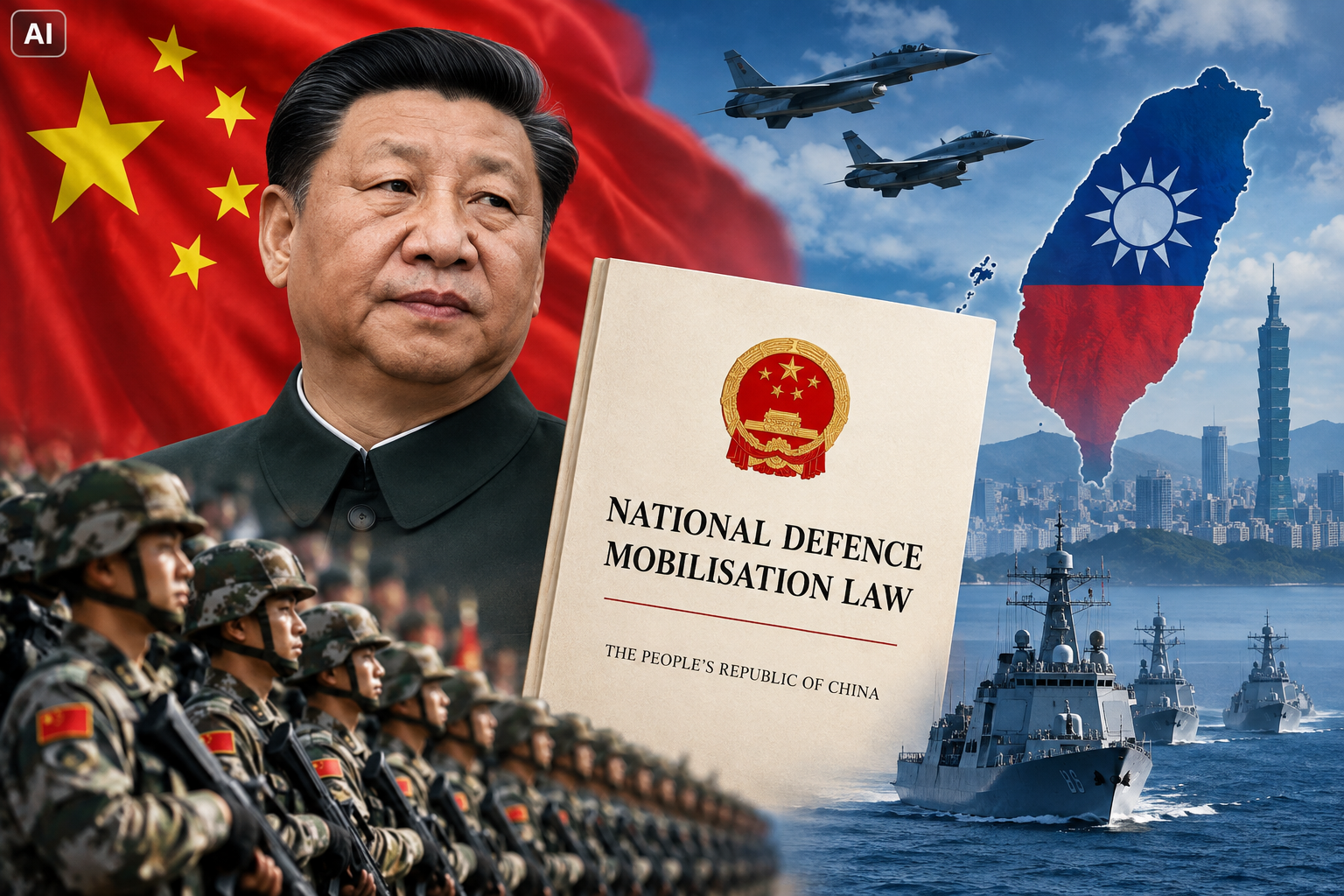
BEIJING: China has amended its National Defence Mobilisation Law for the first time in 16 years, introducing changes that some observers in Taiwan and elsewhere view as strengthening Beijing’s ability to shift from peacetime to wartime mobilisation.
The revised law was approved by the Standing Committee of China’s National People’s Congress on August 28 and is scheduled to take effect on October 1, 2026. The original legislation came into force on July 1, 2010.
While much of the existing framework remains intact, the amendments expand the scope of national defence mobilisation and strengthen provisions concerning civilian resources, strategic industries, infrastructure and military supply chains.
Protection of “Development Interests”
One of the most notable changes is the addition of “development interests” to the circumstances that can justify national defence mobilisation.
Under the 2010 law, mobilisation could be initiated when China’s sovereignty, national unity, territorial integrity or security faced a threat.
The revised legislation retains those grounds but adds the protection of development interests. The law does not clearly define what constitutes such interests, potentially giving the authorities broader discretion in determining when mobilisation may be required.
Some analysts have suggested that the provision could potentially provide a legal basis for protecting China’s overseas economic and commercial interests, although the law does not explicitly state that it authorises military operations abroad.
From Peacetime Capacity to Wartime Capability
The revised law introduces a new definition of national defence mobilisation, describing it as measures taken by the state to facilitate a rapid transition from peacetime to wartime conditions and to transform economic and social capabilities into national defence capabilities.
This concept is reflected in several provisions of the amended legislation.
Civilian projects and products closely linked to national defence will be required to meet military standards and technical specifications where civilian standards do not satisfy defence requirements.
The changes could further strengthen China’s long-standing policy of integrating civilian and military capabilities, allowing infrastructure, technology, manufacturing capacity and other civilian resources to be used for defence purposes when required.
Railways, ports and airports, along with cargo vessels and civilian aircraft, are among the resources covered by the broader mobilisation framework.
Greater Focus on Strategic Reserves and Supply Chains
The amended law also encourages companies, government institutions and social organisations to appropriately increase strategic material reserves and strengthen technological and production capacity reserves needed for national defence mobilisation.
Another provision requires the State Council and the Central Military Commission to conduct security assessments of military-product supply chains and take measures to improve their security and resilience.
Analysts have linked these provisions to China’s wider efforts to reduce dependence on foreign technology and supply chains and to strengthen its ability to withstand potential sanctions, export controls and external economic pressure.
Stronger Central Party Leadership
Another significant change concerns the command structure for national defence mobilisation.
The previous law stated that the State Council and the Central Military Commission would jointly lead national defence mobilisation across the country.
The amended legislation instead places greater emphasis on the centralised and unified leadership of the Communist Party of China Central Committee.
The revised law also refers to Xi Jinping’s thinking on strengthening the military in Article 3.
These changes have been interpreted by some observers as reflecting Xi’s effort to reinforce centralised political control over the military and national defence system.
Has China Increased the Military Service Age?
The amendments have also triggered discussion online over military service requirements.
However, the age limits for military service remain unchanged. Both the 2010 and 2026 laws maintain provisions covering men aged 18 to 60 and women aged 18 to 55 for national defence obligations.
The revised law does, however, explicitly state that eligible citizens have a legal obligation to perform national defence duties.
The issue prompted online speculation that China had expanded the age for compulsory military service. A fact-check by AFP said the circulating claims were misleading and that the age limits themselves had not been changed.
What Does the Chinese Media Say?
Chinese state media has generally presented the amendments as a legal and administrative update designed to bring the national defence mobilisation system in line with changing circumstances rather than as evidence that China is preparing for a specific war.
China’s state news agency Xinhua described the amendments as important changes intended to respond to a “new situation” and evolving requirements facing national defence mobilisation.
The state-run Global Times also rejected interpretations that the legislation should be viewed as a direct “signal of war”. In an editorial, it argued that the law reflects China’s emphasis on defence preparedness, normal administrative procedures and the rule of law.
The distinction is important: the amended law strengthens China’s capacity to mobilise economic, civilian and military resources quickly, but the legislation itself does not announce preparations for a particular conflict or establish that a war is imminent.
Why Is Taiwan Watching the Changes Closely?
The amendments have attracted particular attention in Taiwan because of the broader military and strategic tensions between Beijing and Taipei.
For observers concerned about a potential Taiwan Strait crisis, provisions that make it easier to integrate civilian infrastructure, industrial capacity, strategic reserves and supply chains into national defence planning are significant.
At the same time, the legislation must be distinguished from evidence of an actual decision to launch military action. Legal preparations for mobilisation can indicate an effort to improve national preparedness without necessarily demonstrating that a specific military operation has been ordered or scheduled.
Key Takeaway
China’s revised National Defence Mobilisation Law does not explicitly declare preparations for a particular war. But it does broaden and formalise the mechanisms through which Beijing could mobilise civilian, economic, technological and military resources in a crisis.
The addition of “development interests,” stronger centralised leadership, greater integration of civilian infrastructure and industry, strategic stockpiling and supply-chain security all point to a defence system designed to respond more rapidly to major national-security contingencies.
For Taiwan and other governments watching China’s military posture, the significance lies less in the law being a declaration of war and more in the expansion of the legal and institutional machinery available to Beijing if it decides that large-scale national mobilisation is necessary.