GENEVA, November 11 (Aalimi Nation) – The Ebola outbreak in the Democratic Republic of Congo has passed 11,000 confirmed cases, according to government data released on Tuesday, with at least 5,387 people dead. The Bundibugyo virus epidemic is now the second-largest Ebola outbreak on record, behind only the 2014–2016 West African epidemic.
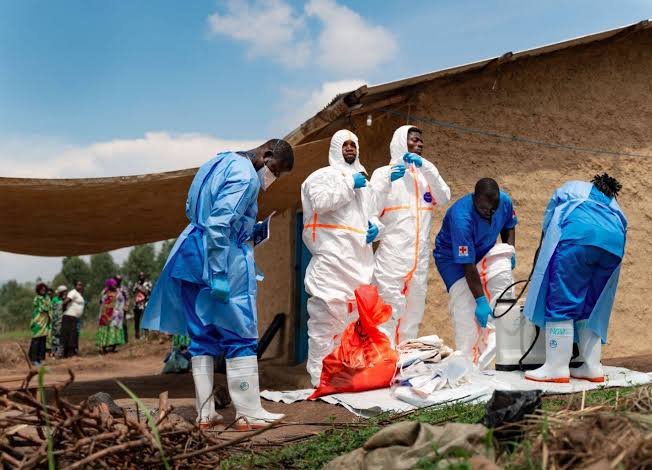
The latest national tally lists 11,042 confirmed cases. Health authorities are struggling to contain the spread, and many deaths have occurred outside treatment centres.
The World Health Organization (WHO) published a detailed update on November 6, using data as of November 3. It counted 10,668 confirmed cases and 5,198 deaths, a crude case fatality ratio of 48.7 per cent, across 67 health zones in eight provinces. The WHO said transmission remained active in 51 of those zones.
Ituri province carries most of the burden, with 7,485 cases and 3,532 deaths, followed by Nord-Kivu with 2,593 cases and 1,422 deaths. Since October 21, the WHO said, 512 deaths were recorded, 335 of them in communities rather than health facilities.
The outbreak has involved five countries: Congo, France, Kenya, Nigeria and Uganda. The WHO said France and Uganda have controlled their outbreaks since August. Kenya has reported nine confirmed cases and two deaths, with no new infections since October 19.
Nigeria confirmed one imported case in Abuja on October 20. The patient was evacuated to Switzerland and remains in isolation, and Nigerian officials have identified 62 contacts while they work to establish the likely source of infection.
Delayed detection, conflict and strained health services have let the virus spread faster than in earlier outbreaks, and it has reached more regions of the continent than any previous Ebola epidemic.
The WHO said funding gaps remain a concern. Follow-up of contacts averaged 86 per cent nationally, below the 95 per cent target. In its last assessment, issued in August, the agency rated the risk as very high in Congo, high for neighbouring countries and low elsewhere in Africa and globally. It said it is revising that assessment, and it advises against restricting travel or trade with affected countries.
The WHO said no approved vaccine or specific treatment exists for the disease, which kills roughly half of those it infects.
A Phase 2/3 platform trial, named Tumaini, began on October 23 in Bunia to test vaccine candidates. WHO expert groups have since recommended adding two more: one developed by the University of Oxford with the Serum Institute of India, and an mRNA vaccine from Moderna, both subject to national approvals. Results are expected in early 2027.
The WHO's revised risk assessment is the next milestone to watch. For now, the focus in Congo remains on finding cases earlier, reaching more contacts and reducing deaths in the community.
The scale of the West African epidemic, in which more than 28,600 people were infected and more than 11,000 died, offers a measure of the scale at which the current outbreak is now being compared.