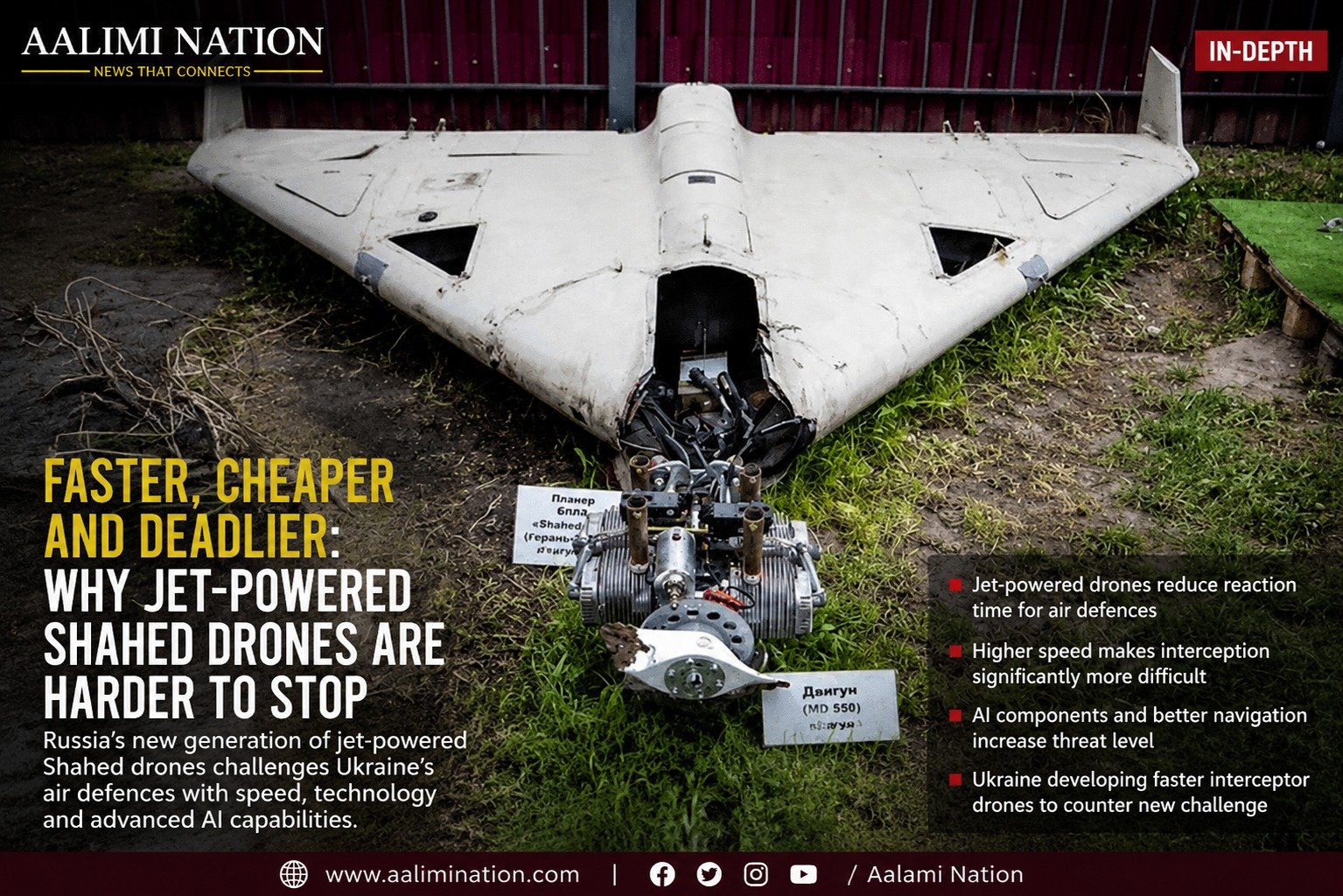
Since late 2022, the Shahed-136, and its Russian-produced counterpart often referred to as the Geran-2, have become among the most widely used long-range attack drones in Russia’s war against Ukraine.
A New Generation of Drone Warfare
Their distinctive engine sound, relatively low production cost and ability to travel hundreds of kilometres made them an important component of Russia's campaign against Ukrainian cities, energy infrastructure and military targets.
But the battlefield is changing.
Ukraine has steadily improved its ability to detect and destroy these drones. According to the figures cited in recent reporting, Ukrainian forces had, during parts of 2025 and 2026, reportedly achieved interception rates of between 90 and 95 percent against incoming Russian attack drones.
That success has forced Russia to adapt.
The answer appears to be a new generation of jet-powered Shahed-type drones—faster, potentially more difficult to intercept and designed to reduce the time available to Ukrainian air-defence systems.
The transformation could mark an important shift in the economics and tactics of drone warfare.
The question is no longer simply how many drones can be launched.
It is increasingly about how quickly they can reach their targets—and whether defenders can react in time.
Why Speed Changes Everything
Traditional Shahed-136 drones are powered by relatively simple piston engines and propellers.
Their advantages have been cost and range. But their greatest weakness is speed.
A conventional propeller-driven drone gives air-defence systems more time to detect, track and intercept it. Ukrainian forces have exploited this weakness through a combination of anti-aircraft guns, electronic warfare, mobile fire groups and increasingly, interceptor drones.
Jet-powered drones change this equation.
A faster drone reduces the window between:
Detection
Identification
Target tracking
Interception
Destruction
This may sound like a small technical difference, but militarily it can be significant.
For example, imagine an air-defence unit detects a slow-moving drone approaching a city from dozens of kilometres away. A relatively slow target may allow operators several minutes to determine its flight path and deploy an interceptor.
A faster jet-powered drone compresses that timeline.
The defending force may have seconds—or a very limited number of minutes—to respond.
This creates what military planners often describe as a reaction-time problem.
The faster the target, the less room there is for human decision-making and conventional interception procedures.
The Numbers Already Show the Challenge
According to Ukrainian military figures cited in recent reporting, Russia launched 115 attack drones during the night of August 4–5, with Ukrainian forces reportedly intercepting or neutralising approximately 85 percent.
The following day, Russia reportedly deployed 101 reconnaissance drones, more than half of which were powered by jet engines.
Ukraine's reported interception rate in that case fell to around 65 percent.
While individual attack statistics can vary depending on the nature of the mission, the number of drones involved and how “neutralised” targets are counted, the figures point toward an important battlefield trend:
Faster drones are becoming more difficult to stop.
This does not mean that jet-powered drones are impossible to intercept.
It means that Ukraine's existing defence model—developed partly around slower Shahed-type aircraft—may need to evolve again.
Ukraine's Success Created Russia's Next Innovation
One of the central lessons of modern warfare is that technological success often produces technological adaptation.
Ukraine became increasingly effective at countering Russian drones.
Instead of relying exclusively on expensive surface-to-air missiles, Ukrainian forces developed a layered defence system using:
Mobile anti-aircraft teams
Heavy machine guns
Electronic warfare systems
Radar networks
Searchlights and acoustic detection
First-person-view interceptor drones
Dedicated anti-drone aircraft
This created a serious problem for Russia.
Using a relatively inexpensive Shahed drone becomes less effective when the defender can destroy it with another low-cost system.
Ukraine's rapidly expanding interceptor drone industry has been particularly important.
The concept is straightforward: instead of firing a multimillion-dollar missile at a relatively cheap drone, Ukraine can use a smaller and cheaper drone to chase and destroy the incoming target.
But jet-powered drones could disrupt this model.
A propeller-powered interceptor may struggle to pursue a significantly faster target.
That means Ukraine may now need faster interceptors, improved radar systems and greater automation.
In other words, the drone-versus-drone war is becoming a race for speed.
Why Jet Engines Make the Drone More Dangerous
The danger posed by jet-powered drones extends beyond raw speed.
A faster drone can potentially complicate almost every stage of air defence.
1. Less Warning Time
The most obvious advantage is reduced reaction time.
Air-defence systems depend on early warning. If a drone travels faster, it reaches defended areas more quickly.
This makes detection networks more important than ever.
2. Harder for Mobile Fire Groups
Ukraine has relied heavily on mobile units equipped with machine guns and anti-aircraft weapons.
These systems can be effective against slow-moving drones.
But a faster drone is a much more difficult target for a human gunner.
The problem is similar to the difference between shooting at a slow-moving vehicle and attempting to hit a fast-moving aircraft.
Speed dramatically reduces the margin for error.
3. Interceptor Drones Face a New Challenge
A slow interceptor cannot easily chase a faster target.
Ukraine's growing fleet of anti-drone interceptors may therefore require more powerful engines, better sensors and automated guidance systems.
This could increase the cost of interception.
4. Greater Ability to Penetrate Defences
A drone attack is often designed to overwhelm defenders.
Russia may launch large numbers of drones from different directions, forcing Ukrainian air-defence systems to divide their attention.
Adding faster drones to the swarm could create additional confusion.
Defenders may be forced to prioritise targets based on speed, altitude and threat level.
That makes the air-defence picture significantly more complex.
Cheap Enough to Launch in Large Numbers
The Shahed's strategic value has always been connected to economics.
Even if a drone does not destroy a major target, it can force the defender to spend money and resources.
This is known as the cost-exchange problem.
If a country launches a relatively inexpensive drone and the defender responds with an expensive surface-to-air missile, the attacker may still gain an economic advantage.
For example:
A relatively low-cost attack drone enters defended airspace.
The defending country detects a possible threat.
An expensive missile is launched to guarantee interception.
The attacker has forced the defender to spend significant resources.
Multiply this by dozens or hundreds of drones and the economic pressure becomes substantial.
Ukraine has tried to solve this problem by using cheaper interception methods.
Russia's introduction of faster drones may be an attempt to force Ukraine back toward more expensive air-defence solutions.
That could be strategically important even if the drones themselves do not have dramatically larger warheads.
Artificial Intelligence Could Make the Threat More Complex
Another concern is the increasing use of advanced navigation, machine vision and artificial intelligence components.
The term “AI-powered drone” can sometimes be exaggerated in public discussion. Not every system described as artificial intelligence is fully autonomous in the science-fiction sense.
However, advanced software can significantly improve a drone's battlefield capability.
Potential functions include:
Improved navigation in electronically contested environments
Terrain recognition
Visual target identification
Autonomous route adjustment
Resistance to GPS jamming
Terminal guidance assistance
For example, a conventional drone may depend heavily on satellite navigation.
If GPS signals are jammed or manipulated, the drone may struggle to reach its target accurately.
A more advanced system equipped with cameras and onboard processing could potentially use visual landmarks or pre-programmed terrain data to continue navigating.
Similarly, machine vision could assist a drone during the final phase of an attack.
This is particularly concerning for defenders because electronic warfare—which has become one of the most effective tools against conventional drones—may become less effective if drones can operate with greater autonomy.
The Black Sea Example
Russia's drone operations have also demonstrated the strategic importance of unmanned systems far beyond the front line.
Ukraine's Black Sea ports are critical for trade and the movement of agricultural exports.
Long-range drones allow Russia to threaten infrastructure without placing conventional aircraft directly over heavily defended territory.
Faster drones could further complicate the protection of:
Ports
Energy infrastructure
Military bases
Logistics hubs
Industrial facilities
Major cities
A drone does not necessarily need to destroy a large target to achieve a strategic objective.
Repeated attacks can disrupt shipping schedules, force infrastructure shutdowns and keep civilian populations under constant pressure.
This psychological and economic impact is one reason why long-range drone warfare has become central to the Russia-Ukraine conflict.
From “Drone Swarms” to Multi-Layered Drone Attacks
The future danger may not come from one advanced drone.
It may come from combinations.
Military analysts increasingly expect future attacks to include multiple types of unmanned systems operating together.
A hypothetical strike package could include:
Slow decoy drones
Designed to attract radar attention and exhaust air-defence resources.
Reconnaissance drones
Used to identify defensive positions and monitor the results of attacks.
Fast jet-powered drones
Designed to exploit gaps and reduce interception time.
Cruise missiles
Used against heavily protected strategic targets.
Electronic warfare systems
Used to disrupt communications and navigation.
The objective would be to overwhelm the defender with complexity.
The defender must successfully identify and prioritise every threat.
The attacker only needs some of them to get through.
Ukraine's Next Challenge: Automation
The growing speed of aerial threats may eventually reduce the role of purely human decision-making.
A person can observe, identify and respond to a target only within certain time limits.
As drones become faster, air-defence systems may require greater automation.
This could involve:
AI-assisted radar analysis
Automated target classification
Autonomous interceptor drones
Computer-assisted firing solutions
Integrated sensor networks
The future may therefore involve AI fighting AI.
An attacking drone may use onboard software to navigate around electronic interference.
A defending interceptor could use computer vision to identify and pursue it.
Human operators may remain responsible for strategic decisions, but the speed of engagement could increasingly require machines to handle immediate tactical calculations.
The Next Arms Race Is Happening in the Sky
The evolution of the Shahed illustrates a broader transformation in modern warfare.
The drone is no longer simply a cheap surveillance device.
It has become a strategic weapon.
Countries are now competing to develop drones that are:
Faster
Cheaper
More autonomous
Harder to detect
More resistant to electronic warfare
Easier to manufacture in large numbers
Russia's move toward jet-powered attack drones is part of this wider arms race.
Ukraine responds with interceptor drones.
Russia increases speed.
Ukraine improves sensors.
Russia develops better navigation.
Ukraine expands electronic warfare.
The cycle continues.
Each innovation creates a countermeasure, and each countermeasure produces another innovation.
What This Means for the Future of the War
The introduction of jet-powered Shahed-type drones does not mean that Ukraine's air defences have suddenly become ineffective.
Ukraine continues to intercept a significant number of Russian aerial targets.
But the technology shift demonstrates that neither side can remain static.
The most important development is not simply the arrival of a new engine.
It is the changing logic of drone warfare.
The earlier Shahed model relied heavily on mass, range and low cost.
The emerging generation appears increasingly focused on speed, survivability and autonomy.
That combination could make future drone attacks more difficult—and more expensive—to defend against.
For Ukraine, the challenge will be to develop interception systems that can keep pace with faster targets without creating an unsustainable financial burden.
For Russia, the challenge will be mass production and ensuring that technological improvements translate into meaningful battlefield results.
But one conclusion is already becoming increasingly clear:
The next phase of the drone war will not simply be about who has more drones. It will be about who can innovate faster than the other side can adapt.
And in the skies over Ukraine, that technological race is accelerating.