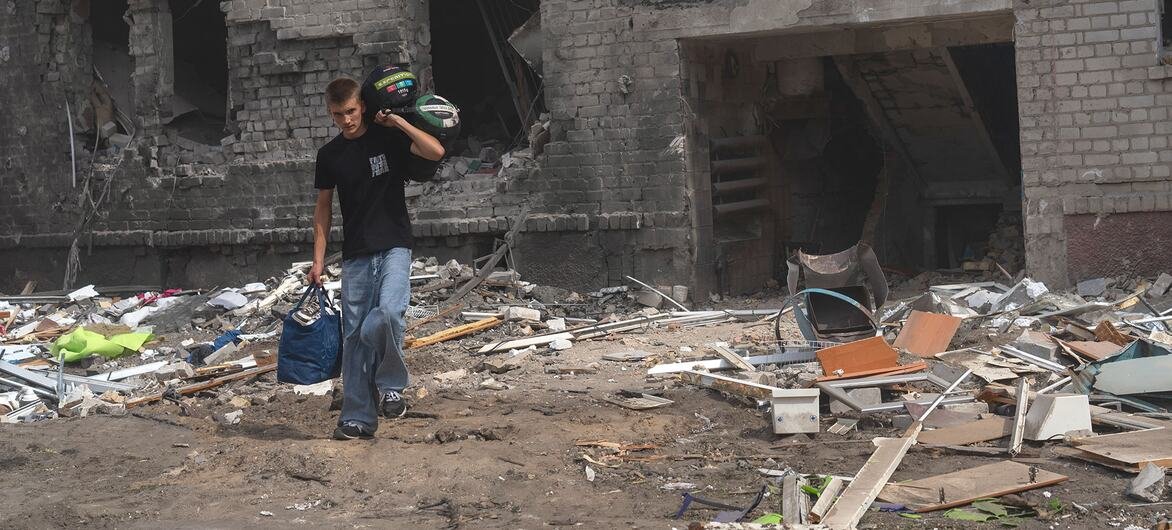
A new United Nations global risk survey has placed large-scale war at the top of the world's most prominent and increasingly imminent risks, marking a sharp shift in how experts view the international threat landscape.
The 2026 UN Global Risk Report, released on September 15, is based on the views of 1,300 stakeholders across 155 countries representing governments, international organisations, civil society, the private sector and academia. Participants assessed 28 political, economic, environmental, societal and technological risks according to their perceived importance, likelihood, interconnectedness and the world's preparedness to respond.
LARGE-SCALE WAR RISES SHARPLY
One of the report's most significant findings is the dramatic rise of large-scale war as a perceived global threat.
The risk climbed 16 places compared with the 2024 assessment, representing the steepest increase recorded for any risk in the survey.
According to the UN, 36 percent of respondents believe the effects of a large-scale war could reach a significant share of humanity within one year, while 76 percent expect such effects within seven years.
The report does not predict that a major war will occur. Rather, these figures represent the perceptions of the experts and stakeholders surveyed about the likelihood and potential impact of such an event.
The UN describes large-scale war as particularly concerning because it ranked among the top risks across multiple dimensions, including importance, imminence, interconnectedness and institutional preparedness.
FROM ENVIRONMENTAL RISKS TO GEOPOLITICAL TENSION
The findings represent a notable change from the UN's previous global risk assessment.
Two years ago, environmental threats, misinformation and pandemics occupied much of the attention in global risk discussions. In the 2026 survey, geopolitical tensions, armed conflict and weakening confidence in institutions have moved closer to the centre of the global risk landscape.
UN Secretary-General António Guterres, in the report's foreword, said political risks had moved to centre stage and that the prospect of large-scale war was viewed as substantially more important and immediate than two years earlier.
At the same time, the institutions expected to manage these risks are perceived as having less capacity to respond effectively.
NO REGION IS IMMUNE
The concern is not concentrated in one part of the world.
The UN says large-scale war and geopolitical tension now appear among the top 10 risks in all seven regions covered by the survey, and among the top five in six of those regions.
That represents a significant change from 2024, when the two risks appeared in the top five in only one region.
The report also identifies regional differences in how emerging risks are perceived.
Weapons of mass destruction, for example, entered the top 10 in Central and Southern Asia, Sub-Saharan Africa and Oceania.
In Eastern and South-Eastern Asia, respondents expressed increased concern about the possibility of a global financial crisis, the negative consequences of artificial intelligence and the growing influence of major technology companies.
AI-related concerns also entered the top 10 in Europe and North America.
WHY RISKS ARE BECOMING CONNECTED
One of the report's central conclusions is that global risks cannot be viewed independently.
Economic fragmentation, shortages of natural resources, misinformation and weakening multilateral institutions can reinforce geopolitical tensions. Those tensions can then increase the likelihood of conflict, which can generate further economic disruption and humanitarian crises.
The survey identified 705 connections between different risks, with the relationship between geopolitical tension and large-scale war emerging as the strongest connection.
This means that a major conflict would not necessarily remain confined to the battlefield. Its consequences could spread through financial markets, energy supplies, trade routes, food systems, migration, technology and international institutions.
AI EMERGES AS ANOTHER MAJOR CONCERN
Artificial intelligence has also become a much more prominent component of the global risk debate.
The report records a sharp increase in concern about AI and frontier technologies, particularly the concentration of technological power.
The issue is not limited to the technology itself. Respondents are also concerned about how increasingly powerful technologies could alter economic structures, information environments and the distribution of political and corporate influence.
At the same time, the survey suggests that the international system is perceived as poorly prepared to manage technological risks.
This creates what the report identifies as a growing gap between the speed of technological development and the ability of international institutions to establish effective safeguards and coordination mechanisms.
CLIMATE CHANGE REMAINS THE MOST IMPORTANT RISK
Despite the dramatic rise of war and geopolitical risks, climate change has not disappeared from the global risk picture.
The UN says inaction on climate change remains the single most important of the 28 risks assessed.
Climate-related concerns continue to rank highly across regions, alongside risks linked to natural-resource shortages.
The decline in the relative ranking of some environmental risks should not be interpreted as evidence that those threats have become less dangerous. The report cautions that risks can receive less attention without becoming less severe.
That distinction is important because political attention can influence the amount of funding and institutional capacity directed toward risk reduction.
PANDEMIC CONCERNS HAVE FALLEN
Another major change since the earlier survey is the decline in perceived risks associated with pandemics and biological threats.
Six years after the COVID-19 pandemic, biorisks and new pandemics have fallen more than any other measured risk in perceived importance.
The UN says these risks have dropped out of the top 10 across all regions.
The change does not mean that pandemics have ceased to pose a danger. Instead, it indicates that the attention of experts surveyed has shifted toward other threats, particularly geopolitical and technological risks.
THE WORLD IS SEEN AS UNDERPREPARED
Perhaps one of the report's most important findings is the gap between the risks identified and the perceived ability of institutions to manage them.
Respondents identified weak governance and coordination, declining political consensus, weakening trust and accountability among the principal obstacles to effective risk management.
Other barriers include inadequate data, poor prioritisation and resistance from political, business or public actors.
The funding gap is also substantial: 86 percent of respondents said funding for risk reduction is insufficient.
The UN specifically highlights natural hazards and the possibility of multilateral institutions failing as areas where resources are inadequate.
THE MULTILATERAL SYSTEM UNDER PRESSURE
The report places considerable emphasis on international cooperation.
The UN's survey suggests that many of the largest risks facing humanity are transnational by nature. A major war, global financial crisis, pandemic, climate disaster or technological disruption can rapidly cross national borders.
Respondents therefore continued to identify joint action by governments as the most effective mechanism for preventing or managing global risks.
The finding comes at a time when international institutions are facing significant pressure from geopolitical competition, disagreements between major powers and declining confidence in multilateral cooperation.
WHAT DOES THE REPORT ACTUALLY TELL US?
The UN is careful to distinguish risk perception from prediction.
The survey does not say that a global war will happen. It records how 1,300 stakeholders assess the likelihood, potential consequences and preparedness surrounding different risks.
That distinction is particularly important when interpreting the 36 percent one-year figure.
It should be understood as a measure of respondents' expectations about the potential global impact of large-scale war — not as a UN forecast that there is a 36 percent probability of a world war occurring within a year.
Likewise, the 76 percent figure reflects respondents' expectations concerning potential effects within seven years rather than an official prediction of a particular conflict.
A WORLD OF INTERCONNECTED CRISES
The broader picture emerging from the report is of a world in which individual crises increasingly reinforce one another.
A geopolitical confrontation can disrupt energy supplies and shipping. Energy shocks can contribute to inflation and food insecurity. Economic instability can intensify political tensions. Misinformation can deepen social divisions, while technological advances can accelerate the spread of false information or introduce new security vulnerabilities.
Climate change and resource scarcity can add further pressure.
The UN's risk framework therefore treats global security not simply as a military issue, but as a system in which security, economics, technology, climate and governance increasingly overlap.
THE UN'S MESSAGE: COOPERATION REMAINS POSSIBLE
Despite the increasingly severe risk environment described in the report, the UN's assessment is not framed as an inevitability of global catastrophe.
The report concludes that governments and international institutions still have tools available to reduce risks — provided they cooperate, improve preparedness, strengthen institutions and invest in prevention.
Secretary-General António Guterres said the 2026 report provides evidence that should inform decisions affecting present and future generations, stressing that action is needed while international cooperation can still help shape a safer course.
KEY FIGURES
1,300 — stakeholders surveyed
155 — countries represented
28 — global risks assessed
16 places — rise in the ranking of large-scale war since 2024
36% — respondents expecting major-war effects to reach a significant share of humanity within one year
76% — expecting such effects within seven years
86% — saying funding for risk reduction is insufficient
705 — connections identified between different global risks
AALIMI NATION ANALYSIS
The significance of the 2026 UN Global Risk Report lies less in predicting a particular war than in documenting a fundamental change in how global decision-makers perceive risk.
Two years ago, the dominant conversation was heavily shaped by pandemics, misinformation and environmental threats. The latest survey shows geopolitical confrontation moving decisively toward the centre of the international risk debate, while technological disruption — particularly AI — is becoming an increasingly important secondary concern.
The report also highlights a paradox: the risks perceived as increasingly interconnected are being confronted by institutions that respondents believe are increasingly underprepared and underfunded.
The result is a warning about preparedness rather than a prediction of war.
For governments, the report raises questions about diplomacy, crisis prevention, arms control, economic resilience, cyber and AI governance, climate adaptation and the ability of international institutions to cooperate during a major crisis.
For the wider public, its central message is straightforward: global risks rarely remain confined to the country or sector where they begin.
Official source: United Nations Global Risk Report 2026