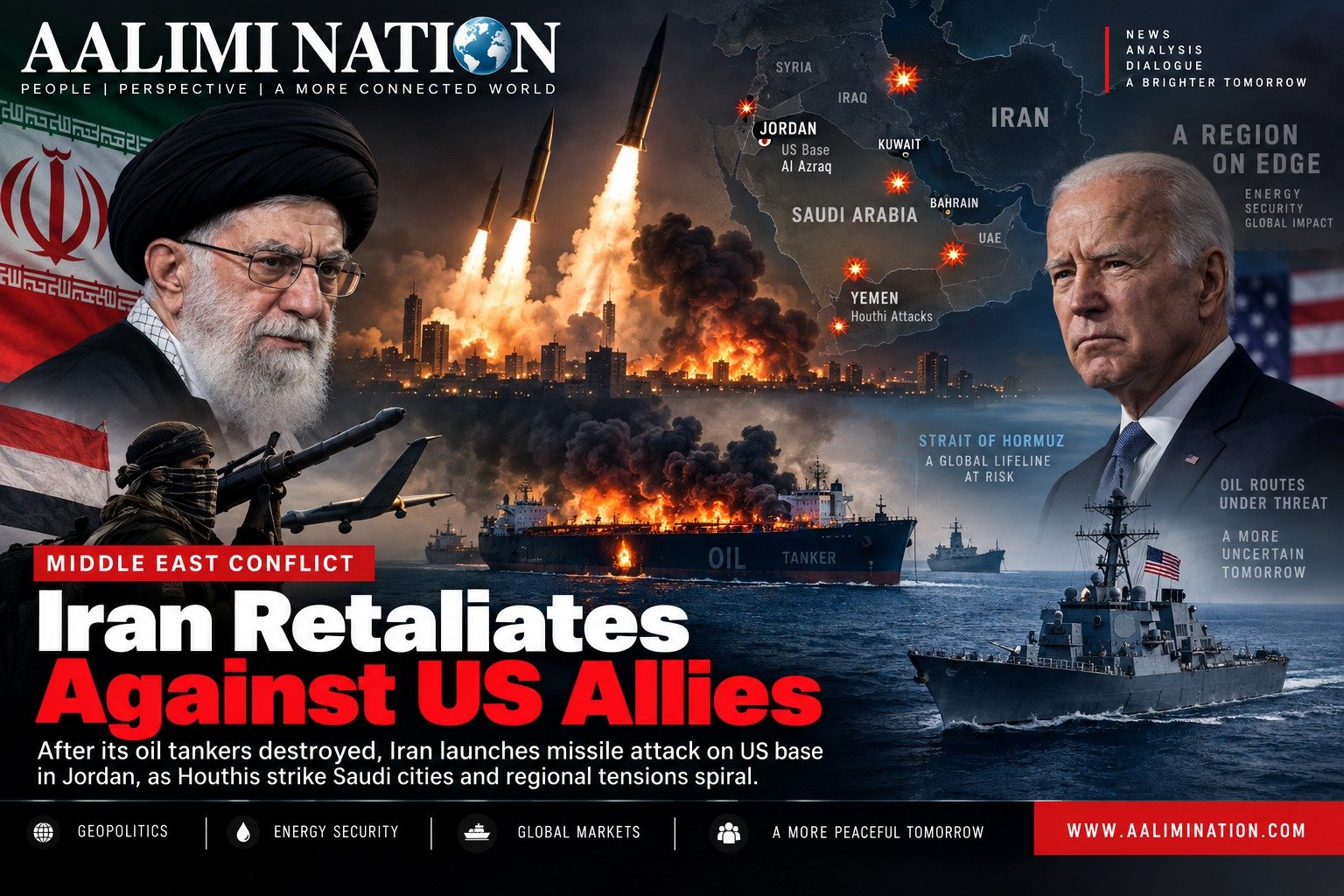
DUBAI, September 8, 2026: The conflict in the Middle East intensified sharply on Tuesday as Iran and forces aligned with Tehran expanded attacks against US allies and regional energy infrastructure, following a series of strikes by American forces against Iranian oil tankers.
Iranian-backed Houthi forces in Yemen launched missile and drone attacks against several cities in southern Saudi Arabia, injuring 73 people and triggering fires at oil and energy installations. The escalation came as the United States said it had destroyed five Iranian crude-oil carriers in a widening confrontation with Tehran.
The latest developments have heightened fears that the conflict could spread further across the Gulf and threaten the region’s energy infrastructure and vital maritime trade routes.
Iran targets US base in Jordan
Iran subsequently launched a ballistic-missile attack against a US military facility near Al Azraq in Jordan, according to a statement from Iran’s Islamic Revolutionary Guard Corps (IRGC) carried by Iranian state media.
Iranian media released footage purporting to show missiles being launched toward the region and claimed the attack inflicted significant damage.
Jordan, however, said its air-defence systems intercepted 18 of the 20 missiles, while the remaining two landed in unpopulated areas. Jordanian authorities reported no casualties from the attack.
The strike marked another direct expansion of Iran’s confrontation with US military forces and their regional partners.
Iran has previously targeted US interests and allied positions across the region during the conflict. A July attack on a US military position killed two American service members, according to US authorities.
Iranian state media also reported that the IRGC had targeted two US destroyers, although the US military had not immediately confirmed the claim.
The US military's Central Command said American forces destroyed five Iranian crude-oil tankers on Tuesday, releasing video footage of the operations.
US officials said the strikes were carried out after Iran’s IRGC allegedly attempted to target a US Navy warship with ballistic missiles on two occasions during the preceding two days. Washington said no American personnel were injured.
US Secretary of State Marco Rubio said the attacks on Iranian tankers were intended to deter further Iranian strikes against US naval forces.
“Iran continues to try to hit U.S. naval ships,” Rubio said during a visit to Colombia, adding that Tehran would face further losses if it continued attempting to attack American warships.
Washington said the vessels targeted by US forces were part of a shadow shipping network allegedly used to generate revenue for the IRGC and Iran’s regional allies.
The Houthi movement in Yemen claimed responsibility for a major operation targeting Saudi territory.
The group said it had launched missiles and drones against a Saudi airbase in Khamis Mushait, as well as assets belonging to Saudi state oil company facilities in Abha, Najran and Jazan.
Saudi authorities reported fires at several locations and said women and children were among the 73 people injured.
Satellite imagery reportedly showed a large cloud of black smoke above the Jazan refinery, while another plume of white smoke was visible over an oil distribution facility in Abha.
The scale of the reported casualties and damage made the attacks among the most significant assaults on Saudi territory since the wider US-Israeli conflict with Iran began in February, according to reports.
The latest attacks have raised concerns about the potential impact on global oil supplies.
After a period of relative calm in August, the United States and Iran have resumed direct exchanges of fire in recent days. International oil markets have responded to the renewed uncertainty, with Brent crude climbing to its highest level since July 23.
Prices rose by roughly another dollar a barrel following the Iranian missile attack on Jordan, although Brent remained below the psychologically important $100-per-barrel threshold.
The risk to energy markets extends beyond the Strait of Hormuz. Continued Houthi attacks could threaten energy infrastructure and shipping routes on the Arabian Peninsula, while attacks on tankers could further complicate international oil transportation.
The confrontation has increasingly become a contest of economic and military pressure between Washington and Tehran.
The United States has sought to maintain the flow of oil through the Strait of Hormuz, one of the world's most strategically important energy chokepoints, while simultaneously attempting to restrict Iranian oil exports.
Iran, meanwhile, has continued to demonstrate its ability to launch missiles and drones against regional targets despite US military strikes that Washington says have significantly weakened Iran's conventional military capabilities.
Tehran has also warned that it could target oil tankers in ports in Kuwait and Bahrain, raising further concerns about the safety of commercial shipping across the Gulf.
A maritime security source separately reported damage to a liquefied natural gas tanker at the Emirati port of Khor Fakkan, although responsibility for the incident had not been established.
Yemen front adds another layer to the conflict
The renewed Houthi escalation has opened another potentially dangerous front in an already expanding regional conflict.
The Houthis control much of Yemen's most populated territory, including the capital, Sanaa. The group has previously disrupted international shipping around the Red Sea and the Bab el-Mandeb Strait, placing additional pressure on US allies and global trade.
Saudi Arabia has led an Arab coalition fighting the Houthis for more than a decade after the group seized control of Sanaa and drove Yemen's internationally recognised government from the capital. Fighting had eased considerably in recent years, but the fragile ceasefire has since broken down.
The latest escalation threatens to reconnect Yemen's long-running conflict with the broader confrontation between Iran, the United States and their respective regional partners.
Regional conflict enters a dangerous phase
The sequence of attacks from Iranian missile strikes and US attacks on oil tankers to Houthi assaults on Saudi energy infrastructure underscores the increasingly interconnected nature of the Middle East conflict.
With Washington attempting to restrict Iranian oil exports while protecting regional shipping, and Tehran and its allies retaining the ability to threaten military and economic targets across the region, the risk of further escalation remains high.
The immediate concern for global markets is whether the latest confrontation remains limited or develops into a sustained campaign against oil infrastructure, commercial shipping and strategic military installations.
For governments across the Gulf, the widening conflict presents a difficult balancing act: protecting critical infrastructure and maritime routes while avoiding steps that could trigger an even broader regional war.
(ANN NEWS)