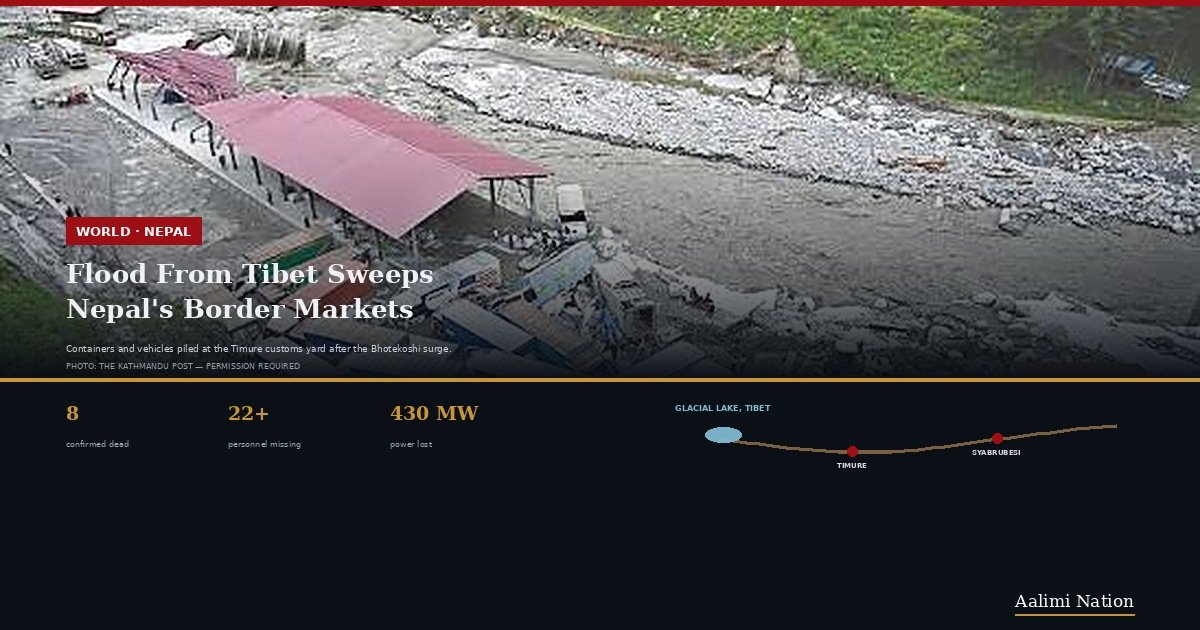
A wall of mud and water tore through the Rasuwagadhi crossing at 8.40am, sweeping away trucks, bridges and hydropower plants. Among the missing are 178 Indians, many of them Kailash Mansarovar pilgrims, and hundreds of foreign travellers from 32 countries.
Aalimi Nation · International Affairs Desk | Kathmandu
The surge reached the border post at twenty to nine in the morning.
Surveillance footage from the Rasuwagadhi crossing, verified by international broadcasters, shows crowds attempting to run from a wall of mud with nowhere to go before it reaches them. Rows of parked buses and freight trucks are pushed aside. Within moments the frame contains only wreckage.
More than 160 people are confirmed dead across Nepal and Tibet, and officials expect the toll to rise. More than 1,300 people remain unaccounted for on both sides of the border.
Nepal's Office of the Prime Minister expressed deep sorrow at the loss of life, offering condolences to bereaved families.
Who is missing
The scale of the missing is what distinguishes this disaster, and it reflects what the Rasuwa corridor is: a trading route and a pilgrimage road at the height of the season.
The Nepal Tourism Board reported that more than 500 foreign nationals from 32 countries are unaccounted for. They include 178 people from India, 65 from the United States, 53 from Ukraine, 51 from Malaysia, 35 from Australia, 33 from Britain and 25 from Canada. A further 127 Nepali travellers are missing.
More than a hundred of the missing Indian travellers were on one of the main routes for the annual Kailash Mansarovar Yatra, the pilgrimage to Mount Kailash and Lake Mansarovar in Tibet that passes through this crossing.
Across the border, Chinese officials reported three dead, two rescued and 558 missing after a mudslide struck the land crossing in Tibet's Gyirong county, including 260 foreign nationals. It is not yet clear whether Nepal and China are counting some of the same people, which means aggregate figures should be treated with caution.
The US State Department said the number of Americans affected has fluctuated through the day and that it does not yet have an accurate figure, with staff in Washington and Kathmandu in contact with the Nepali government.
The United States Geological Survey has attributed the flooding to a glacial collapse rather than rainfall.
Scientists said a large mass of ice fell into the valley below, picking up sediment already saturated by the monsoon and generating the surge that travelled down the Bhotekoshi and into the Trishuli. The USGS confirmed that no earthquake had occurred.
That mechanism matters for two reasons. It explains the absence of warning a glacier does not announce itself the way a storm does and it places the event in the category of disasters that a warming Himalaya is producing more often.
The Dalai Lama, offering prayers on Thursday for those killed, pointed to climate change as a factor.
The flood struck the trading towns along Nepal's border with China, hitting trucks, buildings and hydropower projects strung along the river. Rasuwa district, directly north of Nuwakot, has a population of fewer than 50,000.
Downstream, houses at Trishuli Bazar in Nuwakot were left partially submerged in muddy water. In Dhading district, bridges were washed away, among them the crossing at Malekhu, a stop on the tourist route known for its river sports and fish stalls. Roads and power infrastructure were damaged across the corridor, and Nepal reported a substantial loss of electricity supply from affected hydropower plants.
China has warned of a possible secondary disaster, with more rain forecast for Gyirong county this week. State broadcaster CCTV noted the area is already prone to landslides, mudslides and flash floods.
This is the third serious flood to strike the same corridor from the same direction in little over a year.
In July 2025, a surge originating in Tibet's Lhende river swept away the Miteri Bridge linking Nepal and China, killed at least nine people and left around twenty missing, damaging four hydropower projects and carrying off cargo containers, freight trucks and electric vehicles. Nepal's disaster authority subsequently concluded that a glacial lake in Tibet had ruptured, presenting satellite imagery showing no rainfall beforehand.
The infrastructure rebuilt after that flood has now been destroyed again.
What it means for India
For Indian readers this is not a distant story, and the reasons are immediate.
Nearly two hundred Indian nationals are unaccounted for, a substantial number of them pilgrims on a route the Indian government helps organise and thousands undertake each year. Families will be seeking information from the Ministry of External Affairs and the embassy in Kathmandu, and consular capacity in a disaster of this scale is the first thing to be tested.
The wider lesson is one India has learned repeatedly in Sikkim, Uttarakhand and Himachal Pradesh. Glacial lake outburst floods and ice collapses originate above the settlements they destroy, frequently across a national border, and no single country can monitor the hazard alone. Nepal's hydrology department has been examining satellite data with Chinese authorities; the absence of a standing, shared early-warning system across the Himalayan frontier is precisely what leaves people with no time to move.
Search operations continue along the Bhotekoshi and Trishuli. Officials on both sides have cautioned that the number of dead is likely to increase as access to the worst-affected settlements improves.