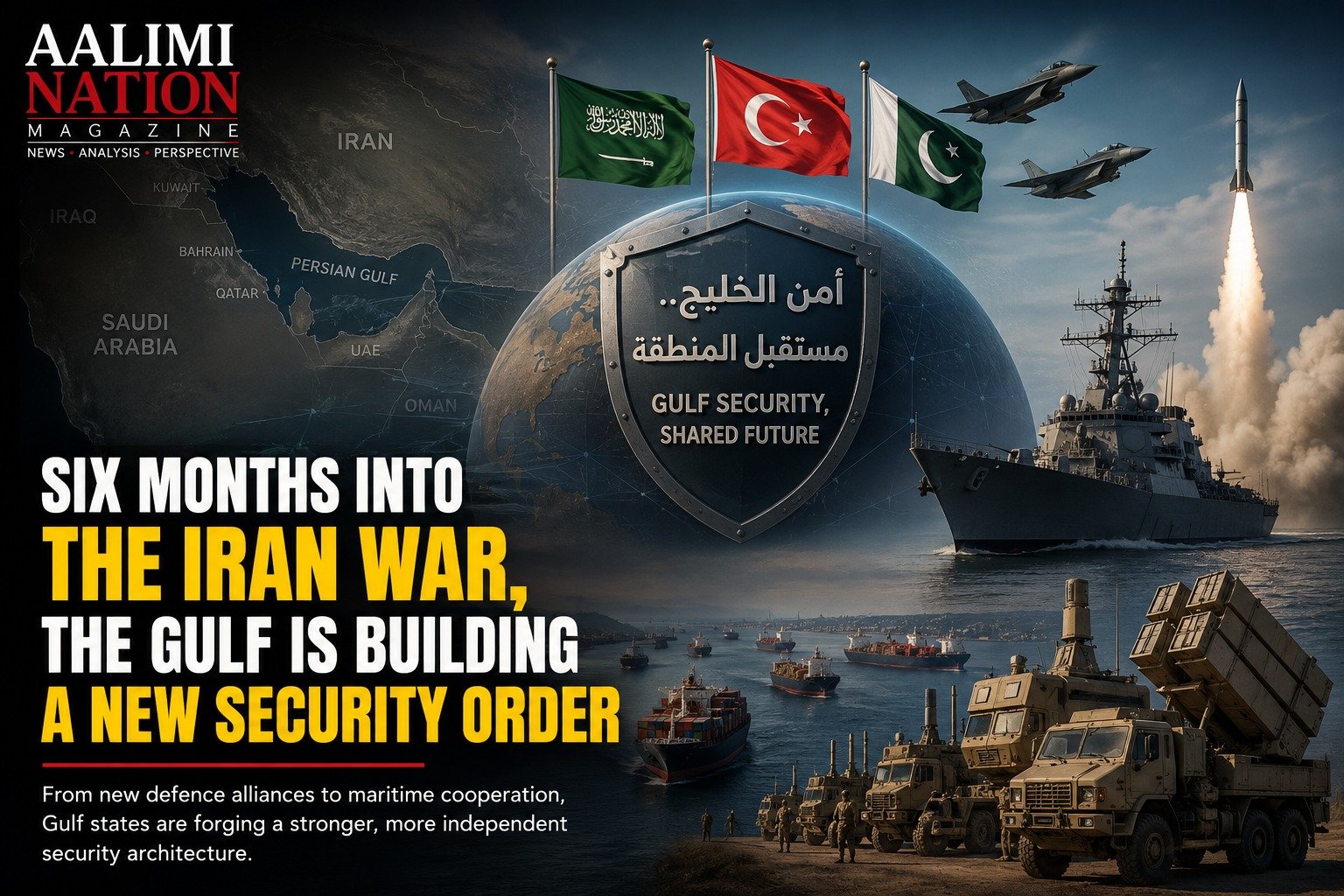
Six months into the Iran war, one reality has become increasingly clear: the security architecture of the Gulf is changing.
For decades, the region's security depended heavily on the United States. American military bases, naval deployments, intelligence networks and defence partnerships formed the backbone of Gulf security. But the recent conflict has exposed the limitations of relying too heavily on a single external power.
The result is not the disappearance of America's role. Rather, Gulf states are beginning to build additional layers of security around it.
From Dependence to Strategic Diversification
The conflict with Iran has forced Gulf capitals to reconsider an uncomfortable question: can their national security be entirely outsourced?
The answer increasingly appears to be no.
Missile attacks, drone warfare, disruptions to energy infrastructure and threats to strategic shipping routes have demonstrated that modern conflicts can affect the Gulf directly, even when regional governments are not formally parties to a war.
This has encouraged countries in the region to pursue a broader security strategy built around multiple partnerships.
The emerging model includes the United States, but also increasingly involves regional powers such as Saudi Arabia, Turkey, Pakistan and other strategic partners.
The objective is not necessarily to replace Washington. It is to ensure that the Gulf has alternatives, redundancy and greater regional capacity when crises emerge.
A New Network of Regional Partnerships
The recent defence understanding involving Saudi Arabia, Turkey and Pakistan illustrates this changing environment.
Such partnerships reflect a broader shift away from the traditional idea that Gulf security is managed primarily through Western military power.
Regional states are now exploring greater cooperation in:
Air and missile defence
Intelligence sharing
Drone warfare
Maritime security
Cybersecurity
Military training
Defence production
This is particularly significant because the threats facing the Gulf are no longer conventional.
Cheap drones can threaten expensive infrastructure. Missiles can disrupt airports and energy facilities. Cyberattacks can target financial systems. Naval mines can affect global التجارة and energy supplies.
No single country can easily manage all these threats alone.
The United States Still Matters
It would nevertheless be premature to suggest that the United States is being pushed out of the Gulf.
America remains the region's most powerful external military partner. Its naval capabilities, intelligence networks, advanced weapons systems and military infrastructure remain difficult for any regional coalition to replicate.
But the relationship is evolving.
The Gulf increasingly appears to be moving towards a model of strategic diversification rather than strategic replacement.
In simple terms, Gulf states want American security guarantees but they also want stronger regional capabilities and relationships that can function when American priorities change.
That distinction is crucial.
The Strait of Hormuz Changed the Debate
The disruption of shipping through the Strait of Hormuz has been one of the clearest reminders of the Gulf's vulnerability.
A relatively narrow waterway can influence global oil prices, shipping insurance, inflation and international trade.
The crisis has demonstrated that Gulf security is not simply a regional issue. It is directly connected to the global economy.
This gives Gulf states an additional incentive to develop stronger maritime cooperation and regional crisis-management mechanisms.
The future security architecture may therefore include greater coordination over naval patrols, shipping protection, intelligence sharing and critical infrastructure.
Saudi Arabia's Expanding Strategic Role
Saudi Arabia is likely to remain at the centre of this emerging architecture.
As the Arab world's largest economy and one of its most influential political powers, Riyadh has both the resources and strategic motivation to build stronger defence partnerships.
Vision 2030 has also added an economic dimension to security.
Saudi Arabia's transformation depends on stable investment, secure infrastructure and uninterrupted trade routes. The Kingdom's ambitious economic projects cannot flourish in an environment of permanent regional conflict.
That makes security cooperation not only a military priority but an economic necessity.
A More Independent Gulf?
The most important long-term development may be the gradual emergence of greater regional strategic autonomy.
For years, Gulf states were often seen primarily through the lens of their relationship with Washington.
That is changing.
Countries across the region are increasingly developing direct partnerships with each other, while also maintaining relations with the United States, Europe, China and other major powers.
This creates a more complex but potentially more resilient diplomatic and security network.
The Gulf is no longer thinking only in terms of alliances.
It is increasingly thinking in terms of strategic ecosystems.
The Challenge Ahead
Building a new security architecture will not be easy.
Regional rivalries remain. Different countries have different threat perceptions. Political disagreements can limit military integration.
There is also the danger that overlapping defence partnerships could create confusion rather than coordination.
A successful regional security structure will therefore require more than defence agreements and joint military exercises.
It will require:
Political trust
Shared intelligence mechanisms
Clear command structures
Crisis communication channels
Integrated air and missile defence
Long-term defence-industrial cooperation
Without these elements, the idea of a new security architecture could remain largely symbolic.
The Beginning of a New Era
Six months into the Iran war, the Gulf appears to be entering a strategic transition.
The old model in which regional security depended overwhelmingly on American military power is being supplemented by a more diverse network of partnerships.
The United States will remain indispensable for the foreseeable future. But Gulf states increasingly want to ensure that their security does not depend on any single power.
That may ultimately be the most significant geopolitical consequence of the conflict.
The Gulf is not abandoning its traditional allies. It is learning that in an increasingly unpredictable world, security requires more than one pillar.
The emerging Gulf order is therefore likely to be defined not by replacing America, but by building a stronger regional system capable of standing alongside it.
AALIMI NATION | Opinion Desk