
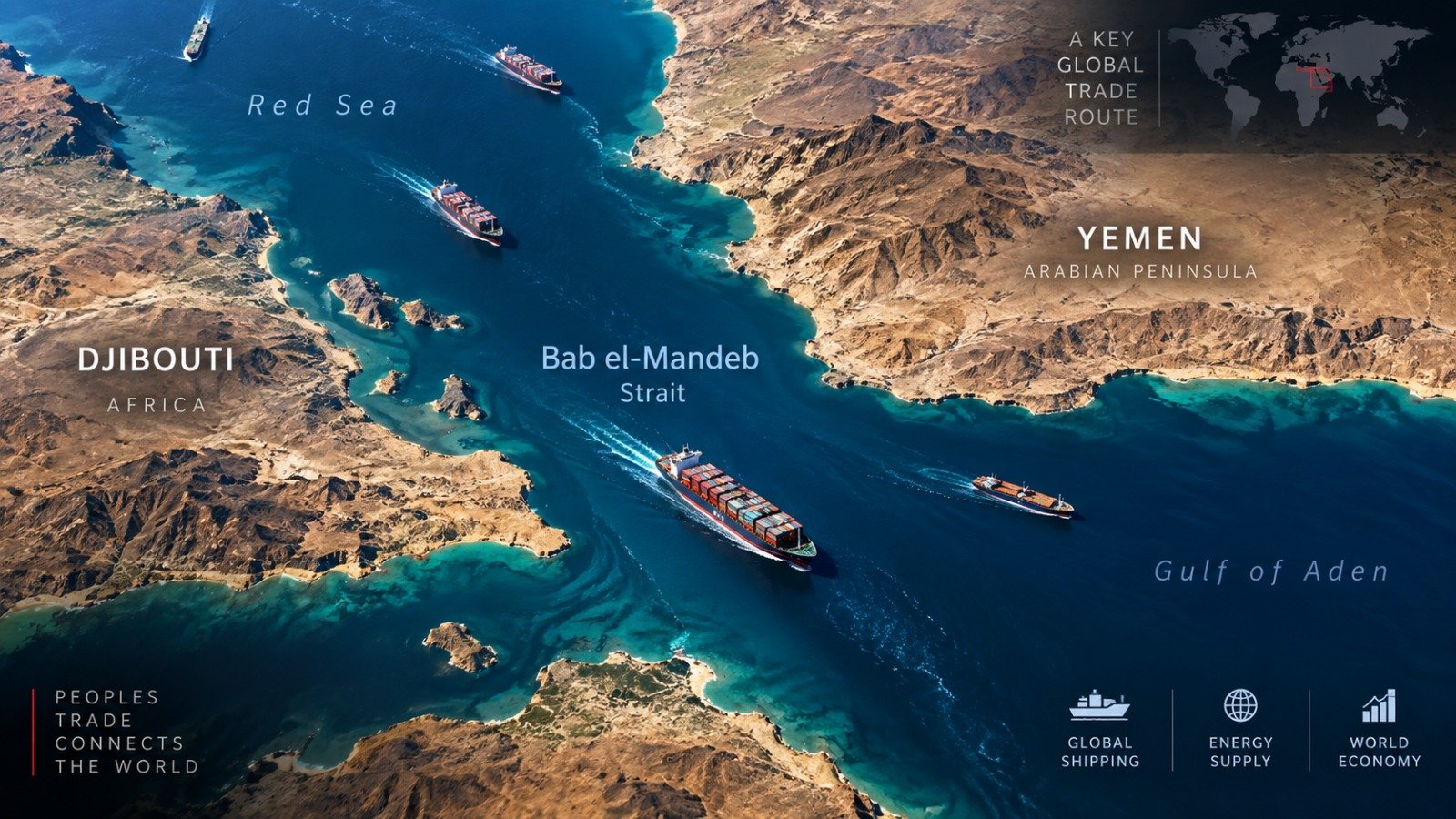
ADEN, September 11, 2026 — AALIMI NATION: The head of Yemen’s Presidential Leadership Council, Rashad Mohammed Al-Alimi, has warned that any growing threat to the Bab el-Mandeb Strait and the Red Sea could have direct consequences for international trade and global supply chains.
Al-Alimi said Iran is seeking to strengthen the Houthis’ ability to establish influence over the strategic waterway and the Red Sea, raising concerns over the security of one of the world’s most important maritime trade routes.
He warned that instability around Bab el-Mandeb would extend beyond Yemen and the wider Middle East, potentially affecting international shipping and the movement of goods between major global markets.
Strategic Maritime Chokepoint
The Bab el-Mandeb Strait connects the Red Sea with the Gulf of Aden and the wider Arabian Sea, making it a critical maritime gateway between Europe and Asia.
Commercial vessels travelling between the Indian Ocean and the Mediterranean typically rely on the Red Sea–Suez Canal route. Any prolonged disruption or heightened security threat in the area can force shipping companies to consider longer alternative routes around the Cape of Good Hope, increasing journey times and transportation costs.
Al-Alimi's warning comes amid continued international concern over the Houthis' military capabilities and their ability to threaten commercial shipping in and around the Red Sea.
Iran and the Houthis
The Yemeni council leader accused Iran of attempting to expand its regional influence by supporting the Houthis and strengthening their ability to operate around strategically important maritime routes.
Tehran has maintained close political and military ties with the Houthi movement, while Iran has repeatedly rejected accusations that it directly controls the group's military decisions.
The Houthis, who control large parts of northern Yemen, have developed significant missile and drone capabilities during years of conflict.
Their activities in the Red Sea have previously triggered international military responses and forced a number of major shipping companies to reassess routes through the waterway.
Wider Economic Concerns
The security of Bab el-Mandeb has implications far beyond the countries bordering the Red Sea.
A sustained threat to shipping could affect freight costs, insurance premiums, delivery times and energy markets, particularly if commercial vessels are forced to avoid the Suez Canal and take substantially longer routes.
The waterway is therefore viewed by governments and shipping companies as a critical component of the global trading system.
Al-Alimi's remarks underline Yemen's concern that the maritime dimension of the regional conflict could develop into a broader international security and economic challenge.
Growing Regional Tensions
The warning comes as tensions involving Yemen, Iran and regional powers remain high.
For Yemen's internationally recognised government, preventing the Houthis from consolidating military control and expanding their reach toward strategic maritime routes remains a major security priority.
The Presidential Leadership Council has repeatedly called for international pressure to prevent Yemen from becoming a platform for attacks on regional states or international shipping.
Any further escalation around Bab el-Mandeb could therefore place additional pressure on regional governments and international powers to protect commercial navigation while seeking a broader political settlement to Yemen's conflict.
AALIMI NATION will continue to follow developments surrounding Yemen, the Houthis, Iran, Red Sea security and the impact of regional tensions on global trade.