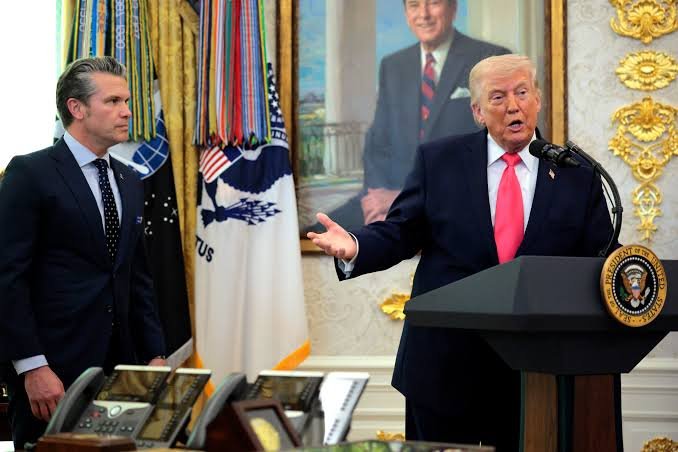
WASHINGTON, September 2, 2026 — US President Donald Trump has sharply escalated his rhetoric towards Iran, saying Washington is not seeking to force Tehran back to the negotiating table while publicly questioning when the Iranian people might rise against their government.
Trump's remarks came as the United States and Iran entered another dangerous phase of direct confrontation, with Washington carrying out fresh strikes against Iranian military targets and Tehran responding with attacks against US interests in the region.
In a post on his Truth Social platform, Trump rejected reports that his administration was attempting to push Iran towards a new agreement.
He also dismissed suggestions that Washington was seeking another diplomatic arrangement with Tehran, arguing that the United States currently holds a stronger strategic position.
Trump said he preferred the current situation to returning to negotiations that, in his view, would fail to deliver Washington's objectives.
Hormuz Becomes Central to the Confrontation
A major element of Trump's strategy centres on the Strait of Hormuz, one of the world's most strategically important maritime chokepoints.
The waterway connects the Persian Gulf with the Gulf of Oman and is a crucial route for global energy shipments.
Trump has claimed that the United States now exercises near-total control over the strategically vital waterway while pointing to the mounting economic pressure on Iran.
Renewed fighting has disrupted shipping through the strait, according to Reuters, while oil prices have climbed amid fears that further attacks could threaten global energy supplies.
For both Washington and Tehran, Hormuz has consequently become a central pressure point in the wider confrontation.
Iran can use the waterway to threaten maritime traffic and exert economic pressure, while the United States has made freedom of navigation and the continued movement of commercial vessels a major security objective.
Trump Asks: ‘When Will the Iranian People Rise Up?’
Trump's most provocative comments focused on Iran's domestic political situation.
He questioned when the Iranian people would “rise up” and fight against their government, appearing to suggest that sustained military and economic pressure could eventually increase internal opposition to Tehran's leadership.
Whether such pressure produces political change, however, remains highly uncertain.
Iran has experienced significant periods of domestic unrest in recent years, but the country's security institutions, including the Islamic Revolutionary Guard Corps (IRGC), remain central to the government's ability to maintain internal control.
Previous US intelligence assessments cited by Reuters have indicated that Iran's leadership remained largely intact despite sustained military pressure, highlighting the difficulty of predicting a rapid collapse of the Iranian government.
Washington Intensifies Economic Pressure
Trump's latest remarks came as the administration continued to expand its economic campaign against Tehran.
US Treasury Secretary Scott Bessent has signalled that Washington intends to target Iranian financial networks and assets associated with the IRGC and could announce additional sanctions against Iranian banks.
The strategy extends beyond traditional sanctions.
Washington is seeking to restrict Iran's access to international financial networks, target IRGC-linked assets overseas and increase pressure on companies and countries that continue commercial dealings with Tehran.
Bessent has also argued that alternative oil pipelines could eventually reduce the strategic importance of the Strait of Hormuz, potentially limiting Iran's ability to use the waterway as an economic weapon.
Military Pressure Intensifies
The economic campaign is unfolding alongside renewed military action.
The US military said it had completed another wave of strikes against IRGC-related targets inside Iran.
Reports indicated that the targets included air-defence systems, radar installations, maritime assets, mine-laying capabilities and communications infrastructure.
Iran responded with attacks against US military interests in several countries, including Jordan, Bahrain, Iraq and Kuwait, according to Reuters.
The latest exchanges followed a period of relative calm during which Washington and Tehran had largely refrained from direct military attacks.
That period now appears to have ended.
Tehran Refuses to Back Down
Iran has continued to reject US demands and warned that further American pressure could trigger additional military retaliation.
Iranian officials have repeatedly linked the future of the Strait of Hormuz to the broader dispute over sanctions, oil exports and negotiations.
The confrontation is therefore developing along two interconnected fronts.
The first is military: direct attacks on Iranian and US targets and the growing possibility of further retaliation.
The second is economic: sanctions, oil exports, banking restrictions and control over maritime trade.
The combination makes the current crisis particularly volatile.
Could Economic Pressure Trigger an Uprising?
Trump's call for an uprising raises one of the most consequential questions surrounding the conflict: can external pressure translate into political change inside Iran?
Economic hardship can fuel public dissatisfaction, but it does not necessarily lead to regime change.
In some circumstances, foreign military attacks can have the opposite effect, allowing governments to rally nationalist sentiment and portray themselves as defending the country against external aggression.
Iran's leadership is likely to emphasise precisely that narrative, presenting the confrontation as a struggle over national sovereignty.
At the same time, prolonged economic disruption, inflation, shortages and declining living standards could deepen public frustration.
The critical question is whether that frustration remains fragmented or develops into sustained and organised political opposition.
For Washington, the answer could determine whether its pressure campaign achieves the political outcome it appears to seek.
Growing Risk of a Wider Regional Conflict
The confrontation is already affecting countries across the Middle East.
US military facilities and personnel throughout the region remain potential targets, while Gulf states face heightened risks to shipping, energy infrastructure and economic activity.
Any major escalation around the Strait of Hormuz could also have global consequences.
The waterway is a vital artery for international energy markets, and prolonged disruption could push oil prices higher, increase shipping and insurance costs and add pressure to economies far beyond the Middle East.
Recent market movements have reflected those concerns, with investors seeking safe-haven assets amid renewed geopolitical uncertainty and fears of energy-supply disruptions.
Diplomacy Remains Possible — But Distant
Despite Trump's increasingly hard-line rhetoric, diplomatic channels have not completely disappeared.
Regional intermediaries continue to explore ways to reduce tensions and restore negotiations.
But Washington and Tehran remain sharply divided over the central issues.
The United States is seeking major restrictions on Iran's nuclear capabilities, limits on its support for regional armed groups and guarantees for freedom of navigation through the Strait of Hormuz.
Iran, meanwhile, is demanding an end to US military pressure and sanctions while insisting on its sovereignty and economic rights.
The latest military exchanges have made an immediate diplomatic breakthrough considerably more difficult.
A High-Stakes Gamble for Trump
Trump's strategy appears to rest on the belief that overwhelming military and economic pressure can force Tehran to fundamentally change its position — or increase pressure inside Iran to the point where political change becomes possible.
But that strategy carries substantial risks.
If Iran's leadership refuses to yield, Washington could face a choice between maintaining a costly pressure campaign and escalating military action further.
If Tehran intensifies its retaliation, US forces and regional allies could become increasingly drawn into the conflict.
And if significant unrest develops inside Iran, the consequences could be difficult for either side to control.
For now, Trump is signalling confidence that Washington holds the stronger hand.
The unanswered question is whether Iran's mounting internal pressures will eventually produce the political change the Trump administration appears to be seeking — or whether sustained external pressure will instead deepen the confrontation and push the region closer to a wider war.