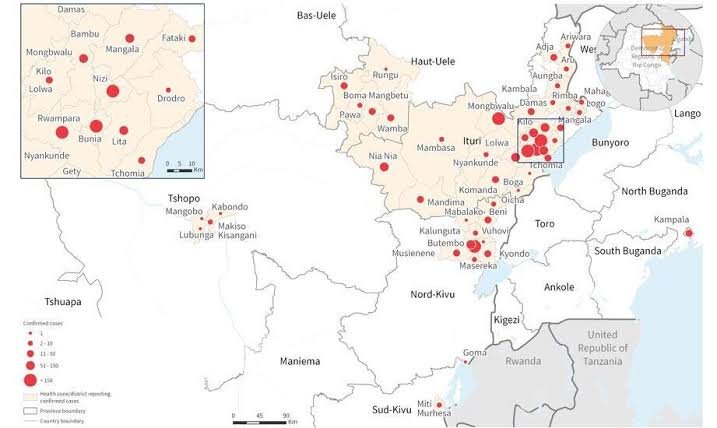
GENEVA, October 26 (Aalimi Nation) – The World Health Organization said the Ebola outbreak caused by Bundibugyo virus has reached 9,704 confirmed cases and 4,687 deaths in the Democratic Republic of the Congo, as imported infections continue to be recorded in Kenya and Nigeria.
The figures, published in the agency's latest outbreak update dated October 23 and based on data to October 20, cover 66 health zones in eight provinces. The WHO put the crude case fatality ratio at 48.3 per cent and said 2,595 patients have recovered. Ituri remains the worst-affected province. Of 482 deaths added since the previous update, 307 occurred in communities rather than in treatment facilities, an indicator that many patients are not reaching care.
Kenya has confirmed nine cases, including one death, and the WHO said eight of them are secondary cases linked to a single imported patient. Kenyan authorities traced and quarantined all 135 contacts of that first patient, and the agency said more than 709,000 travellers had been screened by October 22. Nigeria reported its first case, an imported infection in the capital Abuja, on October 20. The WHO said 44 contacts were being monitored and that the country had activated its national incident management system.
Speaking at a briefing on Thursday, the WHO's regional director for Africa, Mohamed Janabi, said: "We are facing a more complex outbreak landscape." Africa CDC has described the situation as an "extremely serious threat". Congolese health authorities have called it the deadliest Ebola outbreak in the country's history.
The WHO flagged shortfalls in the response. Contact follow-up in Congo stood at 79.7 per cent, below the 95 per cent target, and the agency urged stronger cross-border surveillance, monitoring at points of entry and more laboratory capacity. It also noted that no approved vaccines or specific treatments exist for Bundibugyo virus disease. A Phase 2/3 vaccine trial, known as TUMAINI, was reported by the agency to have begun in Bunia on October 23, though the trial's registry entry had not yet been updated to show recruitment.
Officials in different countries have offered differing accounts of how the Nigerian patient was infected. Uganda's government has rejected suggestions that the infection originated there, with a spokesman calling the link "preposterous", while a Swiss government statement said the patient was believed to have been infected in Uganda. The WHO and Africa CDC have said they have no confirmed information of travel to Congo. The question remains under investigation.
The outbreak was announced in mid-May and remains a public health emergency of international concern. In August the WHO rated the risk as very high in Congo, high for countries sharing a land border with it, and low for the rest of the African region and the world. The agency said it is now revising that assessment to reflect the spread to Kenya and Nigeria.
The WHO continues to advise against any restriction on travel to, or trade with, affected countries. The main indicators to watch in the coming weeks are the speed of contact tracing, the number of community deaths, any further exported cases and the outcome of the revised global risk assessment.