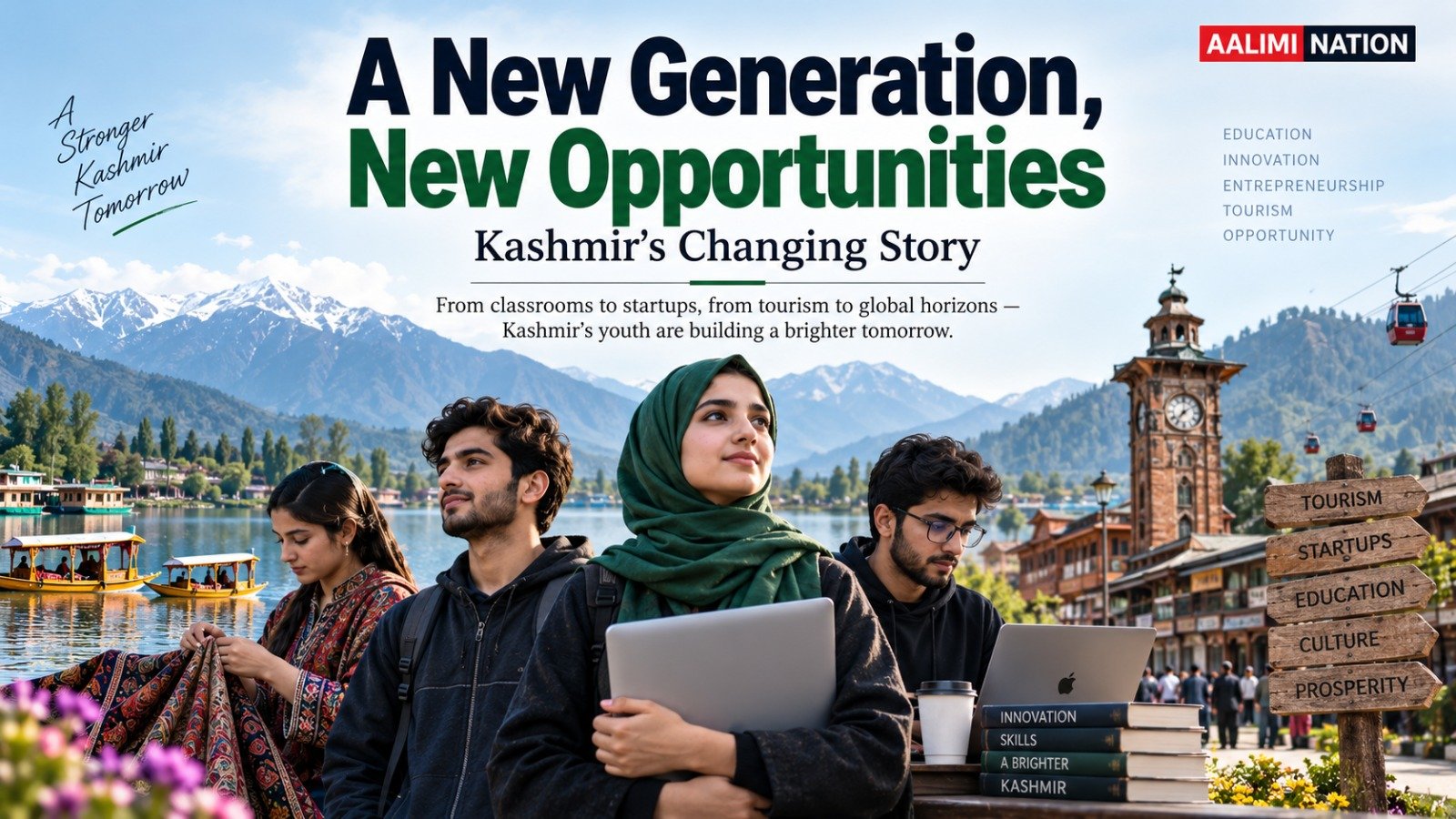
For decades, Kashmir was known to the world largely through the language of conflict. Today, a new generation wants to be known for something else: innovation, education, entrepreneurship, tourism and opportunity.
By;-Tariq Bhat
A Valley at a Crossroads
Kashmir has spent decades at the centre of political and security headlines. But beyond those familiar narratives, another story is taking shape quieter, more economic and increasingly driven by young people.
Across the Valley, young entrepreneurs are experimenting with new businesses, women are building enterprises from their homes, students are pursuing opportunities far beyond the region, and artisans are using digital platforms to reach customers beyond traditional markets.
The transformation is neither complete nor without obstacles. But it reflects a changing aspiration among a generation that increasingly wants to shape its future through education, enterprise and innovation.
The question is no longer whether Kashmir has talent. It clearly does.
The harder question is whether the region can build an ecosystem capable of turning that talent into sustainable businesses, jobs and opportunity.
Tourism: From Destination to Economy
Tourism remains one of Kashmir’s most important economic sectors. Its mountains, lakes, gardens, forests and cultural heritage attract visitors from across India and abroad, while the benefits extend far beyond hotels and transport.
Tourism supports livelihoods in handicrafts, hospitality, agriculture, food, photography, adventure sports and local cultural experiences.
The next challenge is to move from a model centred largely on visitor numbers towards one that creates greater value and more year-round employment.
Kashmir has the potential to develop further in areas such as eco-tourism, winter sports, wellness tourism, film production, heritage tourism, rural tourism and adventure travel.
The objective should be simple: make tourism a broader economic ecosystem rather than a seasonal industry.
Every tourist is not simply a visitor; they are a potential contributor to the local economy.
Education: The Foundation of Tomorrow
No long-term economic transformation is possible without investment in education.
Students from Jammu and Kashmir increasingly pursue higher education across India and abroad, while digital platforms have widened access to learning. But access alone is not enough.
The region continues to face challenges including uneven educational opportunities, gaps between academic qualifications and industry requirements, limited research infrastructure, inadequate career guidance and the loss of talented young people to opportunities elsewhere.
Education must therefore move beyond examinations.
Schools and universities need to prepare students for a labour market increasingly shaped by artificial intelligence, robotics, cybersecurity, entrepreneurship, financial literacy, climate science, communication and design.
The Jammu and Kashmir Skill Development Mission is already expanding its focus on emerging areas including AI, cybersecurity, IT, tourism and other sectors, while its current programmes include AI courses and a wider skills ecosystem.
The central lesson is increasingly clear: a degree may open a door, but skills determine what happens after it.
Kashmir’s Emerging Startup Culture
A new entrepreneurial culture is also beginning to take shape across Kashmir.
Young people are exploring opportunities in technology, e-commerce, agriculture, tourism, healthcare, media, renewable energy and other sectors. Some businesses begin with little more than an idea, a laptop and the determination to make it work.
Yet entrepreneurs often encounter challenges that have little to do with the quality of their ideas.
Approvals, licensing, access to finance, workspace, mentorship, documentation and delayed payments can all become barriers to growth.
For a young entrepreneur, time matters. A delayed approval can mean a delayed launch; a delayed payment can mean a lost opportunity.
If administrative systems become faster and more predictable, entrepreneurship could become a much stronger source of employment.
The next successful company from Kashmir may already exist as an idea waiting for the ecosystem to catch up.
Women Entrepreneurs: An Opportunity for Entire Communities
The growth of women-led enterprises is another important part of Kashmir’s changing economic landscape.
Women are building businesses in handicrafts, fashion, food processing, digital marketing, education, healthcare, tourism and online retail.
Their success has an impact beyond individual incomes. When women gain greater economic independence, the benefits can extend to families and communities.
But participation requires more than encouragement.
Women entrepreneurs need easier registration procedures, access to finance, digital training, wider markets, export opportunities and, where necessary, childcare support.
Economic participation by women should not be viewed simply as a social objective. It is also an economic strategy.
Technology Could Be Kashmir’s Next Growth Engine
Technology has changed one of the region’s oldest economic limitations: geography.
A software developer in Sopore can work for a company in Bengaluru. A designer in Pulwama can serve clients in London. A journalist in Srinagar can reach an international audience without leaving the Valley.
The opportunity is significant, but connectivity alone will not be enough.
Kashmir will need stronger digital infrastructure, technology parks, startup incubators, innovation centres, AI laboratories and cybersecurity training if it wants to compete in a global digital economy.
The region’s skill-development framework is already placing greater emphasis on emerging technologies and industry-linked skills, including AI, IT, cybersecurity and digital sectors.
Technology can reduce geographical disadvantages. But only if people have the skills and infrastructure to use it.
Investment: Confidence Creates Jobs
Private investment can play an important role in creating sustainable employment. But investors generally look beyond incentives.
They look for predictability.
That means clear regulations, reliable infrastructure, skilled workers, efficient public services and timely approvals.
Jammu and Kashmir’s industrial policy has explicitly identified investment, employment generation, entrepreneurship and new technology-driven sectors as areas of economic development.
The challenge now is implementation.
Investment should not be viewed simply as money entering a region. It should be understood as a partnership between government, businesses, workers and communities.
Culture as Economic Capital
Kashmir’s cultural identity is one of its greatest assets.
Its poetry, music, cuisine, crafts, architecture, literature and traditions have value far beyond their historical significance. With the right platforms, they can also become part of a modern creative economy.
Cultural festivals, international exhibitions, digital marketplaces, heritage tourism, film production and creative industries can help turn cultural heritage into sustainable economic opportunities.
Preservation and commercialisation do not have to be opposites. With safeguards for authenticity and community ownership, culture can create livelihoods while strengthening Kashmir’s identity.
The Barriers Cannot Be Ignored
A positive story should not become an uncritical one.
Young people still face bureaucratic delays, complicated procedures, limited access to startup capital, gaps between universities and industry, shortages of private-sector employment and infrastructure challenges, particularly outside major urban centres.
These are not merely administrative inconveniences.
For a business, delay can mean lost revenue. For an investor, uncertainty can mean lost confidence. For a graduate, a lack of opportunity can mean leaving home.
Economic development ultimately depends on how efficiently institutions respond to people who are ready to work, invest and innovate.
A Roadmap for a New Kashmir
AALIMI NATION believes the next phase of Kashmir’s development should place opportunity at the centre of policy.
1. One Digital Citizen Portal
Bring major government services — including certificates, licences, business registration and other applications — onto a secure digital platform with clearly defined timelines.
2. A 30-Day Startup Approval Mission
Create an integrated system through which eligible businesses can obtain essential registrations and clearances within a defined timeframe.
3. A Youth Innovation Fund
Provide seed funding, mentoring and incubation support to young entrepreneurs with viable ideas.
4. University Innovation Centres
Universities should become places where students can develop businesses, conduct research and work directly with industry.
5. Tourism Entrepreneurship Programme
Help young people build homestays, trekking businesses, cultural tours, cafés, transport services and digital tourism platforms.
6. Women Enterprise Network
Create district-level support centres offering finance, training, legal assistance, marketing support and access to wider markets.
7. AI and Digital Skills Mission
Expand access to training in AI, coding, cybersecurity, cloud computing, digital marketing, animation and data analytics.
8. Zero-Paper Governance
Expand digital documentation, electronic signatures, online approvals and real-time application tracking to reduce unnecessary delays.
9. Investment Fast-Track Cell
Create a dedicated mechanism to guide investors through approvals and coordinate with relevant departments.
10. Build the Kashmir Global Brand
Kashmir should be promoted internationally not only as a tourism destination, but also as a place associated with education, handicrafts, technology, innovation and entrepreneurship.
The Next Generation Holds the Key
Kashmir’s future will not be determined by government policy alone.
It will also be shaped by the student who becomes a scientist, the artisan who becomes an exporter, the woman who builds a company, the farmer who adopts new technology and the entrepreneur who creates jobs for others.
The Valley has human potential. What it needs is an ecosystem that allows that potential to flourish.
That means rewarding talent, simplifying governance, encouraging investment, improving skills and ensuring that opportunity is not limited to those who already have access to networks and resources.
Kashmir’s economic transformation will not happen overnight. Nor will every startup succeed, every investment arrive or every policy deliver its intended result.
But the direction matters.
A region once defined internationally by conflict can also become known for its classrooms, businesses, technology, tourism, culture and young people.
The task is to make that possibility real.
AALIMI NATION VIEWPOINT
Kashmir does not need sympathy. It needs opportunity.
The greatest investment in Kashmir is not simply concrete or steel. It is confidence in its young people.
When approvals become faster, ideas have a better chance of becoming businesses. When governance becomes more transparent and predictable, investment becomes easier to attract.
A digitally connected Kashmir, equipped with skills and supported by efficient institutions, has the potential to become a more dynamic regional economy.
The next chapter of Kashmir should be written not only by its past, but by the ambitions of its next generation.