Eight years of Ayushman Bharat raise an important question: can wider coverage translate into truly universal, accessible and affordable healthcare?
India’s healthcare system has been undergoing a significant transformation over the past eight years. The debate is no longer limited to how many hospitals or doctors the country has; it increasingly concerns whether ordinary citizens can access healthcare without being pushed into financial distress.
At the centre of this transformation is Ayushman Bharat, launched in 2018 with the broader objective of advancing universal health coverage.
The scale of the programme is substantial. According to figures reported by DD News, more than 48.51 crore Ayushman cards had been issued by September 21, 2026. The scheme had supported around 13.25 crore hospital admissions, involving treatment worth approximately ₹2.03 lakh crore, through more than 38,000 empanelled public and private hospitals.
These figures indicate the extraordinary scale at which publicly supported healthcare is now operating. But numbers alone do not tell the complete story. The real measure of a healthcare programme is ultimately whether a patient in a village, a migrant worker away from home, an elderly citizen or a low-income family can obtain timely and quality treatment when it is actually needed.
From hospitalisation to financial protection
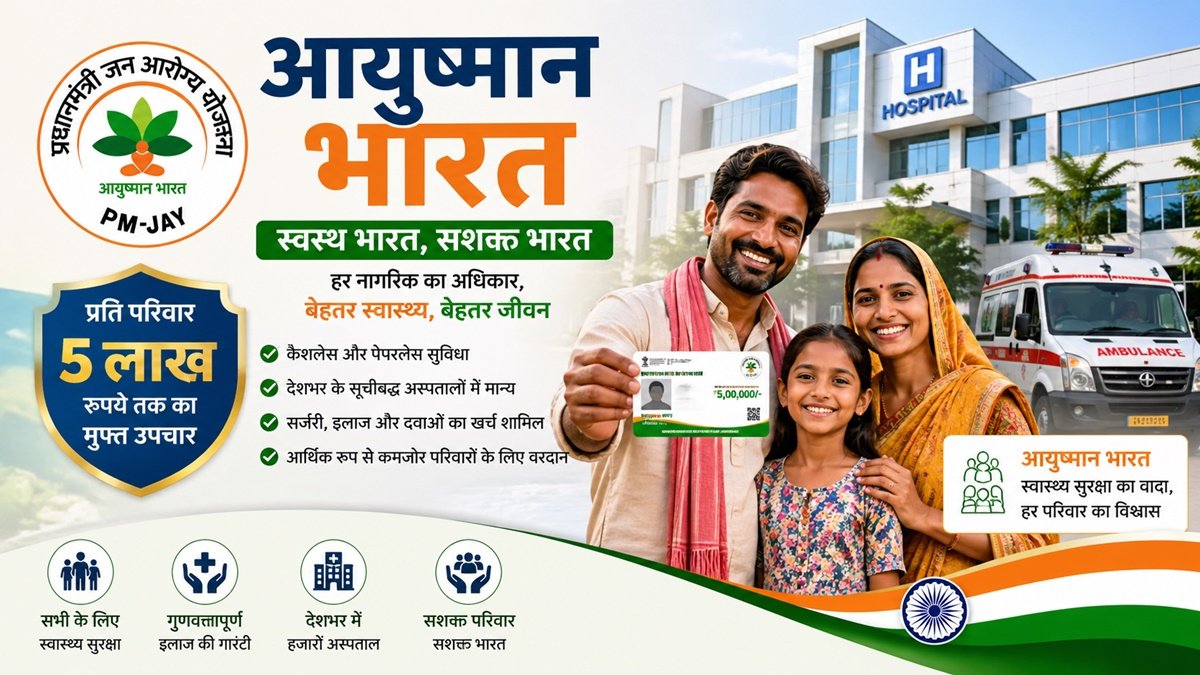
Ayushman Bharat Pradhan Mantri Jan Arogya Yojana provides eligible beneficiaries with cashless hospitalisation cover of up to ₹5 lakh per family per year for secondary and tertiary care.
The Government of India describes PM-JAY as a mechanism for financial protection against catastrophic healthcare expenditure. Official Ministry of Health material confirms the scheme’s ₹5 lakh annual cover and its focus on economically vulnerable families.
This is important in a country where a serious illness can have consequences far beyond the medical condition itself. Hospital bills can affect household savings, education, employment and even the ability of families to meet basic living expenses.
In that context, health insurance is not simply an administrative benefit. It can become a form of social protection.
A broader definition of inclusion
One of the notable developments has been the expansion of coverage to groups requiring particular attention.
According to DD News, the programme has been extended to approximately 37 lakh families of ASHAs, Anganwadi Workers and Anganwadi Helpers, while senior citizens aged 70 and above have also been brought under the scheme irrespective of their socio-economic status.
The Ministry of Health’s annual report confirms the inclusion of ASHAs, Anganwadi Workers and Anganwadi Helpers and the October 2024 expansion covering senior citizens aged 70 and above.
The significance of such expansion goes beyond the number of cards issued. It reflects an attempt to make healthcare protection less dependent on a household’s ability to absorb unexpected medical expenditure.
Healthcare cannot begin at the hospital gate
Perhaps the more important long-term question is whether India can strengthen healthcare before patients reach a hospital.
This is where Ayushman Arogya Mandirs become significant.
The government’s model seeks to bring comprehensive primary healthcare closer to communities, including services for non-communicable diseases, mental health, oral, eye and ENT care, essential medicines, diagnostics and first-level emergency care.
The official Ayushman Arogya Mandir portal reported 1,87,142 functional centres as of September 25, 2026.
That expansion matters because a healthcare system cannot rely entirely on tertiary hospitals. Early diagnosis, preventive care, screening and treatment at the primary level can reduce pressure on larger hospitals and, more importantly, allow health problems to be addressed before they become emergencies.
The success of this model, however, will ultimately depend not only on the number of centres but also on staffing, medicines, diagnostics, referral systems and the quality of services available to citizens.
The digital health transition
Another major element of Ayushman Bharat is the Ayushman Bharat Digital Mission (ABDM).
Digital health has the potential to make medical information more portable and improve coordination between patients, doctors and healthcare institutions. Digital health identities and linked health records could become particularly useful for people who move between states or receive treatment at multiple institutions.
According to the figures cited by DD News, more than 97.61 crore ABHA IDs were operational by September 17, 2026, with more than 119.95 crore health records linked to them.
The promise is considerable. But digital expansion also brings an equally important responsibility: protecting privacy, ensuring informed consent, maintaining data security and making sure that people with limited digital literacy are not excluded from the healthcare system.
Technology should reduce barriers to healthcare—not create new ones.
Building resilience beyond insurance
Healthcare reform also requires investment in infrastructure and preparedness.
The Pradhan Mantri Ayushman Bharat Health Infrastructure Mission (PM-ABHIM) was launched in 2021 with a stated outlay of ₹64,180 crore for 2021–26. Its architecture includes support for health and wellness centres, block public health units, integrated public health laboratories and critical-care facilities.
The Ministry of Health describes Ayushman Bharat as a broader continuum of care spanning primary, secondary and tertiary levels rather than simply an insurance programme.
This distinction is important.
A health card cannot substitute for a doctor. Insurance cannot substitute for a functioning laboratory. A digital health ID cannot substitute for an adequately staffed hospital.
Universal healthcare requires all these components to work together.
The next test is implementation
The scale of Ayushman Bharat is difficult to ignore. Millions of hospital admissions, tens of crores of cards, a rapidly expanding primary healthcare network and a growing digital infrastructure represent a substantial change in the architecture of public healthcare.
But the next phase should be judged by more than coverage statistics.
The crucial questions are practical:
Can beneficiaries find an empanelled hospital when they need one?
Are services genuinely cashless in practice?
Are hospitals reimbursed efficiently?
Are medicines and diagnostics consistently available at primary healthcare centres?
Does digitalisation improve patient care while protecting personal health information?
Are rural and remote communities receiving the same quality of care as major urban centres?
These questions do not diminish the scale of the programme. They are precisely the questions that become more important as a programme expands.
A healthcare system measured by the patient
Ayushman Bharat represents an important shift in the way India approaches public healthcare—from fragmented interventions towards a more interconnected system involving financial protection, primary healthcare, digital infrastructure and health-system preparedness.
The figures cited by DD News demonstrate the programme’s enormous reach. Official government data similarly shows that Ayushman Bharat is being developed as a continuum of care, with Ayushman Arogya Mandirs forming an important primary-care component.
Yet the ultimate test of any healthcare reform remains remarkably simple: what happens to the patient?
If a poor family can receive major treatment without falling into debt, if an elderly citizen can access care without worrying about affordability, if a villager can obtain basic diagnostics close to home, and if a patient's medical records can safely travel with them, then healthcare reform becomes more than a policy document—it becomes a tangible change in everyday life.
Eight years after Ayushman Bharat was launched, India has built an unusually large public healthcare framework around financial protection, primary care and digital technology.
The challenge now is to ensure that scale is matched by quality, access by accountability, and innovation by inclusion.
That will determine how deeply Ayushman Bharat ultimately changes the healthcare experience of ordinary Indians.
— Aalimi Nation Opinion Desk
Source/Credit: DD News, with reference to official Ministry of Health & Family Welfare data.