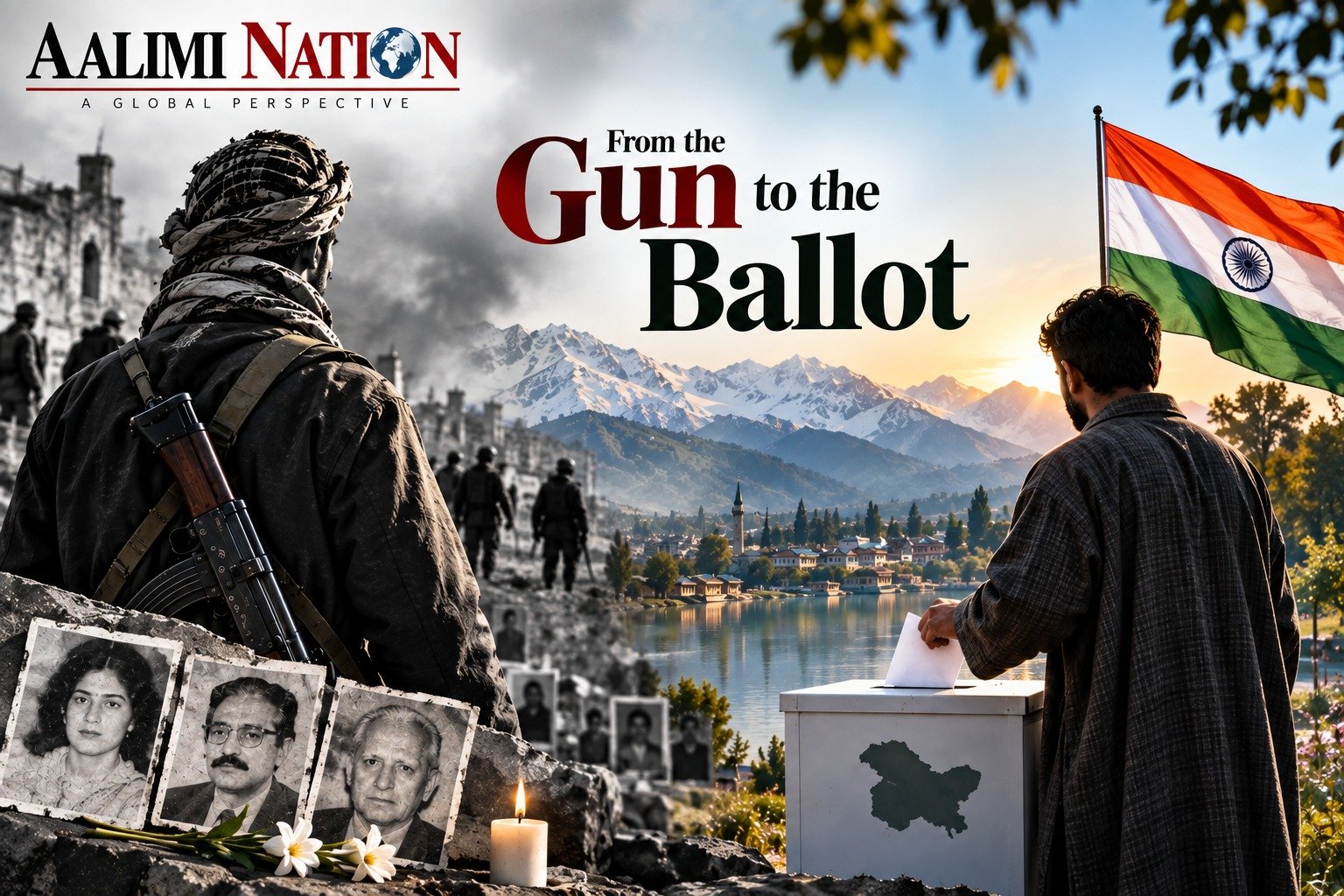
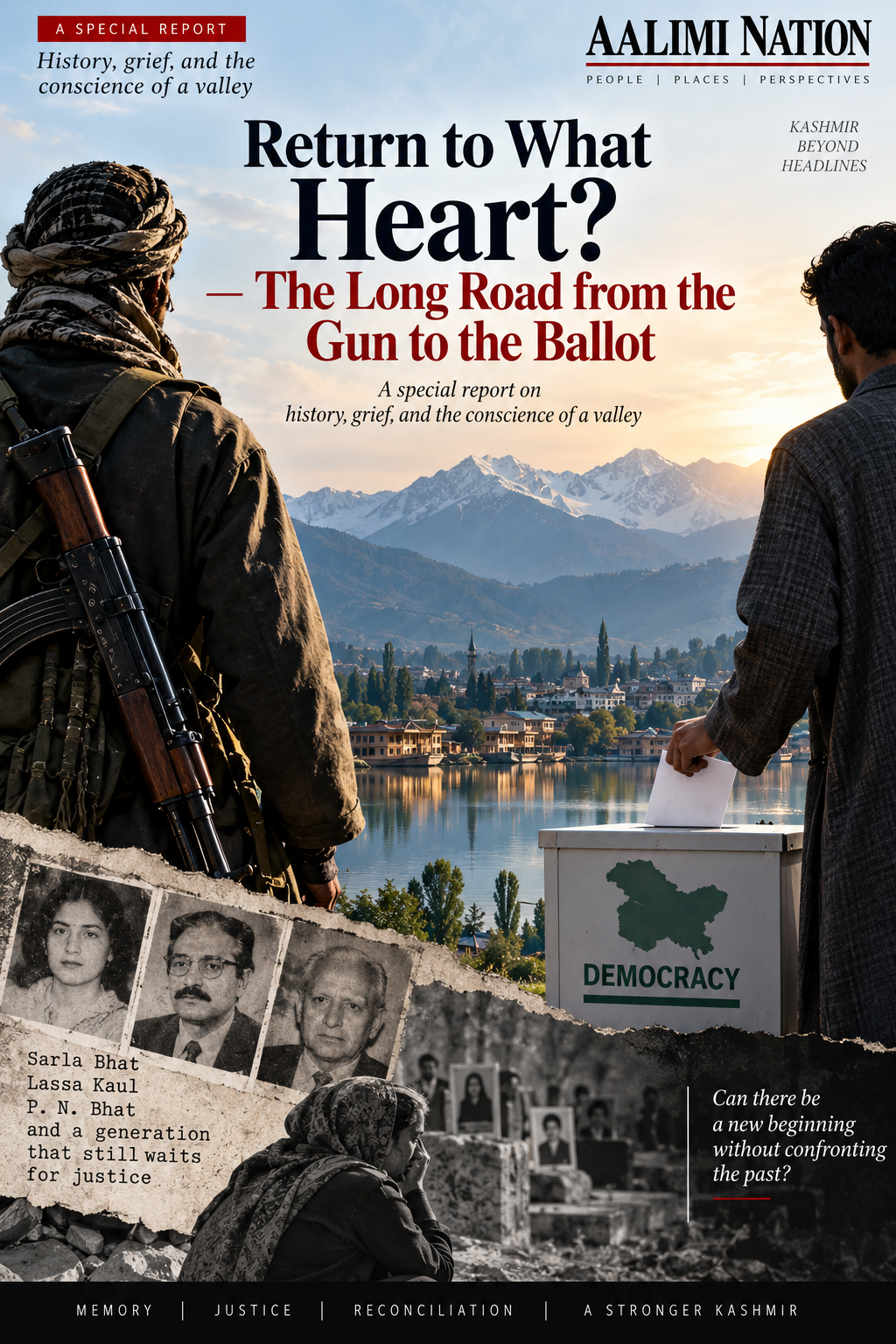
Return to What Heart? — The Long Road from the
Gun to the Ballot
A special report on history, grief, and the conscience of a valley
Kashmir is not merely a name for mountains, lakes, and valleys that photograph well. It is
also the homeland of mothers who buried sons before their time, of widows whose
households fell silent in the space between one gunshot and the next, and of children who
grew up clutching not a father’s hand but his photograph.
This piece is addressed to a particular kind of return: men who once walked the path of the
gun and now wish to walk the path of politics. The question is not why they came back.
Returning is not, in itself, a wrong. Setting down a weapon in favour of a ballot paper is, on
its face, a good and welcome thing. But a larger question follows close behind it: did these
men lay down only their arms — or did they also pick up the weight of what those arms once
did?
1990: The Year Kashmir Cannot Set Down
The Kashmir of 1990 lived under a low, constant ceiling of fear. There were threats
whispered and threats delivered. There were abductions. There was killing by design — the
kind aimed not at random but at a community, a profession, or simply a way of thinking the
gunmen found inconvenient.
Certain names from that year have never stopped asking questions of the present. Sarla
Bhat, a young nurse, was abducted, tortured, and murdered in April 1990; the investigation
into her death has recently been revived, and in 2026 the relevant agency named Yasin
Malik and others in its chargesheet. Lassa Kaul, an official at Doordarshan, was threatened
for the programming he oversaw and was, in time, killed for it. P. N. Bhat — lawyer, social
worker, writer — was murdered in December 1990, in an era when disagreement itself could
carry a death sentence.
There is little value in reciting this history for its own sake. The point is to understand how
much of it still lives, unhealed, in the valley’s collective memory. With that in mind, we chose
to put the question directly to three people who work inside that memory every day: a
professor at the University of Kashmir, a veteran schoolteacher, and a retired judge.