
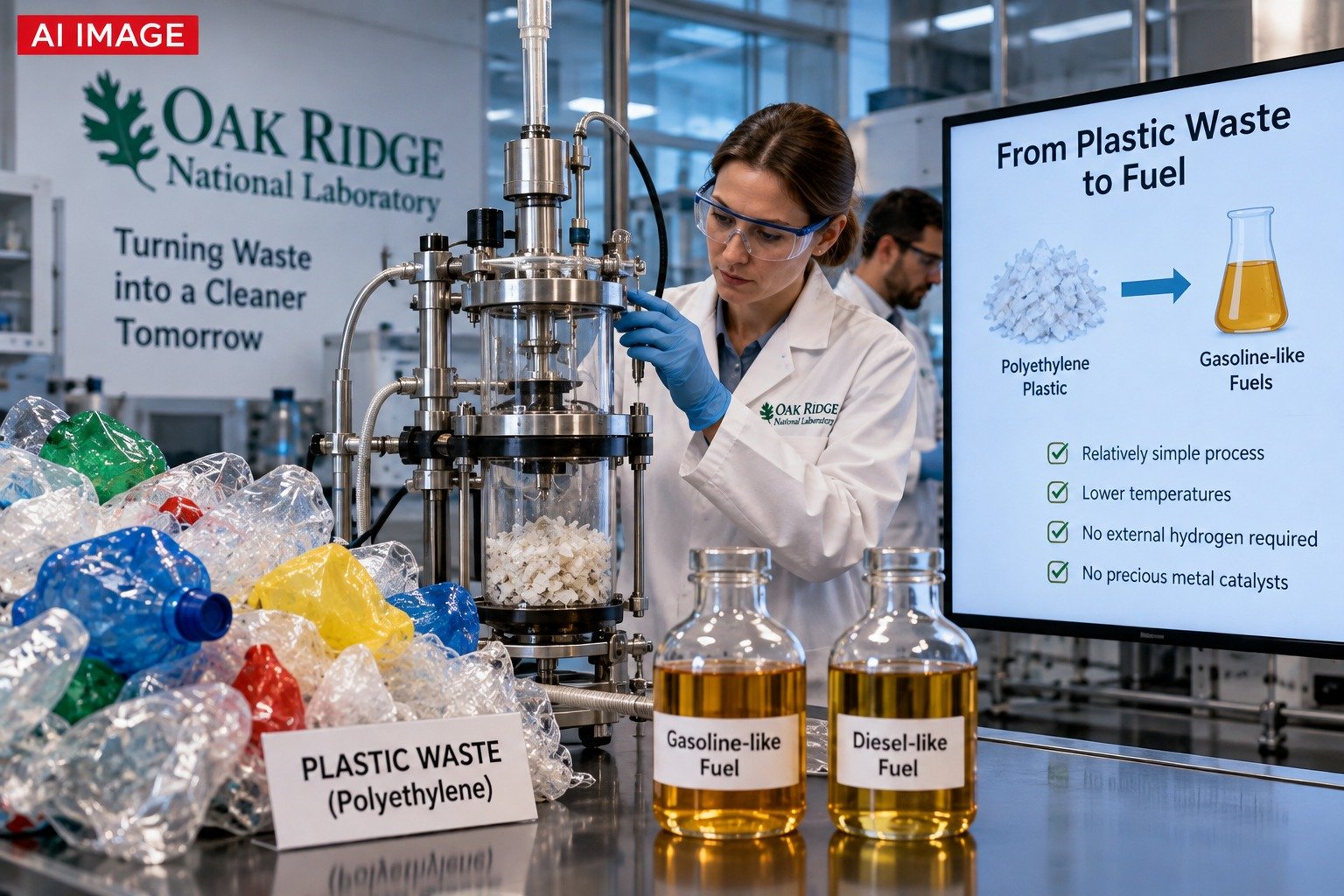
The method could offer a new approach to dealing with one of the world's most persistent waste problems by transforming commonly discarded plastics—including material used in shopping bags and plastic cutting boards—into useful hydrocarbon products.
A different approach to plastic recycling
The researchers use molten salts containing aluminium chloride (AlCl₃) as both the reaction medium and catalyst. Unlike several conventional methods for converting plastics into fuels, the process does not require an external hydrogen supply, organic solvents or precious-metal catalysts.
The molten salt creates highly acidic catalytic sites that break the long molecular chains of polyethylene into smaller hydrocarbon molecules. Scientists used advanced spectroscopy, nuclear magnetic resonance and neutron-scattering techniques to study how the chemical transformation takes place.
Lower temperatures
One of the most notable features of the process is its relatively low operating temperature.
ORNL reports that the system can convert polyethylene at temperatures below 170 degrees Celsius. That is substantially lower than conventional plastic pyrolysis, which can require temperatures of roughly 450–500 degrees Celsius.
In experiments, the researchers achieved a gasoline yield of about 60 percent under mild conditions. The resulting hydrocarbons fall within gasoline- and diesel-range fractions, depending on the plastic feedstock and reaction conditions.
What happens to the plastic?
Polyethylene consists of long chains of carbon and hydrogen atoms. During the process, the molten salt's catalytic sites promote chemical reactions that break and rearrange those chains.
Shorter molecular chains can form hydrocarbons in the gasoline range, while more complex and larger chains can produce compounds in the diesel range. ORNL says the technology can also process high-molecular-weight and more structurally robust plastic materials that are difficult to handle using conventional recycling methods.
The researchers have applied for a patent covering the technology.
Could plastic waste become a fuel resource?
The research is significant because polyethylene is among the most widely used plastics, while large quantities of plastic waste are difficult to recycle economically.
ORNL describes the technology as a potential pathway for converting plastic waste into value-added fuels and chemical feedstocks. However, the process remains a research and technology-development effort; further work is required to determine how effectively it can be scaled up and deployed commercially.
The research team says the relatively simple reaction system, commercially available salts and absence of precious-metal catalysts could make the approach attractive for future industrial applications.
For now, the discovery offers a promising scientific route to treating plastic waste not simply as an environmental burden, but as a potential source of useful carbon-based products.