AMMAN / ISLAMABAD — Jordan's air defences worked. Eighteen of the twenty Iranian missiles fired at the kingdom overnight on Tuesday were intercepted, the Jordanian Armed Forces said, and the two that got through came down in open ground. American forces at the base fired more than thirty Patriot interceptors. No one was killed.
And American warplanes were still damaged on the ground.
An A-10 Thunderbolt II, the ground-attack aircraft universally known as the Warthog, was left with a severely damaged wing at Muwaffaq Salti Air Base in Jordan's Zarqa governorate. Around eight F-15E Strike Eagles sustained lighter damage and have since been returned to service. The damage was first reported by CBS News and subsequently confirmed to Air & Space Forces Magazine by people familiar with the matter. A US Central Command spokesman did not respond to a request for comment.
That gap between a high interception rate and real losses on the flight line is the significant part of this incident. A Trump administration official had described the Iranian barrage as ineffective against integrated air and missile defences. The reporting since complicates that assessment considerably. Iran does not need to defeat a Patriot battery to take a squadron's aircraft out of the fight for a week; it needs two missiles out of twenty to land within a few hundred metres of a parking apron.
What led to it
The strike was retaliation, and it arrived quickly.
On 8 September, US Central Command said American forces had destroyed five Iranian oil tankers — four crude carriers in the Gulf of Oman and one near Kharg Island, Iran's principal oil export terminal. That operation was itself described as a response to Iranian ballistic missile attempts against a US Navy warship. Three days earlier, on 5 September, the US had struck three other Iranian tankers as Washington and Tehran contest control of the Strait of Hormuz.
Iran's Islamic Revolutionary Guard Corps said it had carried out what it called devastating strikes on US forces at the base, which it referred to as Al-Azraq, and claimed to have hit maintenance, preparation and deployment sites for F-35, F-16 and F-15 aircraft. In the same round, the IRGC said it had attacked eight tankers and two warships. Tehran also warned tanker crews near Kuwaiti and Bahraini ports to abandon their vessels. Iran-backed Houthi forces separately targeted energy infrastructure in southern Saudi Arabia, including the Jazan refinery, which processes some 400,000 barrels a day.
Jordan's exposure
The kingdom did not choose this position, and it is an uncomfortable one.
Muwaffaq Salti is operated primarily by the Royal Jordanian Air Force but has hosted US Air Force F-15E Strike Eagles for roughly a decade, and additional American aircraft have been deployed there as the confrontation with Iran has widened. Amman has consistently said it will intercept anything that threatens its territory, and it has done so.
The political cost is a separate matter. A member of Iran's parliament recently used social media to urge Jordanians to seize the base and take American personnel captive — an appeal aimed squarely at Jordanian public opinion rather than at Jordanian policy. For a government that hosts American aircraft while managing a population deeply hostile to the wider war, each intercepted missile solves a military problem and sharpens a domestic one.
The line from Zarqa to the petrol pump
The clearest consequence of this week's escalation is not military. It is the price of a barrel of oil, and it is already being paid by people thousands of kilometres from the fighting.
Brent crude rose above $101 a barrel on Wednesday, its first time above that mark since May, with West Texas Intermediate near $95. The Strait of Hormuz carried roughly a fifth of global oil supplies before the war. The US Energy Information Administration, in its outlook released on 9 September, said Brent averaged $91 a barrel in August, $7 higher than in July, and estimated that global oil inventories have fallen by about 400 million barrels this year. It does not expect Middle Eastern production to return to pre-conflict levels before the second quarter of 2027.
Pakistan. The government raised petrol by Rs3.40 per litre and high-speed diesel by Rs6.72, effective 10 September, taking petrol to Rs367.75 and diesel to Rs392.67. It was the third straight daily increase; over three days petrol has risen Rs21.88 and diesel Rs14.62. Since Islamabad moved to a daily pricing mechanism on 17 July, replacing the weekly system, petrol has climbed by more than Rs50 a litre and diesel by around Rs40. Taxes and levies still account for roughly Rs114 on every litre of petrol and Rs100 on diesel. The current rates remain below the peaks of 3 April, when petrol touched Rs458.41 and diesel Rs520.35.
India. The pressure is being absorbed further up the chain, for now. The Indian crude basket reached $106.26 a barrel on 7 September and is averaging $100.75 this month, against $90.19 in August and $82.04 in July. India imports more than 88 per cent of its crude, and its oil import bill for April to July came to $63.4 billion, up from $40.5 billion a year earlier. Retail prices have not moved since 25 May, which means state-owned oil marketing companies are absorbing the difference: analysts put marketing margins at roughly minus ₹5 a litre on petrol and minus ₹23 to ₹25 on diesel, with under-recoveries of about ₹200 on a domestic LPG cylinder. In Delhi, petrol stood at ₹102.12 and diesel at ₹95.20 on 8 September.
The rupee has weakened past ₹95 to the dollar as oil-related dollar demand builds. Analysts cited by news agencies expect the Reserve Bank to hold the repo rate at 5.25 per cent at its 7 October review rather than cut, and do not rule out a tightening bias if Brent stays above $100 long enough to feed into broader inflation.
What to watch
Three things will decide whether this week was an episode or a turn.
The first is whether Iran can repeat the result at Muwaffaq Salti. Damaging aircraft through a functioning air-defence umbrella once may be arithmetic; doing it repeatedly would change how the US disperses aircraft across the region.
The second is Hormuz. Every previous attempt to reopen the strait has collapsed over which routes vessels may use and whether the American naval blockade lifts first. Goldman Sachs has warned that Brent could exceed $120 in 2027 if Gulf output stays roughly four million barrels a day below pre-war levels, though that is not its base case.
The third is domestic, and it is the one that will matter most to readers in this part of the world. Pakistan is passing the increase to consumers daily. India is holding retail prices and letting its oil companies carry the loss, which is sustainable for a quarter and not much longer. If Brent stays above $100 into the winter, the fuel bill in Srinagar, Jammu, Lahore and Karachi becomes a political question rather than a market one.
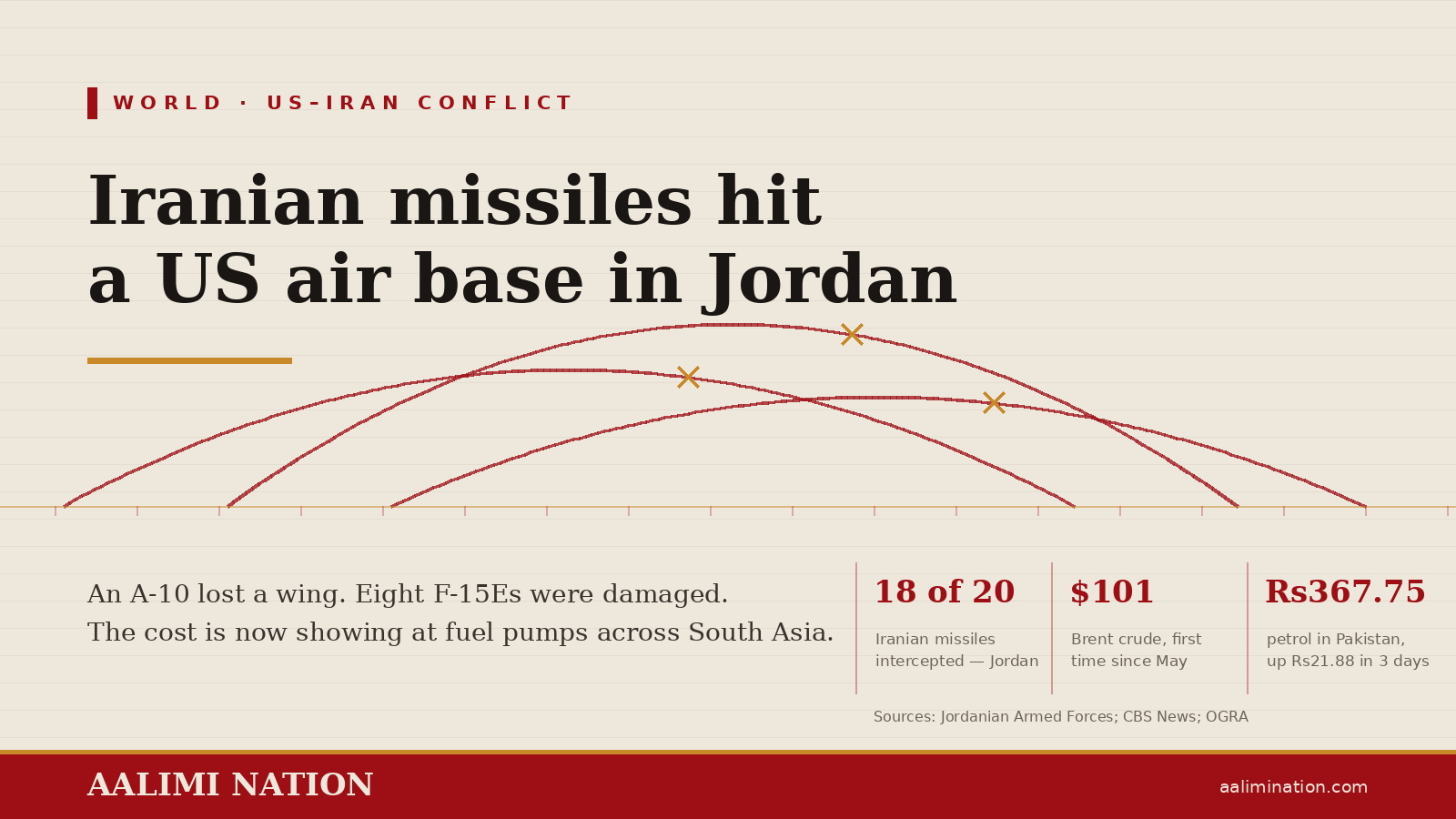
The lead graphic is in the file I sent — 1600×900, crimson and gold, marked Aalimi Nation, carrying the three figures.
One thing before you hit publish: check the Brent level and the Indian crude basket one more time. Both were moving hourly yesterday, and the $101 line is the first number a reader will test against their own news feed.