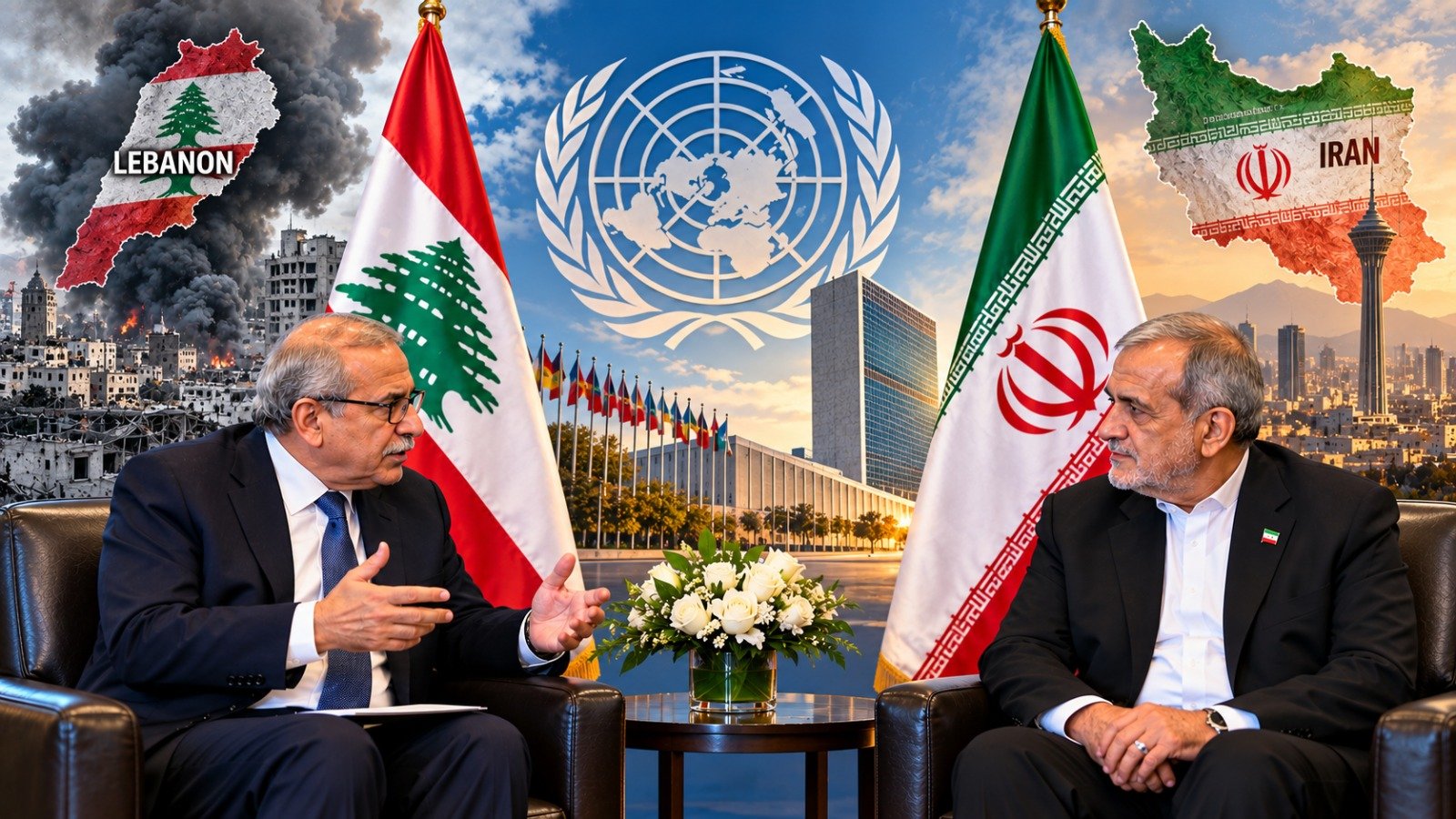
Lebanese Prime Minister Nawaf Salam has told Iranian President Masoud Pezeshkian that Lebanon does not want to become a battleground for regional conflicts or a platform for exchanging messages between rival powers.
During a meeting with Pezeshkian on the sidelines of the United Nations General Assembly in New York, Salam stressed the need for a new relationship between Beirut and Tehran based on mutual respect for sovereignty, independence and non-interference in internal affairs.
The meeting was attended by Lebanese Foreign Minister Youssef Rajji and Iranian Foreign Minister Abbas Araghchi.
Salam said Lebanon had already paid a heavy price in terms of its security, stability and economy and could no longer afford to be drawn into regional confrontations.
A relationship between two states
Salam said relations between Lebanon and Iran have historical roots and involve ties between the two countries and their peoples. However, he said Beirut wanted to open a new chapter based on proper state-to-state relations.
According to Lebanese media reports, Salam stressed that such relations should respect the sovereignty and independence of both countries, avoid interference in internal affairs and focus on areas of common interest.
He also expressed his wishes for the Iranian people’s security, stability, prosperity and development, while urging Tehran to appoint a new ambassador to Lebanon.
Israeli withdrawal remains Lebanon’s priority
On the situation involving Israel, Salam said Lebanon’s immediate priority was the complete withdrawal of Israeli forces from Lebanese territory and an end to military operations.
He also stressed the importance of restoring the Lebanese state’s full authority across its territory and ensuring that weapons remain under state control.
Salam’s remarks came as his diplomatic activities in New York focused on efforts to end Israeli military operations in southern Lebanon, restore Lebanese sovereignty and prepare for the period following the expected end of the United Nations Interim Force in Lebanon (UNIFIL) mission at the end of 2026.
Beirut seeks continued international presence in the south
Salam said Lebanon did not want a security vacuum to emerge after the UNIFIL mission ends.
Beirut, he said, is seeking a mechanism that would maintain an international presence in southern Lebanon to carry out monitoring, reporting and coordination responsibilities under a mandate approved by the UN Security Council.
Pressure continues in southern Lebanon
Tensions and Israeli military operations in southern Lebanon remain a major concern for the Lebanese government.
Beirut has been working to strengthen the presence of state institutions in affected areas, facilitate the return of residents and support reconstruction efforts.
During a high-level meeting in New York, Salam called for a transition from emergency humanitarian assistance toward recovery and reconstruction, arguing that strengthening state institutions in southern Lebanon is essential to restoring stability.
At the same time, Lebanon continues to face an internal debate over Hezbollah’s weapons and the role of the Lebanese state in the south.
The Salam government has reiterated that decisions concerning war and peace should rest with the Lebanese state and that weapons should ultimately be held exclusively by state institutions.
AALIMI NATION | International Affairs