
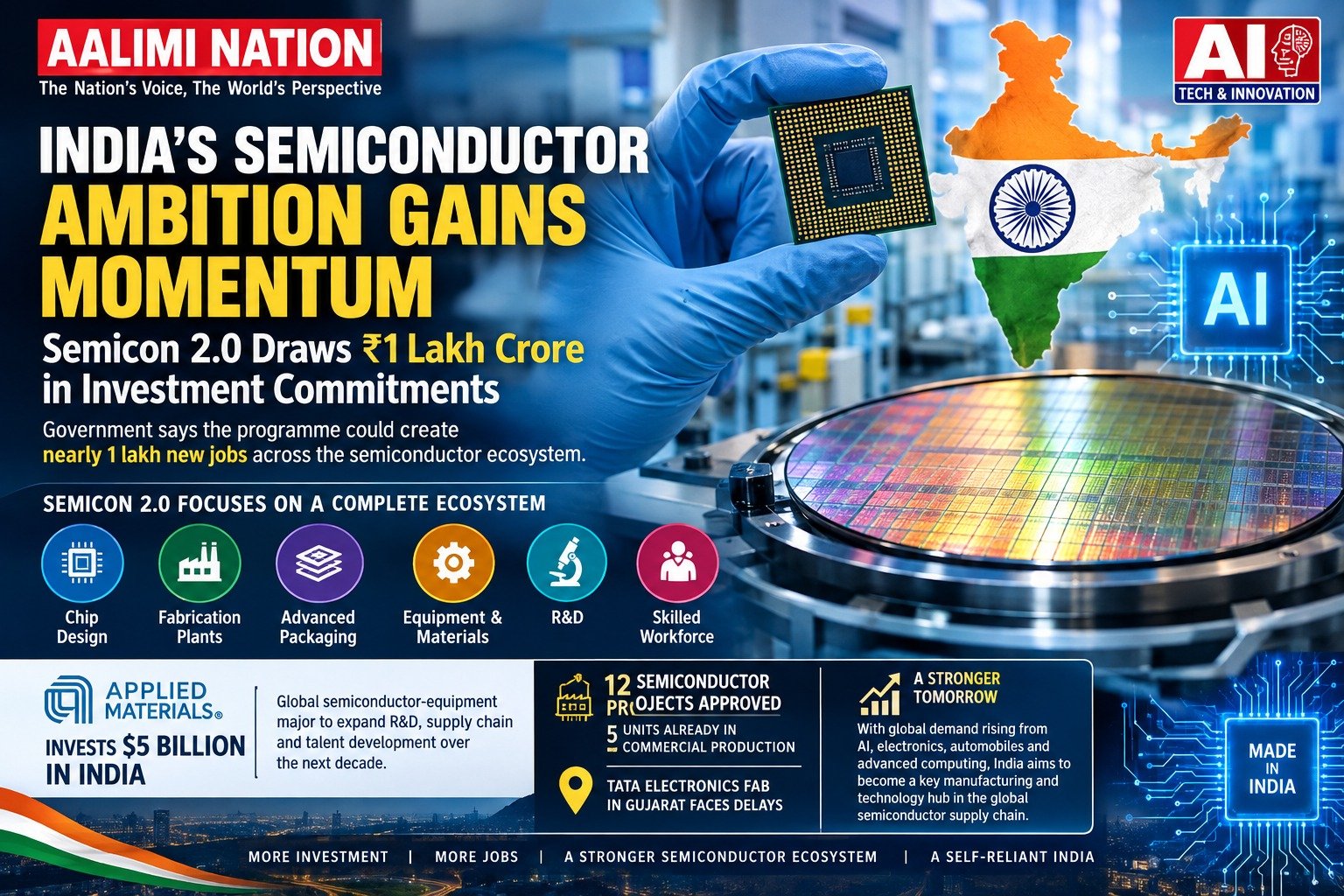
New Delhi, September 20, 2026: India’s ambition to build a globally competitive semiconductor industry is gaining significant momentum, with the government announcing that Semicon 2.0 has attracted investment commitments of around ₹1 lakh crore, potentially creating nearly one lakh new employment opportunities across the wider semiconductor ecosystem.
The announcement was made during SEMICON India 2026, held in New Delhi from September 17 to 19, as the government sought to showcase India’s growing capabilities in one of the world’s most strategically important technology sectors. The three-day event brought together more than 600 companies and representatives from 52 countries, highlighting the growing international interest in India’s semiconductor plans.
The government says Semicon 2.0 is intended to move India beyond individual chip-manufacturing facilities and create a complete semiconductor ecosystem covering chip design, fabrication, advanced packaging, semiconductor equipment and materials, research and development, and skilled manpower.
From Chip Plants to a Complete Ecosystem
India’s semiconductor strategy has entered a new phase. While the first stage of the government’s semiconductor programme concentrated heavily on establishing fabrication and packaging capacity, Semicon 2.0 is designed to address the wider supply chain that supports chip manufacturing.
The Union Cabinet approved Semicon 2.0 in July 2026 with an overall outlay of ₹1,27,500 crore. The programme has six broad pillars: semiconductor design, machines and materials, new fabrication facilities, advanced packaging, research and development, and talent development.
This broader approach is significant because a modern semiconductor industry requires much more than a fabrication plant. Fabs depend on highly specialised equipment, ultra-pure materials, chemicals, gases, precision engineering, testing facilities, logistics, software and a large pool of trained engineers and technicians.
The government estimates that the latest investment commitments could translate into close to one lakh new jobs across the ecosystem, with investments expected to materialise over the next two to three years as individual companies complete their required corporate approvals.
Applied Materials Announces $5 Billion India Investment
One of the biggest announcements at SEMICON India 2026 came from Applied Materials, the US-based semiconductor-equipment company, which announced plans to invest $5 billion in India over the next decade.
The investment, announced under the company’s Applied Materials India Vision 2035, is aimed at expanding research and development, strengthening the domestic semiconductor supply chain and developing specialised talent.
Applied Materials also announced plans for a 140-acre advanced semiconductor research park, designed to bring together research laboratories, engineering capabilities, customers, suppliers and other ecosystem partners. The company has said it wants to increase its India-based supply-chain capacity tenfold by 2035.
The company’s India workforce has already grown substantially, and its expansion signals that India’s role in the semiconductor industry could increasingly extend beyond software and chip design towards equipment engineering, product development, research and global supply-chain operations.
12 Semiconductor Projects Approved
India has also made progress under the earlier semiconductor programme. Twelve semiconductor projects have now been approved across six states, with combined investment commitments exceeding ₹1.64 lakh crore, according to government figures.
Several facilities have moved from the planning stage into commercial production. Government data says five semiconductor units have commenced commercial production, while the broader programme includes projects covering fabrication, assembly, testing, packaging and compound semiconductors.
Among the major projects is Tata Electronics’ planned semiconductor fabrication facility in Gujarat. The project is expected to become an important part of India’s effort to establish large-scale chip fabrication capacity. However, the project has faced delays, illustrating the complexity of building a semiconductor fab from the ground up. Reuters reported that the Tata Electronics facility has been delayed by nearly two years.
Why Semiconductors Matter
Semiconductors are the basic building blocks of modern technology. They power smartphones, computers, automobiles, telecommunications networks, medical equipment, defence systems, satellites, data centres and artificial-intelligence infrastructure.
The rapid expansion of AI and high-performance computing is creating particularly strong demand for advanced chips and the equipment needed to manufacture them. At the same time, geopolitical tensions and supply-chain disruptions have encouraged major economies and multinational companies to diversify semiconductor manufacturing beyond a small number of established production hubs.
India is attempting to position itself as one of those alternative locations.
The country already has a significant advantage in semiconductor design and engineering. Government figures indicate that India accounts for nearly 20% of the global semiconductor chip-design workforce, while more than one lakh engineers from hundreds of organisations have received access to advanced chip-design tools.
The Challenge Ahead
Despite the recent progress, India’s semiconductor ambitions face substantial challenges.
Building a semiconductor ecosystem requires enormous capital, reliable infrastructure, uninterrupted power and water supplies, highly specialised equipment, sophisticated logistics and a deep network of suppliers. Establishing a large fabrication plant is particularly complex and can take years before reaching stable commercial production.
India must also reduce dependence on imported semiconductor equipment, materials and specialised components if it wants to build a resilient domestic ecosystem.
That is why Semicon 2.0 places considerable emphasis on equipment and materials manufacturing, indigenous chip design, research, advanced packaging and workforce development, rather than focusing solely on fabs.
The government has also set out programmes to expand semiconductor training and research. More than 400 academic institutions are involved in chip-design activities, while the government plans to train one lakh technicians as part of the broader effort to build an industry-ready workforce.
India’s Next Semiconductor Test
The latest investment announcements represent an important shift in India’s semiconductor story. The country is moving from announcing policies and incentives towards building actual manufacturing, packaging, research and supply-chain capabilities.
But the success of Semicon 2.0 will ultimately depend on whether investment commitments translate into functioning facilities, competitive products, reliable supply chains and skilled employment.
For India, the objective is no longer simply to manufacture chips. It is to develop an ecosystem capable of designing, developing, manufacturing, packaging and supporting semiconductor technologies at global scale.
As demand for chips continues to rise with artificial intelligence, electric vehicles, advanced electronics, telecommunications and high-performance computing, the next decade could determine how deeply India becomes integrated into the global semiconductor value chain.
For New Delhi, the semiconductor race is no longer only about building fabs. It is about building the ecosystem around them.