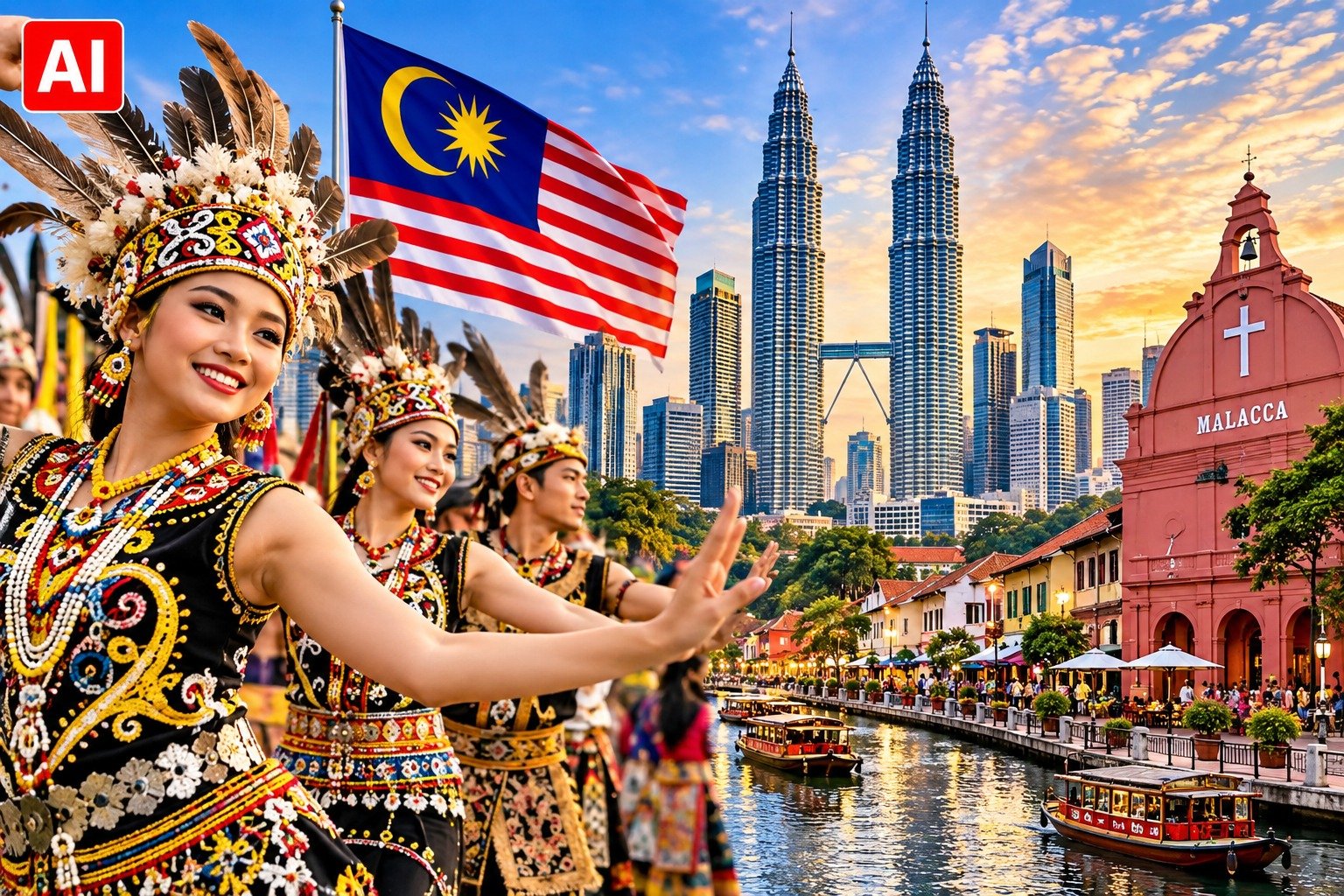
Malaysia’s cultural identity has been shaped by centuries of migration, trade, religion and interaction among diverse communities, creating a society where Malay, Chinese, Indian and indigenous traditions continue to influence everyday life.
Religious and cultural festivals remain an important part of Malaysian society. Muslims celebrate Hari Raya Aidilfitri and Aidiladha, while Buddhist, Hindu and Christian communities observe festivals including Wesak, Deepavali and Christmas. National Day, celebrated on August 31, provides a common national occasion across communities.
A distinctive Malaysian tradition during major celebrations is the “open house,” in which families welcome guests and serve traditional food regardless of their ethnic or religious background.
Food Reflects Malaysia’s Multicultural Society
Malaysia’s cuisine is similarly shaped by its diverse population. Malay, Chinese and Indian culinary traditions have developed distinctive Malaysian forms over time.
Popular dishes include nasi lemak, nasi goreng and sate, while Chinese and Indian culinary traditions have also become deeply embedded in Malaysian food culture. Indigenous communities in different parts of the country maintain their own food traditions, often based on locally available crops, vegetables and fish.
From Malacca to a Major Trading Centre
Malaysia’s history is closely connected to maritime trade. The Strait of Malacca became an important crossroads connecting China, India, the Middle East and Southeast Asia.
The rise of Malacca around the beginning of the 15th century transformed the region. After its ruler embraced Islam, Malacca developed into a major trading centre and an important hub for the spread of Islam in Southeast Asia. Merchants from China, India, Arabia and Persia were among those who passed through the port.
European Powers Enter the Region
Malacca's strategic importance eventually attracted European powers. Portuguese forces captured the city in 1511, followed by Dutch control beginning in 1641.
The arrival of European powers marked a major transformation in the political and commercial history of the Malay Peninsula, while neighbouring sultanates continued to play important roles across the region.
British Rule Reshaped the Economy
British influence expanded significantly from the late 18th century. Penang, Malacca and Singapore became major centres of British commercial activity, while British political influence gradually extended across the Malay sultanates.
The colonial economy increasingly focused on commodities including tin and rubber, while railways, roads and port infrastructure were developed to support the movement and export of resources. Large-scale migration from China and India also transformed the demographic and social landscape of Malaya.
Independence and the Birth of Modern Malaysia
The Federation of Malaya achieved independence on August 31, 1957, under Prime Minister Tunku Abdul Rahman.
Six years later, on September 16, 1963, Malaysia was formed with Malaya, Sabah and Sarawak becoming part of the new federation. Singapore initially joined the federation but later separated and became an independent country.
A Country Built on Multiple Histories
From ancient maritime trade and the spread of Islam to European colonialism, migration, independence and federation, Malaysia's modern identity reflects a complex historical process.
Its cultural landscape today combines Malay traditions with Chinese, Indian and indigenous influences, while its history remains closely connected to the wider commercial and cultural networks of Southeast Asia.
Aalimi Nation Perspective: Malaysia's story illustrates how geography, trade, migration and cultural exchange can shape the identity of a modern nation over centuries.