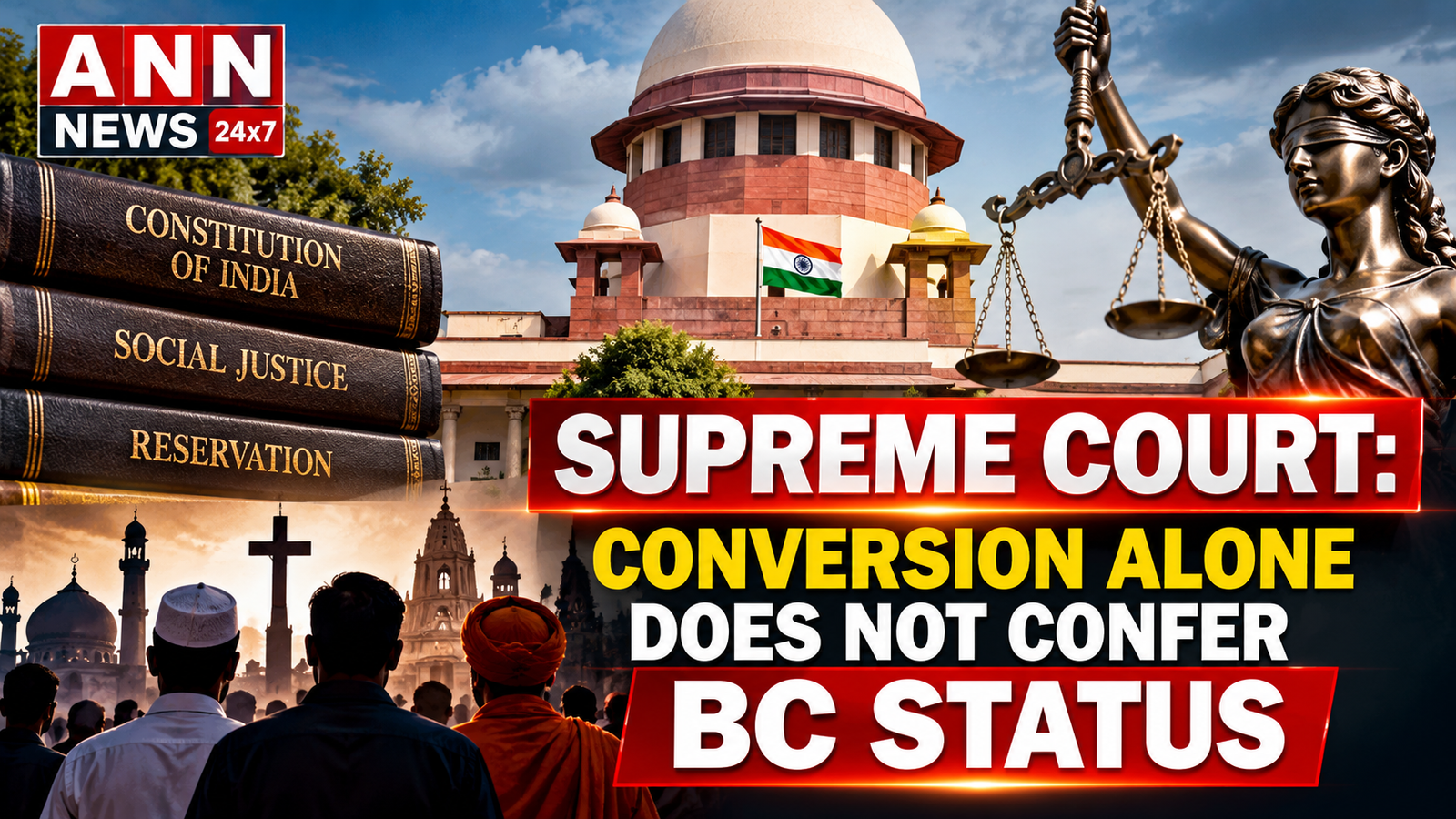
NEW DELHI, October 21 (Aalimi Nation) – The Supreme Court has held that conversion to Islam does not, by itself, entitle a person to reservation as a member of a Backward Class Muslim community, upholding a Madras High Court ruling that struck down a 2024 Tamil Nadu government order.
The court dismissed the state's special leave petition. In its judgment, reported this week, it said that "conversion to Islam does not, by itself, confer membership of any particular notified Backward Class Muslim community".
The case
The dispute began with a man born to Hindu parents in 1993 who converted to Islam in 2015, a change recorded in a certificate and later published in the state gazette. In 2020, the taluk office rejected his application for a Backward Class (Muslim) community certificate as a "Muslim Labbai", saying he had changed his religion but not his caste.
In March 2024, after a Backward Class Commission considered the issue, the state issued a Government Order allowing persons already receiving reservation as Backward Classes, Most Backward Classes or Denotified Communities to obtain a Backward Class Muslim certificate on conversion to one of seven recognised communities. The Madras High Court declared that order unconstitutional in June 2026.
What the Supreme Court held
The state argued that the writ petition challenged only the individual rejection and did not seek to quash the Government Order. The Supreme Court disagreed, observing that the man's claim rested on the order itself, so its validity necessarily arose. The state had been heard and had filed its response, the court noted.
On the merits, the court said backwardness arising within the Hindu social order does not automatically carry over upon conversion to Islam, Christianity or another non-Hindu religion. Reservation under Article 16(4) of the Constitution, it said, "cannot be claimed solely on pre-conversion backwardness". The court described conversion as no "one-way bridge" for carrying caste-based status into a new religion.
The bench found that the Government Order confused the continuation of disadvantage with membership of a notified Backward Class Muslim community. It lacked an intelligible basis and a rational connection to its aim, the court said, and so failed the test of equality under Article 14.
Certificates and private bodies
The court also dealt with how such status is proved. A community certificate, it said, "is declaratory of, and does not create or confer, the status it purports to recognise", and an executive order cannot override constitutional and statutory conditions. Deciding who is entitled to a certificate is a public function that cannot be left to a private body such as a jamath, it added.
Among its other conclusions, the court said persons professing a religion other than Hinduism, Sikhism or Buddhism cannot be treated as Scheduled Caste members under the Constitution (Scheduled Castes) Order, 1950. Where a person reconverts, entitlement requires an independent, fact-specific decision by the competent authority.
Background and what next
The court relied on earlier rulings including Indra Sawhney, Ashoka Kumar Thakur, Kailash Sonkar and C. Selvarani. Commentary on the judgment notes that the issue of linking Scheduled Caste status to religion has been examined by earlier commissions, and that a commission headed by Justice K.G. Balakrishnan is currently studying it.
The ruling is likely to guide how states issue community certificates to converts. Any state wishing to extend reservation to such groups would have to do so within the constitutional limits the court has now set out.