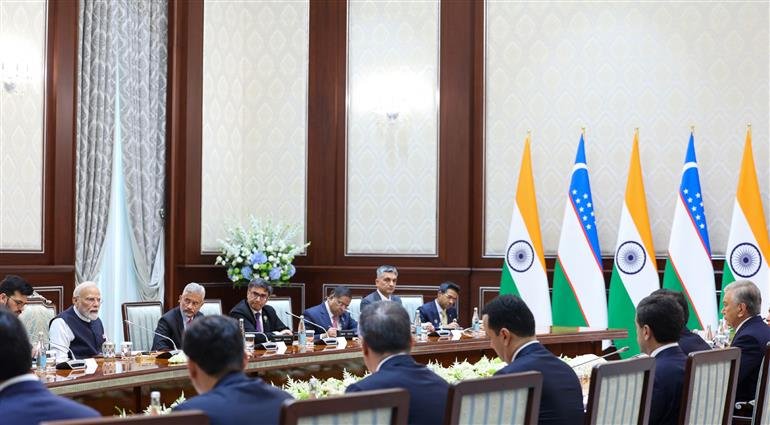
NEW DELHI / TASHKENT — India and Uzbekistan have taken a significant step towards strengthening their bilateral relationship, with the two countries announcing 11 agreements and a series of new initiatives during the Prime Minister's State Visit to Uzbekistan.
The most significant announcement was the decision to elevate the India-Uzbekistan Strategic Partnership to a Comprehensive Strategic Partnership, signalling broader cooperation across political, economic, cultural, technological and people-to-people sectors.
According to an official statement issued by the Press Information Bureau on Saturday, the agreements cover areas ranging from cultural heritage and traditional medicine to mining, tourism, higher education, environmental protection and financial cooperation.
Cultural Heritage and Education Cooperation
A Cultural Exchange Programme for 2026-30 was among the major agreements signed by the two governments.
India and Uzbekistan also agreed to cooperate on the conservation and restoration of the ancient Buddhist sites of Fayaz Tepa and Kara Tepa in Termez, reflecting the historical and civilisational links between the two regions.
The two countries also signed an agreement on archival cooperation between India's National Archives and Uzbekistan's Uzarchive.
In the education sector, the governments agreed to expand cooperation in higher education and scientific research.
India also announced 100 Lal Bahadur Shastri Scholarships for the Hindi language, while an ICCR Sanskrit Chair will be established at the Tashkent State University of Oriental Studies.
Cooperation in Traditional Medicine and Natural Resources
The two sides signed a Memorandum of Understanding covering cooperation in Ayurveda and other traditional systems of medicine.
Another agreement between India's Ministry of Mines and Uzbekistan's Ministry of Mining Industry and Geology will focus on cooperation in geology and mineral resources.
The partnership is expected to strengthen institutional engagement in areas related to exploration, geological research and resource development.
Tourism and Regional Partnerships
India and Uzbekistan also launched a tourism cooperation programme covering the period from 2026 to 2028.
The agreement aims to encourage greater collaboration between the tourism sectors of both countries and promote travel and cultural exchanges.
A separate cooperation agreement was signed between the Indian state of Gujarat and Uzbekistan's Samarkand region to establish partnership relations.
Economic and Financial Cooperation
The two countries agreed to establish an Economic and Financial Dialogue through a Memorandum of Understanding between India's Ministry of Finance and Uzbekistan's Ministry of Economy and Finance.
One of the notable commercial developments involves NPCI International Payments Limited and Uzbekistan's National Interbank Processing Centre.
The agreement will enable Indian UPI applications to scan Uzbekistan's national QR payment system, UZQR, allowing Indian travellers to make merchant payments in Uzbekistan.
The move is expected to improve convenience for Indian visitors and support growing commercial and tourism links between the two countries.
Environmental Cooperation
India also announced a grant of USD 1 million for afforestation efforts in the Aral Sea region, an area facing severe environmental challenges.
The two countries additionally signed an agreement on cooperation in environmental protection between India's Ministry of Environment, Forest and Climate Change and Uzbekistan's National Committee on Ecology and Climate Change.
Diplomatic Engagement
A separate Memorandum of Understanding was signed between India's Sushma Swaraj Institute of Foreign Service and Uzbekistan's Diplomatic Academy at the University of World Economy and Diplomacy.
The agreement is aimed at strengthening cooperation in diplomatic training, academic exchanges and institutional engagement between the foreign policy establishments of the two countries.
The outcomes of the State Visit underline the growing strategic importance of India-Uzbekistan relations, particularly as both countries seek deeper engagement across Central Asia, connectivity, trade, culture and emerging technologies.
Key Outcomes at a Glance
India-Uzbekistan partnership elevated to a Comprehensive Strategic Partnership
11 MoUs and agreements signed
Cooperation expanded in culture, heritage and archives
Restoration support for ancient Buddhist sites in Termez
Cooperation in Ayurveda and traditional medicine
New agreements on mining and mineral resources
Tourism cooperation programme for 2026-28
Expanded higher education and scientific research ties
USD 1 million grant for afforestation in the Aral Sea region
100 Lal Bahadur Shastri Scholarships for Hindi language studies
ICCR Sanskrit Chair to be established in Tashkent
Indian UPI apps to gain access to Uzbekistan's UZQR payment system
Gujarat and Samarkand region to establish partnership relations