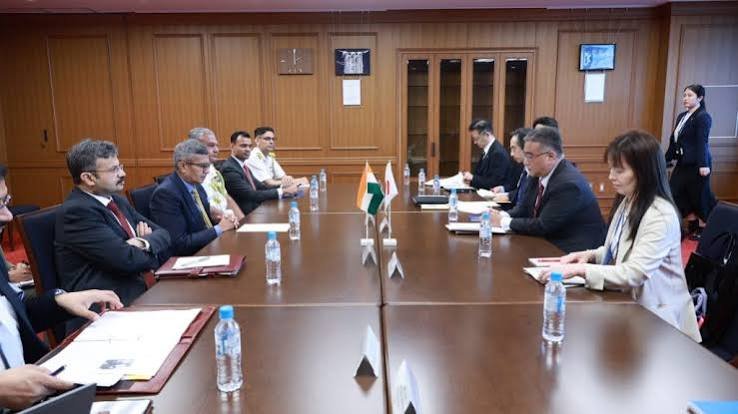
NEW DELHI, November 19 (Aalimi Nation) – India and Japan agreed on Thursday to speed up defence cooperation in underwater and missile technologies, and Japan's Ground Self-Defence Force will use an Indian firing range for training in 2027, the first time it has done so, according to official statements after the fourth India-Japan 2+2 dialogue in Tokyo.
Defence Minister Rajnath Singh and External Affairs Minister S. Jaishankar represented India at the ministerial talks. Japan was represented by Defence Minister Shinjiro Koizumi and Foreign Minister Toshimitsu Motegi. The dialogue sits under the two countries' Special Strategic and Global Partnership.
India-Japan defence cooperation moves ahead
The talks built on the Joint Declaration on Security Cooperation signed in August 2025. Officials said a Japanese military delegation had recently visited India to study facilities for missile and weapons firing exercises, ahead of the firing-range announcement. Mr Koizumi described the plan as "a major step strategically".
Mr Singh called for faster cooperation in "niche, underwater and missile technologies" and urged wider industrial collaboration under the "Design with Japan, Make in India" framework. In a bilateral meeting on the sidelines with Mr Motegi, he said the two sides had reviewed their "growing defence cooperation" and maritime security.
Maritime security and shipboard systems
On maritime security, the two sides agreed to implement the recently signed Memorandum of Arrangement on Maritime Security Cooperation. It covers maritime and air domain awareness, search and rescue, and an information-sharing arrangement. They also said they would seek an early conclusion of a Maritime Ship Repair Arrangement, which would give each country's navy access to the other's repair facilities, and would strengthen cooperation on mine-countermeasure capabilities.
Both sides agreed to fast-track defence agreements linked to the UNICORN project, short for Unified Complex Radio Antenna. It is a mast-shaped communications system for warships that Japanese vessels already use, and the two countries are discussing its co-development and co-production.
The ministers also noted progress on air and space domain awareness. Recent milestones include the first participation of Japan Air Self-Defense Force fighter aircraft in the bilateral Veer Guardian 2026 exercise in India. The third India-Japan Defence Industry Forum was held in Tokyo on October 13.
Jaishankar on connectivity and supply chains
Mr Jaishankar said India-Japan cooperation supports a multipolar Asia and a multipolar world, and that it comes at a time of geopolitical and economic uncertainty. "We are two nations committed to keeping the Indo-Pacific free and open," he said, adding that the other Quad partners share that commitment.
He pointed to the vulnerability of maritime connectivity and strategic chokepoints after recent developments in the Persian Gulf. He also criticised what he called the weaponisation of connectivity, natural resources, services, supply chains and market access, and urged the two countries to build resilience and explore alternatives.
The ministers also discussed the changing nature of warfare. Mr Jaishankar said: "We are witnessing the effective application of smart weapons and innovative solutions." He added that India-Japan cooperation on defence fits into a larger engagement on innovation and startups.
What comes next
Officials said the two countries will mark 75 years of diplomatic relations in 2027, the year the firing-range training is due to begin. No dates, locations or troop numbers for the exercise were announced, and no timeline was given for concluding the ship repair arrangement or the UNICORN agreements.