The Indian Army has finally signed for the American anti-tank system it first saw demonstrated at Babina in 2009. The quantity tells you this is an evaluation, not a purchase and the real question is what happens to DRDO's own missile if the Javelin performs.
Aalimi Nation · Defence & Strategic Affairs Desk | New Delhi
The Indian Army signed a Letter of Offer and Acceptance on Friday for the FGM-148 Javelin anti-tank guided missile, closing a procurement conversation that began sixteen years ago and has outlasted four defence ministers.
The US embassy in New Delhi confirmed the signing under the Foreign Military Sales process. Ambassador Sergio Gor announced it on X the following day.
"BIG news! India plans to buy the battle-tested Javelin anti-tank system," Gor wrote, adding that it was "a great step forward in the U.S.-India defense relationship and opens the door to co-production possibilities. The engagement between our two nations is at record high levels!"
The embassy statement described the milestone as reflecting the enduring partnership between the two countries, strengthening the US-India Major Defense Partnership and opening discussions on mutually beneficial co-production opportunities to bolster both defence industrial bases.
The package is worth $45.7 million. Nine months earlier, the US State Department had approved the possible sale after a formal request from New Delhi.
What is actually being bought
Here is where the announcement and the arithmetic diverge, and where the story is.
The Defense Security Cooperation Agency certified the sale in November 2025: 100 FGM-148 Javelin missiles, 25 Lightweight Command Launch Units or Block 1 Command Launch Units, together with 216 Excalibur artillery rounds. The Javelins are described in the DSCA framing as fly-to-buy rounds.
Fly-to-buy is a term of art. It means the customer buys a small batch, fires them under its own conditions, and decides afterwards whether to order at scale. It is not a fielding decision. It is an examination.
Set that against the requirement. The Indian Army has said it needs at least 40,000 anti-tank guided missiles over twenty years. One hundred missiles is one quarter of one per cent of that. Twenty-five launch units would equip a handful of infantry sub-units, not a corps.
So the correct reading of Friday's signature is not that India has bought the Javelin. It is that India has agreed to test it, formally, with American cooperation, sixteen years after first being shown it.
The Army first saw the Javelin fired at the Yudh Abhyas exercise at Babina, near Jhansi, in 2009.
In August 2010, then defence minister A. K. Antony told Parliament in a written reply that "the Defence Ministry proposes to issue a Letter of Request to the US government under their Foreign Military Sales route for procurement of third generation anti-tank guided missile along with transfer of technology."
That last clause along with transfer of technology is what stalled everything for a decade and a half. India wanted the missile and the ability to build it. Washington, at that stage, was willing to sell the first and not the second.
The intervening years contain a parallel story. In 2015 the defence ministry sanctioned DRDO to design and develop an indigenous man-portable anti-tank guided missile, the MPATGM. In 2017 India walked away from a $500 million deal with Israel's Rafael for the Spike missile, in part because the Israeli firm was reluctant to provide full technology transfer under Make in India, and in part because DRDO gave assurances it could deliver a comparable weapon within four years.
The retired Brigadier Rumel Dahiya, a Delhi-based defence analyst, captured the frustration of that period at the time. "It is a sad irony that we need equipment but neither produce it nor let it be procured from elsewhere in time," he told Sputnik in 2017.
DRDO has since made real progress. The MPATGM has been tested successfully at both minimum and maximum range, carries a miniaturised infrared imaging seeker, and is a genuine third-generation fire-and-forget weapon. Rajnath Singh has publicly congratulated DRDO on its performance, calling it an important step towards Atmanirbhar Bharat.
The Javelin's arrival therefore lands in a crowded field, not an empty one.
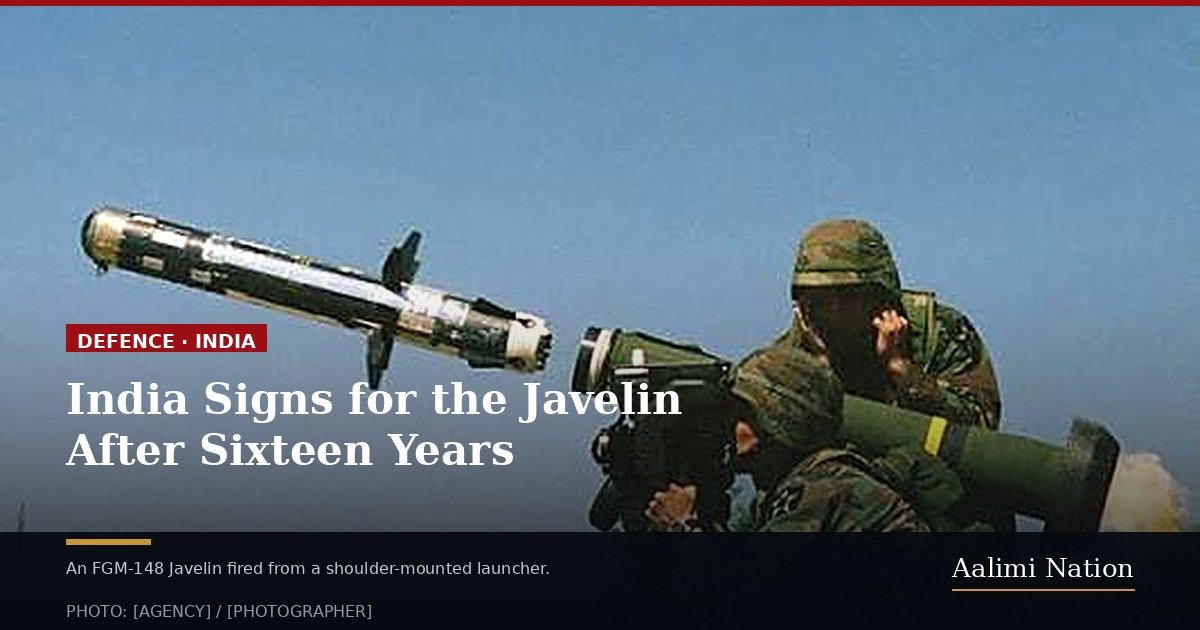
The Javelin is a man-portable, medium-range, fire-and-forget system built by the Javelin Joint Venture of RTX and Lockheed Martin, in service with the US Army, the Marine Corps and a long list of foreign customers. Reports place its use in Afghanistan and Iraq at more than 5,000 engagements.
Two features matter operationally. The infrared seeker locks onto the target before launch, so the operator can fire and immediately move — a decisive advantage over second-generation missiles that require the gunner to remain exposed while guiding the round. And its top-attack profile brings the missile down onto the thinner armour on a tank's roof rather than the thick frontal plate.
Ukraine made the Javelin famous, and that is worth handling carefully. The system performed well there against Russian armour in specific conditions ambushes, urban approaches, columns without adequate infantry screening. It is not a universal answer, it is expensive per round, and modern active protection systems are designed specifically to defeat it.
The interesting question is not India versus Pakistan or China. It is Javelin versus MPATGM.
If the fly-to-buy rounds perform well, India will face a choice it has deferred for a decade: order the American missile in quantity, with or without co-production, or hold the line for the indigenous system and accept a longer wait. Both paths can technically run together — co-produced foreign lines and domestic development are not mutually exclusive — but they compete for the same budget, the same factory investment and the same ministerial attention.
That competition, rather than the signing ceremony, is the story to follow over the next two years.
Washington has been signalling its preference. In February, the United States announced plans to pursue new procurements and co-production arrangements for Javelin to meet Indian requirements. Defence Secretary Pete Hegseth raised co-production at the Shangri-La Dialogue in Singapore in May, language Gor echoed on Saturday. The signing also follows the ten-year India-US defence framework agreement concluded last year.
For New Delhi, co-production is the prize, not the missile. A licence to build Javelins in India, with the industrial base and skills that come with it, would be worth considerably more than a hundred rounds. Whether that offer materialises — and on what technology-transfer terms is precisely the question that kept this deal unsigned since 2010.
Three things will indicate which way this goes.
Whether the fly-to-buy evaluation is followed by a bulk order, and how large. Whether any co-production agreement includes manufacturing rights or only assembly. And whether MPATGM procurement orders continue at scale alongside it, or quietly thin out.
The $45.7 million figure is modest by the standards of Indian defence procurement smaller than a single squadron's worth of most things New Delhi buys. Its significance is procedural rather than financial: after sixteen years of letters, requests and reversals, the paperwork is finally signed.
What India actually does with those hundred missiles will determine whether that mattered.