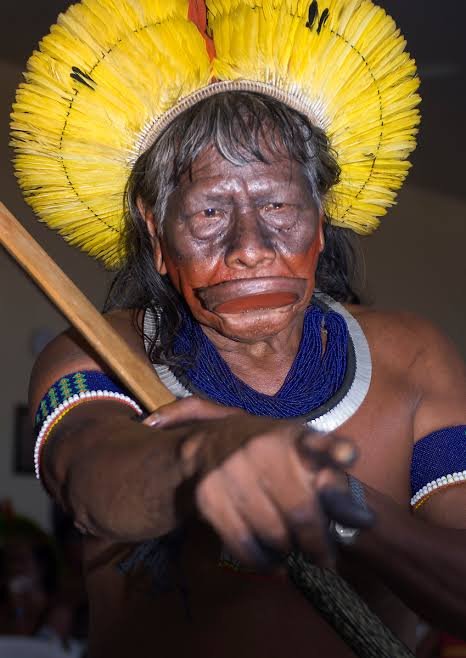
BRASILIA, November 20 (Aalimi Nation) – Brazil's government has formally recognised an Indigenous territory in the Amazon region where the veteran leader Raoni Metuktire was born, and President Luiz Inacio Lula da Silva visited the 94-year-old chief in Mato Grosso state on Thursday.
Kapot Nhinore Indigenous Territory recognised
A Justice Ministry order declared the Kapot Nhinore Indigenous Territory to be the permanent possession of the Mebengokre, also known as Kayapo, and Yudja peoples. The land covers about 362,000 hectares, or roughly 895,000 acres, along the Xingu River on the border of Para and Mato Grosso states. Indigenous Peoples Minister Eloy Terena said 84 percent of it is forest.
The declaration is a significant step towards formal demarcation, which still requires a presidential decree. The administrative process began in 2004, and the government defined the territory's boundaries in 2023. Lula acknowledged that the work is not finished, noting that about 200 rural properties overlap the territory. He said the government would work "very hard to resolve this once and for all."
"We are simply restoring the rights and dignity you should never have lost," Lula said at the ceremony.
Lula meets Raoni
Lula met Raoni in Peixoto de Azevedo, near the Amazonian village where the chief has lived for decades. Raoni has been receiving palliative care for cancer since September and was in hospital for several days last week with a lung infection and low blood pressure. Lula said he had been deeply distressed on hearing of the hospitalisation while attending the COP31 climate summit in Turkiye, and that he wanted to settle the land question while Raoni was still alive. He also said there was "no Brazilian more authentic than our comrade Raoni."
Raoni's grandson, Roiti Metuktire, said the decision came as a surprise to the family and described it as the chief's last wish. Raoni had campaigned for the land's protection for about three decades.
Pressure on the land
Without formal protection, the territory has faced pressure from soybean farmers and cattle ranchers. A Greenpeace report released on Wednesday found that about 17 percent of its forest had been cleared since 1988, and a 2023 report by the group found more than 47,000 hectares in use for pasture or soy. Greenpeace Brazil spokesperson Danicley Aguiar called it "the ancestral territory of the most celebrated defender of forests."
Rural producers oppose demarcation, arguing that it would cause serious economic harm to thousands of non-Indigenous residents and farmers.
Background
Brazil has nearly 800 Indigenous lands, about 60 percent of them fully regularised. Since returning to office in 2023, Lula has resumed demarcations, with 20 territories fully demarcated in three years. A 2022 analysis found that Brazil's Indigenous territories lost about 1 percent of native vegetation over three decades, compared with 20 percent on private land nationwide, which is why experts regard such territories as among the strongest barriers against deforestation in the Amazon.
He walked beside Lula at the president's inauguration in 2023.
What happens next
The next step is a presidential decree to complete demarcation, along with a process to resolve the claims of the roughly 200 properties on the land. The government has not announced a timetable for either.