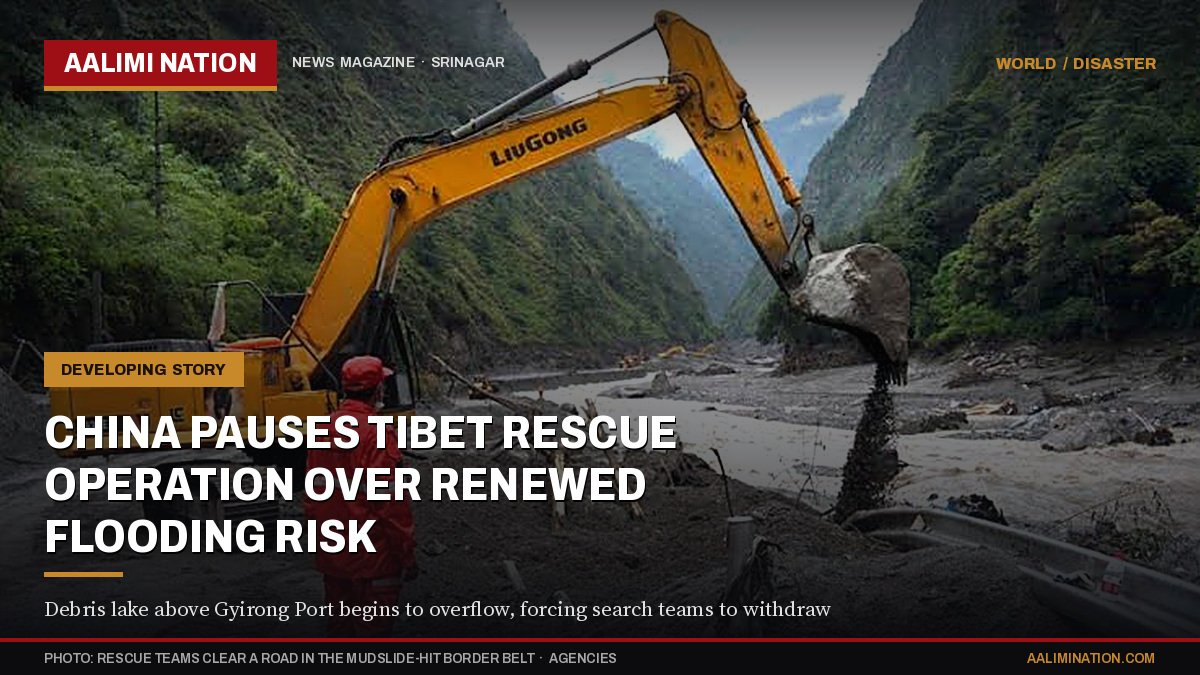
Beijing, August 28: China has temporarily suspended rescue operations near the epicentre of devastating floods in Tibet after authorities warned of a fresh flooding threat from a newly formed lake near the China-Nepal border.
Chinese state media reported that the lake, formed after a massive landslide sent huge quantities of mud and debris into the area, has begun overflowing towards locations where rescue teams were preparing to operate. Emergency personnel have been ordered to withdraw from the danger zone and remain on standby.
The development has added to the dangers facing communities along the Nepal-Tibet border after powerful flash floods on August 26 swept water, ice, rocks and mud through Himalayan valleys, destroying roads, bridges, settlements and other infrastructure.
In Nepal, the confirmed death toll has risen to 469, while more than 1,300 people remain missing. Rescue teams are continuing searches in severely damaged areas, but destroyed roads, difficult terrain and the threat of further flooding are hampering operations.
New flood threat emerges in Tibet
Chinese authorities say the newly formed lake continues to fill amid ongoing rainfall. Officials have warned that water levels could rise sharply in the coming days, increasing the possibility that the natural barrier holding back the water could fail.
A sudden breach could send a large volume of water downstream, threatening areas around Gyirong County and Gyirong Port, a major border crossing between Tibet and Nepal.
Emergency engineering teams are monitoring the lake and assessing measures to reduce the risk. China has also issued a Level-IV flood alert for the affected area.
Authorities are using drones, satellite imagery and other technologies to monitor the disaster zone and assist efforts to locate missing people.
Hundreds still missing
The disaster has affected local communities as well as foreign nationals. Chinese authorities have reported hundreds of people missing on the Tibet side of the border region, including foreign tourists and pilgrims.
Hundreds of people have already been evacuated from affected areas, while rescue teams continue to monitor conditions and search for those still unaccounted for.
Rescue efforts face growing risks
The suspension of rescue operations underscores the dangerous conditions facing emergency workers. Authorities are concerned that another sudden release of water could put rescuers and survivors at further risk.
The flooding followed a major collapse of glacier ice, rock and debris in the high Himalayas, sending a powerful surge into river systems flowing towards Nepal. Geological and satellite assessments indicate that the disaster involved a major ice-and-rock collapse rather than a conventional earthquake-triggered flood.
Emergency teams on both sides of the border are now facing a difficult balance between urgently searching for missing people and protecting rescuers from further hazards.
With water levels continuing to rise and more rainfall possible, authorities have warned that the situation remains unstable and that downstream communities could face additional flooding