WASHINGTON, August 31, 2026: Google Maps has begun displaying Lake Ontario as “Lake America” for users in the United States following an executive order issued by President Donald Trump, a move that comes amid heightened trade tensions between Washington and Ottawa.
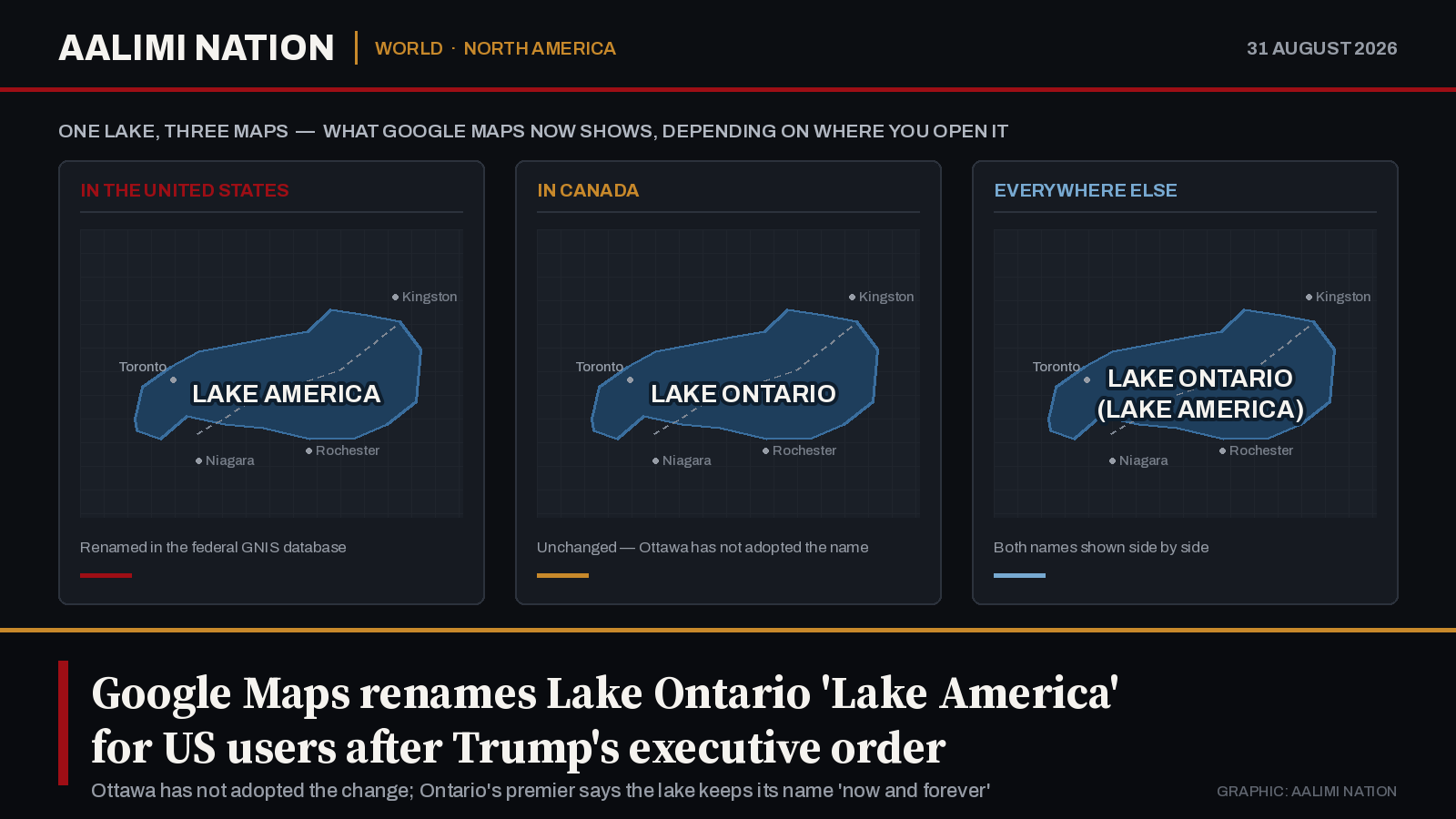
Google said the change reflects an update to the U.S. Geographic Names Information System (GNIS), the federal database used to establish official geographic naming conventions for the US government.
Under the updated system, Google Maps users in the United States will see the lake identified as “Lake America,” while users in Canada will continue to see its traditional name, “Lake Ontario.” Users accessing the platform from other countries will see both names.
The change follows Trump’s announcement last week that the lake would be renamed within the United States government naming system. Lake Ontario is the smallest of North America’s five Great Lakes by surface area.
The controversy has emerged against the backdrop of worsening relations between the United States and Canada, as a widening trade dispute has seen both countries impose tariffs on billions of dollars worth of each other’s goods.
The executive order applies only to US government terminology and does not alter Canada’s official geographic naming conventions or international usage.
In a blog post explaining the decision, Google said it follows official government geographic naming sources when updating its mapping services.
“People using Maps in the US will see ‘Lake America’, those in Canada will continue to see ‘Lake Ontario’, and those outside of the US and Canada will see both names,” the company said.
The move has drawn strong opposition from Canadian political leaders.
Canadian Prime Minister Mark Carney rejected the renaming, while New York Governor Kathy Hochul said her state would not recognise or adopt the new designation.
Ontario Premier Doug Ford also dismissed the move, unveiling a prominent lakeside sign declaring: “Lake Ontario: Now and Always.”
Ford said President Trump was free to use whatever terminology he chose within the United States but insisted that the lake would continue to be recognised internationally by its historic name.
The dispute echoes Trump’s earlier decision to rename the Gulf of Mexico as the “Gulf of America” within US government terminology, a change that Google Maps similarly reflected differently depending on the user’s location.
The Lake Ontario controversy has also created unexpected challenges for Canadian government agencies and websites that rely on Google Maps data. Ontario officials said they were reviewing affected digital platforms to ensure the lake continues to be identified by its established Canadian name.
The dispute over the name has become the latest symbolic flashpoint in increasingly strained relations between Washington and Ottawa, highlighting how political decisions over geography and national identity can extend beyond government policy into global digital platforms.