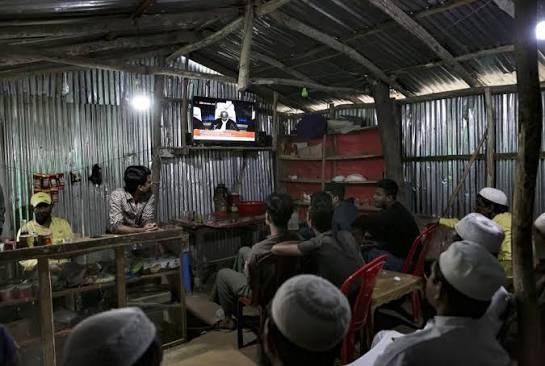
THE HAGUE, November 19 (Aalimi Nation) – The International Court of Justice on Thursday found that Myanmar's security forces killed thousands of Rohingya civilians in 2017 and that genocidal intent was shown in specific instances, in a judgment that The Gambia had sought for seven years.
The ruling was read out by the court's President, Judge Yuji Iwasawa, at the Peace Palace in The Hague. The reading ran for about three hours.
What the court found
The court said the evidence showed that Myanmar's forces killed around 10,000 Rohingya. It also cited widespread sexual violence, extreme violence against children and attacks on Rohingya who were fleeing the country.
Judge Iwasawa noted that The Gambia had to show that an intent to destroy the group was "the only reasonable inference that can be drawn from the evidence". The court concluded that, in the cases it examined, the pattern of atrocities supported that inference of an intent to destroy a substantial part of the Rohingya minority.
The court also held that Myanmar failed in its duty to prevent genocide. It reasoned that the authorities should have been aware of the risk once armed civilians joined the campaign against the Rohingya.
Details such as the voting breakdown among the judges and any specific orders on reparations, punishment of those responsible or guarantees of non-repetition had not been confirmed in the reports available at the time of writing. Reaction from Myanmar's authorities to the judgment was also not yet available.
Background of the case
The Gambia filed the case in November 2019 under the 1948 Genocide Convention, with the backing of the Organisation of Islamic Cooperation. It asked the court to declare that Myanmar had breached the convention, to order an end to unlawful acts against the Rohingya and to ensure that those responsible are punished. It also asked for reparations and for conditions allowing Rohingya to return safely.
In 2022, the court ruled by fifteen votes to one that it had jurisdiction to hear the application, rejecting Myanmar's preliminary objections.
Myanmar has consistently denied genocide. It has said the 2017 military operations were a legitimate response to attacks by armed groups, including the Arakan Rohingya Salvation Army, on police posts. It has also disputed The Gambia's standing to bring the case on the Rohingya's behalf.
A United Nations fact-finding mission had earlier concluded that the campaign included "genocidal acts". The 2017 crackdown drove at least 730,000 mainly Muslim Rohingya into Bangladesh. According to UN figures, more than 1.3 million Rohingya remain displaced across South and Southeast Asia, including about 1.2 million in the camps of Cox's Bazar in Bangladesh. Roughly 550,000 are believed to remain in Myanmar under restrictions on movement, healthcare and livelihoods.
What happens next
The court's judgments are final and cannot be appealed. The court has very limited means of enforcement, however. If Myanmar does not comply, The Gambia could ask the United Nations Security Council to act, where permanent members hold veto powers.
This is a developing story, and this report will be updated as the full judgment and official reactions become available.