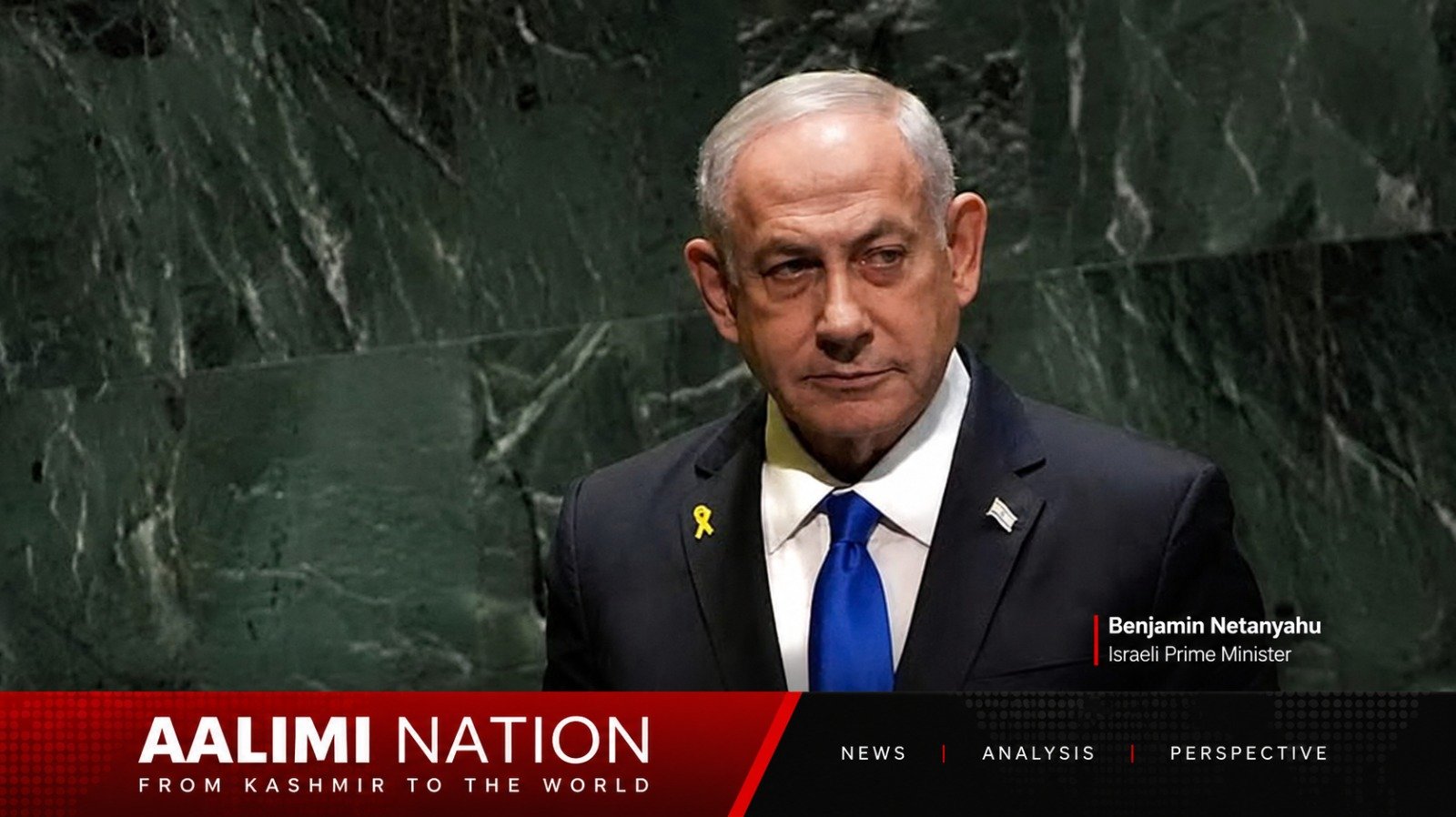
JERUSALEM — Israeli Prime Minister Benjamin Netanyahu has reaffirmed his government’s determination to pursue what he described as the mission of bringing down Iran’s ruling regime, warning Tehran that any attack on Israel would trigger a response beyond what Iranian leaders could imagine.
Speaking at an Israeli Cabinet meeting marking the Jewish New Year, Netanyahu said the “first mission” was to confront Iran’s leadership and insisted that Israel remained committed to completing the objective.
Netanyahu portrayed Iran’s government as increasingly weakened and under pressure, saying it was fighting for its survival and was approaching its end.
His remarks represent another escalation in the Israeli leadership’s increasingly direct rhetoric about Iran’s political future.
Netanyahu renews regime-change threat
Netanyahu has repeatedly spoken in recent days about the possibility of the Iranian government collapsing.
In an earlier interview, he said Israel would work to bring down the Iranian regime and suggested that Israeli institutions were already working toward that objective.
He has also warned that an Iranian decision to launch another attack against Israel could prove disastrous for Tehran.
The latest remarks suggest that Israel’s objectives in the confrontation may extend beyond degrading Iran’s military capabilities and limiting its strategic programmes.
They increasingly include exerting pressure on the political leadership in Tehran.
However, whether military pressure can actually produce regime change remains highly uncertain.
Iran has a large territory, powerful security institutions and an extensive state apparatus, including the Islamic Revolutionary Guard Corps. Any attempt to force a political transition through military action would therefore carry significant risks and unpredictable consequences.
Israel threatens a wider response
Israeli Defence Minister Israel Katz has also issued increasingly severe warnings to Tehran.
Katz recently said that if Iran attacked Israel, Israel would respond by targeting Iranian infrastructure, including elements of its civilian and energy infrastructure.
The threat marks a significant escalation in Israeli rhetoric because attacks on energy and civilian infrastructure could have consequences far beyond the immediate military confrontation.
Such actions could also increase pressure on Iran’s economy and critical services while raising the risk of further retaliation.
Israeli military tests readiness
The rhetoric from Israel’s political leadership has been accompanied by increased military preparedness.
The Israel Defense Forces launched a surprise, high-level readiness exercise designed to assess its ability to respond to a sudden multi-front confrontation.
The exercise comes as Israel faces security challenges across several theatres, including Iran, Lebanon and Gaza.
The possibility of simultaneous escalation on multiple fronts remains one of the most serious concerns for Israeli military planners.
A conflict involving Iran could potentially activate allied or aligned armed groups elsewhere in the region, creating pressure on Israel well beyond the Iranian front itself.
Iran remains under pressure
Netanyahu’s statements come against the backdrop of renewed military confrontation involving Iran, Israel and the United States.
The latest escalation has also increased international concern over the Strait of Hormuz, one of the world’s most important energy transit routes.
Any prolonged disruption to shipping through the waterway could have consequences for global oil supplies and prices.
The Strait of Hormuz carries a substantial share of the world’s seaborne oil trade, meaning that an expansion of the conflict beyond Iranian and Israeli territory could quickly become an international economic crisis.
Can Israel actually topple Iran’s government?
Netanyahu’s declaration raises a much larger question: Can sustained military pressure bring down Iran’s political system?
History suggests that regime change through military force is considerably more complicated than destroying military infrastructure.
Iran’s political system is supported by multiple institutions, security organisations and networks of power. Even severe damage to military facilities would not necessarily translate into the collapse of the state.
There is also the question of what would follow a collapse.
A sudden breakdown of central authority in a country as large and strategically important as Iran could produce political fragmentation, internal conflict or a prolonged power struggle.
For Israel and its allies, therefore, regime change could create uncertainties that are difficult to control.
The risk of a wider regional war
The most immediate concern is that escalating threats could produce a cycle of retaliation.
An Iranian strike on Israel could trigger a major Israeli response. Attacks on Iranian military, energy or civilian infrastructure could then prompt further Iranian retaliation, potentially drawing the United States and regional armed groups deeper into the conflict.
That could transform the confrontation from a bilateral or limited military exchange into a much wider regional war.
The Strait of Hormuz remains particularly sensitive. Any disruption there would affect not only Israel and Iran but also major Asian and European economies dependent on Gulf energy supplies.
A dangerous new phase
Netanyahu’s latest remarks demonstrate that Israel is increasingly framing its confrontation with Iran in terms that go beyond conventional deterrence.
The stated objective is no longer simply to prevent an Iranian attack or degrade specific military capabilities. Israeli leaders are openly discussing the possibility of ending the current Iranian political system.
Whether that objective is achievable remains uncertain.
What is clear, however, is that the rhetoric raises the stakes considerably.
For Tehran, an Israeli campaign aimed at regime survival could leave its leadership with strong incentives to retaliate.
For Israel, meanwhile, the challenge is balancing military pressure against the danger of triggering a conflict that could spread across several fronts.
And for the wider Middle East, the consequences could extend from missile attacks and military confrontation to energy markets, shipping routes and regional stability.
The central question now is not simply whether Israel can strike Iran. It is whether the escalating campaign can achieve its political objective without triggering a much larger war.