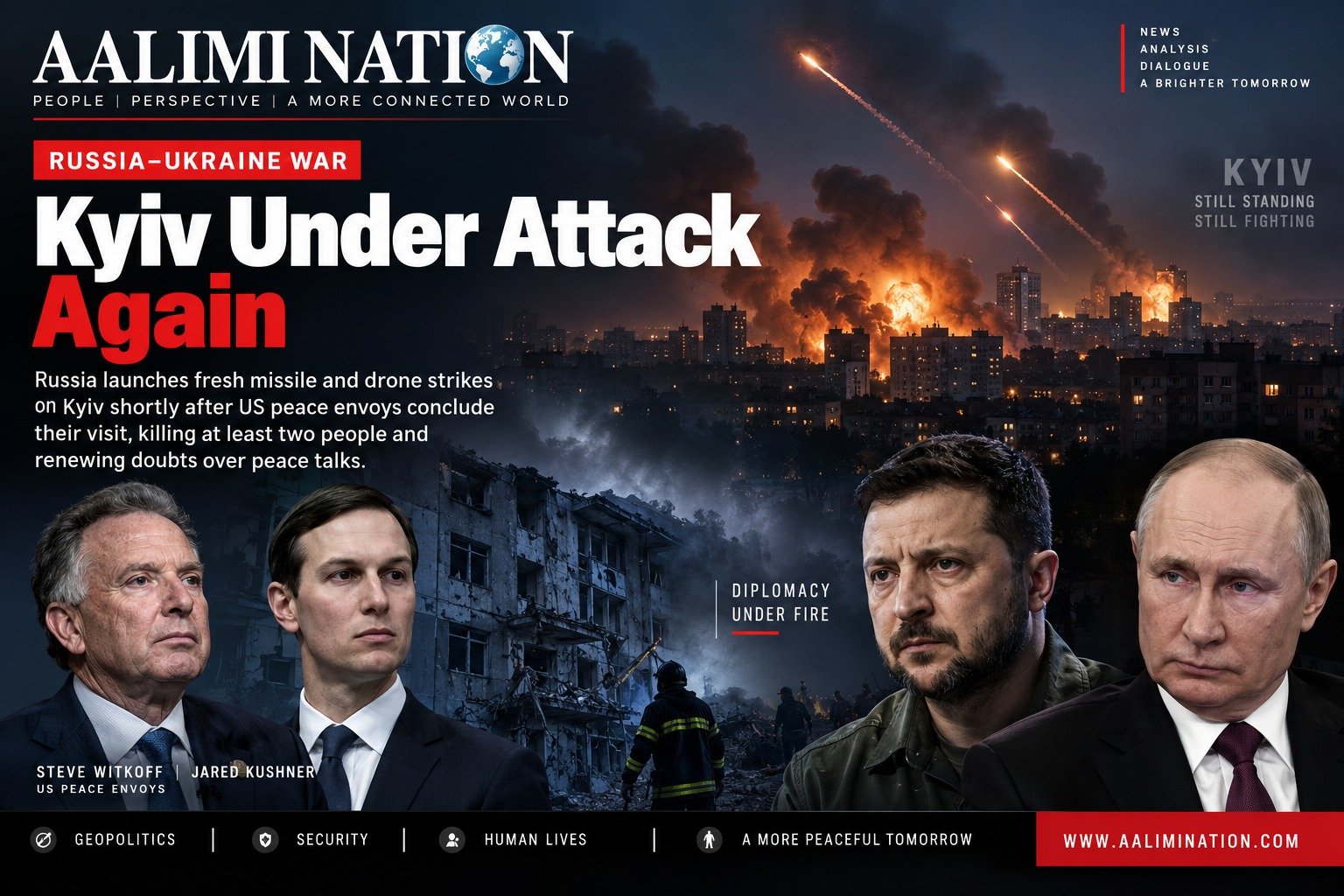
Ukrainian authorities said the overnight bombardment killed at least two people and wounded several others, while residential buildings and other civilian infrastructure were damaged across the capital. Multiple fires were reported in different districts following the strikes.
The timing of the attack drew an immediate and forceful response from Ukrainian officials. Foreign Minister Andriy Sybiha condemned the bombardment, pointing to the fact that it came shortly after the departure of the American envoys who had been engaged in diplomatic efforts aimed at ending the war.
Sybiha argued that the latest strikes exposed a widening gap between Moscow’s diplomatic rhetoric and its actions on the battlefield, saying Russian ballistic missiles were effectively “speaking louder” than its statements about diplomacy.
US peace efforts face fresh test
The attack came after Witkoff and Kushner travelled to Moscow and Kyiv as part of a renewed US diplomatic initiative aimed at reviving negotiations to end Russia’s war against Ukraine.
The American envoys first met Russian President Vladimir Putin in Moscow before travelling to Kyiv, where they held discussions with Ukrainian President Volodymyr Zelenskyy.
While the meetings failed to produce an immediate breakthrough, Zelenskyy said the US delegation had presented several potentially useful ideas for advancing the peace process.
According to the Ukrainian president, future negotiations could address issues including energy infrastructure, grain shipments and prisoner exchanges, areas where limited agreements have previously provided openings for dialogue between the two sides.
Moscow presented a sharply different account of the overnight operation.
Russian authorities said their forces had carried out a large-scale strike against military-related targets, including drone production and storage facilities and logistics centres in and around Kyiv.
Ukraine's Air Force said its air-defence systems intercepted a significant number of incoming drones and cruise missiles during the assault. However, ballistic missiles remained a major challenge because of their speed, trajectory and the difficulty involved in intercepting them.
The latest barrage again highlighted Ukraine's continued vulnerability to long-range Russian attacks despite the country's extensive air-defence network.
The escalation has cast fresh doubt over prospects for restarting substantive peace negotiations.
Washington's latest diplomatic push has raised hopes of renewed dialogue, but Moscow and Kyiv remain sharply divided over several fundamental issues, particularly territorial control and the security guarantees that would underpin any future settlement.
For Ukraine, security arrangements are central to preventing another large-scale Russian offensive. Moscow, meanwhile, continues to demand concessions that Kyiv has repeatedly rejected.
The latest strikes therefore underscore the difficult reality confronting the US-led diplomatic effort: talks may be taking place at the highest political level, but the war on the ground continues with little sign of an immediate halt.
Russia's full-scale invasion of Ukraine began in February 2022, triggering Europe's largest armed conflict in decades. More than four years later, both sides continue to conduct frequent missile and drone attacks while diplomatic efforts seek a pathway towards a ceasefire and eventual political settlement.