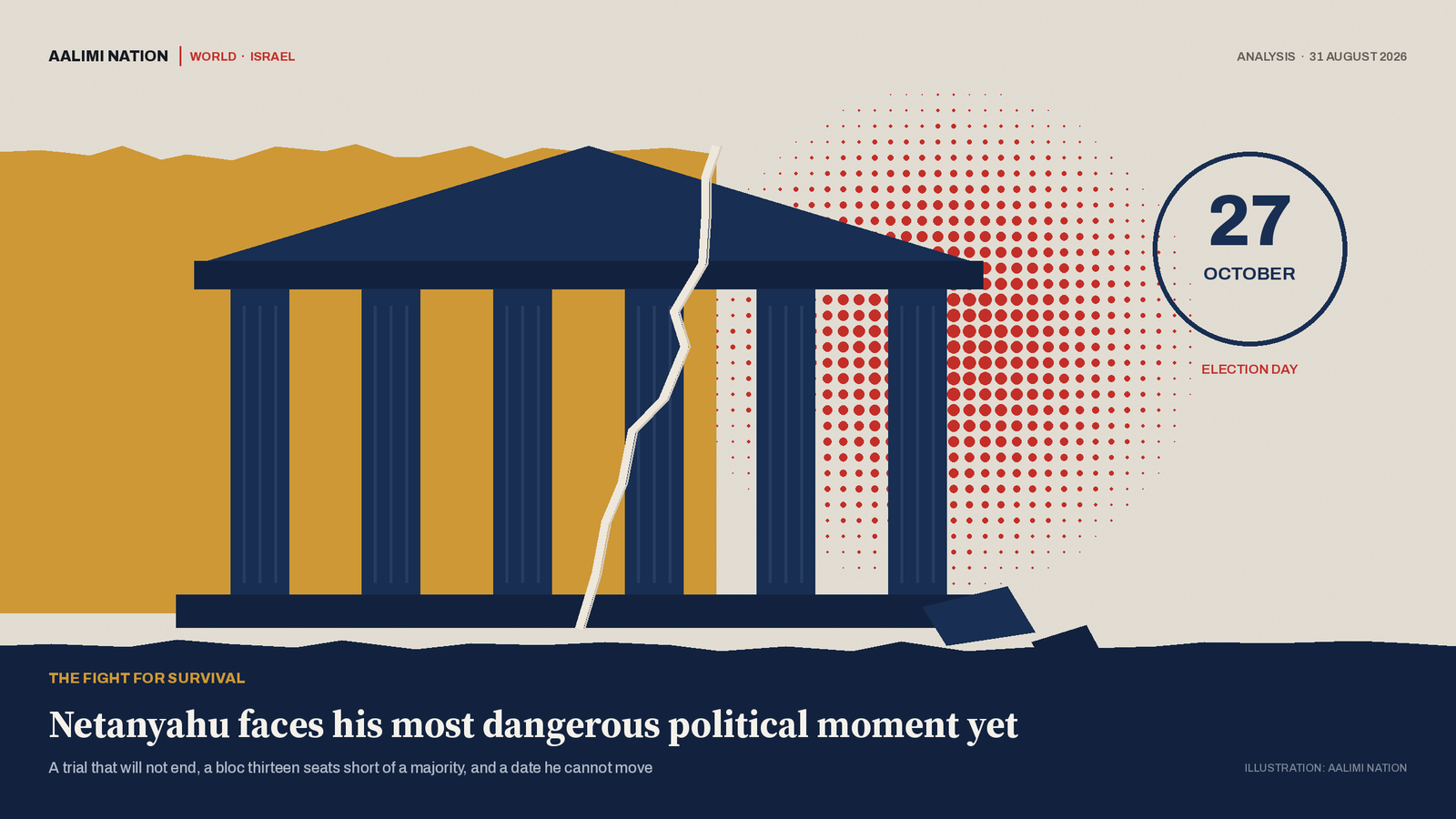
JERUSALEM: Israeli Prime Minister Benjamin Netanyahu is heading towards the October 27 election facing a political and legal predicament unprecedented for a sitting Israeli leader.
While continuing to govern Israel during one of the country's most turbulent periods, Netanyahu is simultaneously defending himself in a long-running criminal corruption trial involving three separate cases.
Indicted in 2019, Netanyahu's trial began in 2020. He faces charges of fraud and breach of trust in multiple cases, along with a bribery charge in the most serious of them.
Netanyahu has consistently denied all wrongdoing, arguing that the prosecution against him is politically motivated.
His legal challenges, however, extend beyond his own courtroom battle. His wife, Sarah Netanyahu, has a previous criminal conviction and is currently the subject of a separate investigation over allegations related to the intimidation of a key witness in her husband's corruption trial.
Both have denied wrongdoing in the ongoing proceedings.
Three Cases Before the Court
The corruption proceedings against Netanyahu centre around three major investigations known as Case 1000, Case 2000 and Case 4000.
Case 1000: Gifts from Wealthy Businessmen
In Case 1000, prosecutors allege that Netanyahu and members of his family received expensive gifts, including cigars and champagne, from wealthy businessmen.
In return, prosecutors claim Netanyahu intervened in matters that could potentially benefit those businessmen.
Case 2000: Media Influence Allegations
Case 2000 focuses on recorded conversations between Netanyahu and Arnon Mozes, the publisher of the Israeli newspaper Yedioth Ahronoth.
Prosecutors allege that the discussions involved the possibility of securing more favourable media coverage for Netanyahu in exchange for measures that could weaken the rival publication Israel Hayom.
Case 4000: The Most Serious Charges
The most serious allegations are contained in Case 4000.
Prosecutors accuse Netanyahu of advancing regulatory decisions benefiting telecommunications giant Bezeq in exchange for favourable coverage from the Walla news website, which was owned by Bezeq's controlling shareholder, Shaul Elovitch.
Netanyahu faces charges of fraud and breach of trust across the cases, along with a bribery charge in Case 4000.
Reports have suggested that the bribery charge has faced legal difficulties, with judges reportedly questioning whether prosecutors would be able to prove the allegation. However, even if the bribery charge were eventually dropped, Netanyahu would still face trial on the remaining fraud and breach-of-trust allegations.
98 Court Hearings as Netanyahu Takes the Stand
Netanyahu began giving testimony in December 2024.
His direct testimony, cross-examination and subsequent questioning stretched over approximately 18 months and reportedly involved 98 court hearings.
The proceedings were repeatedly interrupted or delayed because of overseas travel, health issues, diplomatic engagements and major security developments.
Netanyahu completed his testimony on June 24, but the trial itself remains far from over, with additional witnesses still expected to appear.
Netanyahu has also explored another possible route out of the lengthy legal proceedings.
In November 2025, while the criminal trial was still ongoing, Netanyahu reportedly sought a pardon from Israeli President Isaac Herzog without admitting guilt.
President Herzog later indicated that legal avenues and possible settlement mechanisms would need to be exhausted before such a request could be properly considered.
A pardon granted before the conclusion of a criminal trial would be highly unusual in the Israeli legal system.
Winning another election would not automatically end the prosecution.
Israeli law allows Netanyahu to remain prime minister while facing criminal proceedings, creating the extraordinary situation in which political power and criminal prosecution continue side by side.
Sarah Netanyahu: Previous Conviction and New Investigation
Sarah Netanyahu has her own legal history.
In 2019, she accepted a plea agreement in a case involving allegations that state funds were improperly used to purchase catering services for the prime minister's official residence.
Under the agreement, she admitted wrongdoing, while a more serious fraud allegation was reduced. She agreed to reimburse the state and pay a financial fine.
In February 2025, Israeli authorities confirmed the opening of a criminal investigation into allegations involving attempts to intimidate Hadas Klein, a key prosecution witness in Case 1000, and possible interference in Netanyahu's corruption trial.
The investigation followed Israeli media reports alleging efforts to organise demonstrations and public campaigns against Klein and other individuals connected to the prosecution.
No indictment has been announced in connection with that investigation.
Netanyahu's legal challenges also extend beyond Israel's borders.
On November 21, 2024, the International Criminal Court issued an arrest warrant for Netanyahu in connection with allegations relating to the war in Gaza.
The ICC said its judges found reasonable grounds to believe that Netanyahu could bear criminal responsibility for alleged war crimes and crimes against humanity.
The allegations referenced by the court included the use of starvation as a method of warfare, murder, persecution and other alleged inhumane acts.
The arrest warrant does not constitute a criminal conviction. Netanyahu and Israel have rejected the ICC's jurisdiction and strongly disputed the allegations.
Nevertheless, the warrant has added another layer of international legal and diplomatic pressure on the Israeli leader.
For Netanyahu, the coming election is not merely another political contest.
It comes at a moment when his personal legal battles, Israel's continuing security challenges and the political consequences of the Gaza war are increasingly intertwined.
A victory at the ballot box would strengthen his political position but would not erase the criminal proceedings against him. A defeat, meanwhile, could dramatically alter the political protection and influence he has exercised as Israel's longest-serving prime minister.
As Israel approaches October 27, Netanyahu finds himself fighting on multiple fronts — in the courtroom, in the political arena and on the international stage.
For a leader whose career has been defined by political resilience, the coming months could represent one of the most consequential battles of his life.