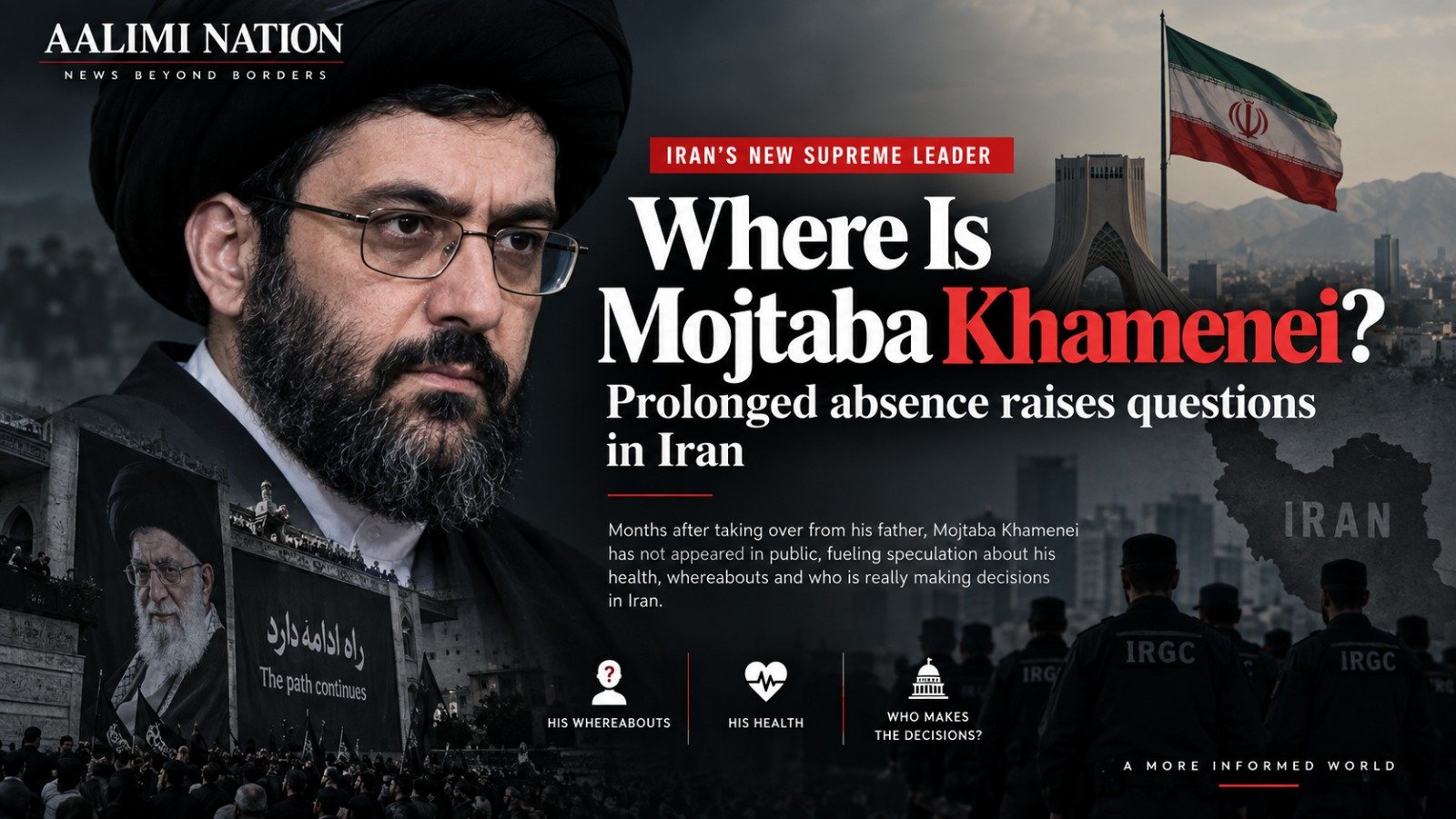
More than six months after becoming Iran’s Supreme Leader, Mojtaba Khamenei remains largely absent from public view, fueling questions inside and outside Iran about his whereabouts, health and the way state power is being exercised.
TEHRAN, AALIMI NATION:
Mojtaba Khamenei succeeded his father, Ayatollah Ali Khamenei, after the former Supreme Leader was killed in a U.S.-Israeli strike on February 28, 2026. Mojtaba was appointed Supreme Leader on March 8.
Yet since taking office, he has not made a conventional public appearance or delivered a publicly released live video or audio address. His prolonged absence became particularly notable during his father’s state funeral in July, when his brothers were publicly shown attending the ceremonies but Mojtaba was not seen.
Security Concerns Cited by Iranian Officials
Iranian officials have attributed Mojtaba’s absence to security concerns, arguing that revealing his location or allowing him to appear publicly could make him a target.
Before his father’s funeral, Ayatollah Hakim Elahi, a representative of Iran’s Supreme Leader in India, said Mojtaba was unlikely to attend because authorities could not guarantee his safety.
Reports have also said Mojtaba was injured in the February 28 strike that killed his father. Iranian authorities have maintained that his injuries were limited and that he recovered, while other reports have alleged more serious injuries. These accounts have not been independently established.
Written Statements, But No Public Address
Despite his absence, Mojtaba has continued to issue written statements on major political, religious and national issues.
According to EFE, he had issued 21 written statements by September 7, covering issues including religious occasions, the war and Iran’s economy. His messages have been read by state television presenters and subsequently distributed through official or affiliated channels.
On August 30, Reuters reported that Mojtaba issued a written message calling on Muslim countries, particularly Gulf states, to strengthen unity and cooperation. The statement was distributed through his Telegram account.
The written communications indicate that his name continues to be used in the formal exercise of Supreme Leader authority. However, the absence of a direct public appearance has continued to generate questions about his physical condition and day-to-day role.
Claims About His Health Remain Unverified
Reports concerning Mojtaba’s health have varied significantly.
Some Iranian officials and individuals close to the government have said he survived the February attack with relatively minor injuries and continues to exercise ultimate authority over major state decisions.
Other reports have alleged that he suffered serious injuries and has remained in a secure location because of his condition and the continuing threat of assassination.
There is currently no independently verified public evidence that conclusively establishes the severity of any injuries he may have sustained.
A number of videos circulated online during the year have also been presented as supposed evidence of Mojtaba’s first public appearance. Fact-checkers have determined that at least some of these videos were old or misleadingly presented.
Why Was He Absent From His Father's Funeral?
Perhaps the most striking aspect of Mojtaba’s disappearance from public view was his absence from the state funeral of his father.
Iranian state television showed Mojtaba’s brothers Mostafa, Meysam and Masoud Khamenei attending the funeral ceremonies in Tehran. Mojtaba, however, was not publicly seen.
Iranian officials said security considerations were responsible.
The explanation has nevertheless generated debate because senior Iranian officials, members of the Khamenei family and foreign dignitaries attended the ceremonies under heavy security.
The absence subsequently became one of the main reasons for speculation about Mojtaba’s health and whereabouts.
Who Is Making Iran's Key Decisions?
Mojtaba’s prolonged absence has also raised a broader political question: how is decision-making being managed at the highest level of the Islamic Republic?
Iranian authorities maintain that Mojtaba remains the country’s Supreme Leader and continues to exercise his constitutional and religious authority.
At the same time, some analysts have suggested that the unusual circumstances could encourage a more collective decision-making structure involving senior political, military and security institutions.
In particular, questions have been raised about the influence of the Islamic Revolutionary Guard Corps (IRGC) and other powerful institutions during a period of war, economic pressure and heightened security concerns.
These interpretations remain matters of analysis rather than independently established evidence that Mojtaba has lost control of state affairs.
Is Mojtaba in Iran?
There has been no independently verified public confirmation establishing his current physical location.
Various reports and claims have placed him in secure locations inside Iran, while other unverified reports have suggested that he may have been moved elsewhere.
One recent account cited a religious figure who claimed that Mojtaba was present in Mashhad during his father's burial. However, the account relied on unnamed witnesses and has not been independently verified.
Iranian President Masoud Pezeshkian has also said that he has met Mojtaba and that the Supreme Leader remains alive and involved in governing.
However, the lack of independently verifiable visual or audio evidence has meant that questions surrounding Mojtaba’s public absence have persisted.
A Leadership Under Extraordinary Pressure
The uncertainty surrounding Mojtaba comes at an exceptionally difficult moment for Iran.
The country is dealing with the consequences of war, continuing security threats, economic pressure and tensions with Israel and the United States.
In such circumstances, the visibility of the Supreme Leader carries political significance. Supporters of the government argue that keeping Mojtaba away from public view is a necessary security measure.
Critics, meanwhile, argue that prolonged secrecy inevitably creates uncertainty about the country's leadership and decision-making process.
For now, there is no independently verified evidence establishing that Mojtaba Khamenei is dead or incapacitated. Equally, there has been no conventional public appearance that would definitively settle questions about his current physical condition and whereabouts.
The Questions That Remain
More than six months into Mojtaba Khamenei’s leadership, several questions remain unanswered:
Where is Iran’s Supreme Leader?
How serious were the injuries he reportedly sustained in the February attack?
Why has he not appeared publicly since taking office?
How much of Iran’s day-to-day decision-making is being conducted directly by him, and how much is being handled by other senior institutions?
For the moment, Iranian authorities insist that Mojtaba Khamenei is alive, in control and continuing to lead the Islamic Republic.
But until he appears publicly or independently verifiable evidence emerges about his condition and location, the mystery surrounding Iran’s most powerful political office is likely to remain a major subject of international attention.